
Iran is sinking in sinkholes from overwatering

sinkhole in tehran

What’s that sinking feeling?

In Iran, the very ground under your feet may drop away.

The issue here isn’t war. The issue is land subsidence, a human-caused phenomenon that’s been ignored and mismanaged In Iran for decades. Over-pumping of groundwater is causing Iranian land to subside; that is, to sink.

Land subsidence causes damage like water pipes bursting, roads collapsing, and sewer and gas lines breaking. Houses and buildings crack as their foundations weaken. Iran is one of the most earthquake-prone countries in the world. With this land deformation, even a minor quake could cause catastrophic disaster.

The GFZ German Research Center for Geosciences in Potsdam used satellite data to reveal the extent of the subsidence. A tool known as Interferometric Synthetic Aperture Radar, which spots even the most minute difference in ground deformation, revealed that land around Imam Khomeini International Airport (IKIA) was sinking at around 5 centimeters per year. This is considered a “moderate” rate of land subsidence. According to Iran’s National Cartographic Center, other areas are sinking at the rate of 31 cm per year.

Land sinks slowly, almost invisibly. But now the effects of land subsidence are plain to see; especially when a hole in the earth opens up and swallows a whole car under your eyes. At risk are cities, historical sites, and crucial structures like Iran’s airport. In Tehran, Isfahan and Rafsajan, land has dropped by over 12 inches (30 cm) per year. It can’t be ignored anymore.

90% of Iranian groundwater is used for farming. Much is wasted through inefficient management, such as unmonitored drilling of deep wells to make up for reduced rainfall. 14.5 cubic meters of groundwater are pumped every second, an unsustainable rate of use. One way to reduce waste and water theft is to implement water metering.

One might think that innovative farming methods such as Saudi Arabia’s proposed hydroponic greenhouses might penetrate Iranian thought.

As for the largest urban center, 70% of Tehran’s water needs are supplied by five nearby dams. Now, according to current state media reports, the reservoirs are only 13 percent full.

Better management of water resources is needed, such as projects to reduce waste and recycle water; but corruption and plain official indifference impede it.
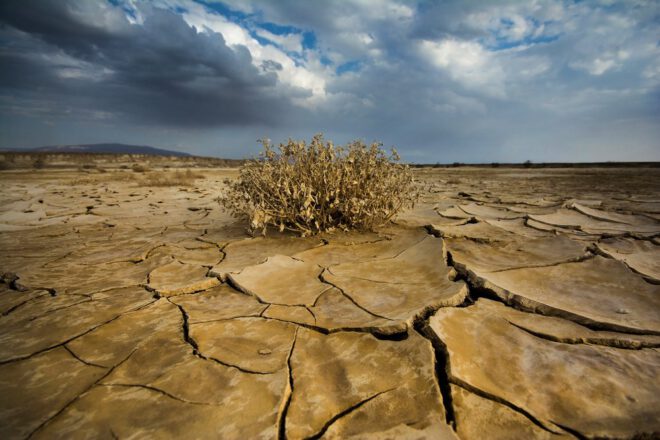
drought in Iran

Discussing water scarcity and air pollution in Tehran, the best that President Masoud Pezeshkian had to offer was a proposal to move Iran’s governmental hubs away.

“We have no choice but to move the country’s political and economic center closer to the sea,” he said.

In other words, no plan to manage water where the majority of people live: just moving government structures on to a better place.

Climate change and air pollution have roles in this sorry story too. Droughts plague Iran. In 2024, precipitation was 60% below average. Ice formed on mountains, which as snowmelt helps fill wells and aquifers, could help, except that it’s contaminated with pollution that rises from urban air.

Human population growth also strains water resources and distribution: the population of Tehran, for example, has exploded from 2 million to over 15 million in the last five decades. With a population of 90+ million, ignoring land subsidence and the reasons it happens could eventually lead to widespread disaster.

Photos via Tehran Times

 

Miriam Kresh
Miriam Kreshhttps://www.greenprophet.com/
Miriam Kresh is an American ex-pat living in Israel. Her love of Middle Eastern food evolved from close friendships with enthusiastic Moroccan, Tunisian and Turkish home cooks. She owns too many cookbooks and is always planning the next meal. Miriam can be reached at miriam (at) greenprophet (dot) com.

LEAVE A REPLY

Please enter your comment!
Please enter your name here

TRENDING

Astro uses AI to help procure land for renewable energy

For oil-rich, environmentally vigilant Gulf states, Astro isn’t just another startup story. It is a blueprint for accelerating an energy transition that is now existential, not optional.

Huge Fish Nursery Discovered Under Freezing Arctic Seas

In 2019, an underwater robot camera exploring the seabed...

Remilk makes cloned milk so cows don’t need to suffer and it’s hormone-free

This week, Israel’s precision-fermentation milk from Remilk is finally appearing on supermarket shelves. Staff members have been posting photos in Hebrew, smiling, tasting, and clearly enjoying the moment — not because it’s science fiction, but because it tastes like the real thing.

The US leaves 66 United Nations organizations to “put America first”

The world needs a reset and to restart well intentioned cooperation projects from start. Because right now the UN and EU projects look like software built on code from the 80s, rickety, patched, slow to adapt, and prone to crashing under the weight of outdated assumptions.

Turkey named as climate change COP31 home in 2026

Murat Kurum as President-Designate of COP31

Qatar’s climate hypocrisy rides the London Underground

Qatar remains a master of doublethink—burning gas by the megaton while selling “sustainability” to a world desperate for clean air. Wake up from your slumber people.

How Quality of Hire Shapes Modern Recruitment

A 2024 survey by Deloitte found that 76% of talent leaders now consider long-term retention and workforce contribution among their most important hiring success metrics—far surpassing time-to-fill or cost-per-hire. As the expectations for new hires deepen, companies must also confront the inherent challenges in redefining and accurately measuring hiring quality.

8 Team-Building Exercises to Start the Week Off 

Team building to change the world! The best renewable energy companies are ones that function.

Thank you, LinkedIn — and what your Jobs on the Rise report means for sustainable careers

While “green jobs” aren’t always labeled as such, many of the fastest-growing roles are directly enabling the energy transition, climate resilience, and lower-carbon systems: Number one on their list is Artificial Intelligence engineers. But what does that mean? Vibe coding Claude? 

Somali pirates steal oil tankers

The pirates often stage their heists out of Somalia, a lawless country, with a weak central government that is grappling with a violent Islamist insurgency. Using speedboats that swarm the targets, the machine-gun-toting pirates take control of merchant ships and then hold the vessels, crew and cargo for ransom.

Leopoldo Alejandro Betancourt López Turned Ocean Plastic Into Profitable Sunglasses

Few fashion accessories carry the environmental burden of sunglasses. Most frames are constructed from petroleum-based plastics and acrylic polymers that linger in landfills for centuries, shedding microplastics into soil and waterways long after they've been discarded. Leopoldo Alejandro Betancourt López, president of the Spanish eyewear brand Hawkers, saw this problem differently than most industry executives.

Why Dr. Tony Jacob Sees Texas Business Egos as Warning Signs

Everything's bigger in Texas. Except business egos.  Dr. Tony Jacob figured...

Israel and America Sign Renewable Energy Cooperation Deal

Other announcements made at the conference include the Timna Renewable Energy Park, which will be a center for R&D, and the AORA Solar Thermal Module at Kibbutz Samar, the world's first commercial hybrid solar gas-turbine power plant that is already nearing completion. Solel Solar Systems announced it was beginning construction of a 50 MW solar field in Lebrija, Spain, and Brightsource Energy made a pre-conference announcement that it had inked the world's largest solar deal to date with Southern California Edison (SCE).

Related Articles

Popular Categories