

Red Sea helps farmers prosper near dead or dying aquifers
RedSea LLC, a company founded in the heat of Saudi Arabia has cracked the code for sustainably growing plants in high heat conditions. They offer the answer to increasing cultivation on dead and dying aquifers.
Growing food in greenhouses in a European winter makes sense. The Dutch invented the idea in the 1800s when botanist Charles Lucien Bonaparte wanted to grow medicinal plants in Leiden. These greenhouses retain heat in the enclosures, allowing cultivation even during the cold Northern European winter months.
Hydroponics –– or growing trees and plants in a water medium with nutrients –– is having a moment now but it started with a California botanist in the 1800s and was perfected in the 90s by cannabis growers in Canada. Hydroponics tech is now used for growing salads in food deserts everywhere. Hydro-grown has its challenges, and high costs, however.
Drip irrigation, designed to precisely control the delivery of scarce water and costly fertilizer directly to plant roots is credited to the Polish-Israeli agronomist Simcha Blass. This solution allowed cultivation in arid climates where the growing season was limited. More recently, American-Israeli Daniel Hillel received the World Food Prize for devising drip irrigation systems in the developing world and this technology, delivered by companies like Netafim and Rivulis, is now a multi-billion dollar global business.

Climate change and increasing world temperatures now presents additional challenges for agriculture –– especially where climates are becoming more hostile, and water less available. A growing world population, and concerns over food security in the hottest countries in the world has shifted the focus of innovators to ask the question of how to sustainably feed this growing population, and how to overcome the challenges of cultivating in increasingly arid climates.
RedSea LLC, a company founded in the heat of Saudi Arabia, has cracked the code for sustainably growing plants in high heat conditions and they offer the answer to increasing cultivation on dead and dying aquifers.
The founders include an Australian plant biologist Prof. Mark Tester, known as the Indiana Jones of the plant world, Prof. Derya Baran, a leading materials scientist and Dr. Ryan Lefers, an expert on water systems and water preservation in agriculture. The trio have built a platform of technologies that adapts the best of the innovative pioneers before them in materials, AI, hydroponics, smart farms, and drip irrigation and have applied know-how in materials, water and plant genetics to sustainably grow crops in hot and dry climates.


This starts with the water, as access to fresh water is an increasing challenge with agriculture currently using up to 70% of available fresh water to grow crops. The challenge was how to grow plants in increasingly arid conditions on dead or dying aquifers. Tester went to the Galapagos on a mission to figure it out and came home inspired by the tomato plants that he found there growing on rocks right next to the sea.

He tells Green Prophet that he questioned whether these tomato plants could handle the salt, and if so, could they be modified to be grown commercially while reducing the draw of fresh water resources? Brackish water is saltier than water that comes from the tap and plants don’t like it. It is the water found in estuaries where rivers meet the sea. It is also the water found in aquifers near the sea or in deserts –– or in areas where climate change, and overpopulation has depleted aquifers.

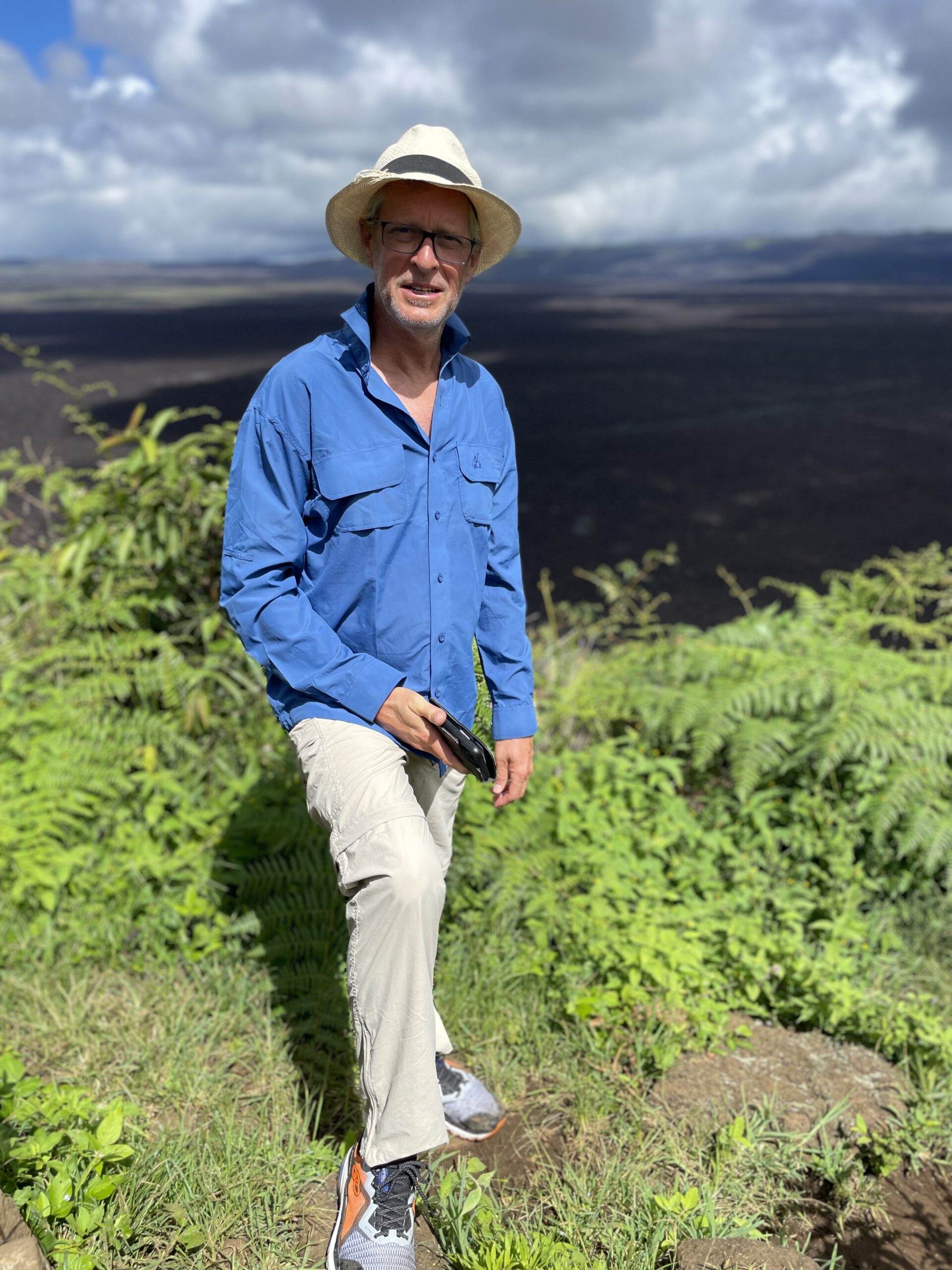
In all parts of our drought-facing world, and especially in the dry Middle East and regions of California and Texas, brackish water in damaged and dead aquifers is common. Tester has made it his life mission, and with his co-founders established a successful company now scaling into new markets, to grow food on dead and dying aquifers.
“It really depends on the crop, but when our technologies are combined this means you can build greenhouses near dead or dying aquifers. In reality there are a lot of factors in play, but this is the idea,” says Tester, pointing to a suite of agri-climate technologies RedSea has built: “The fundamental idea to address is to reduce the use of freshwater for producing fresh food and if we can do that by using more saltwater, then that is definitely a useful contribution.”
Tester was educated in the UK at Cambridge. He is a research professor at KAUST, King Abdullah University of Science and Technology, Saudi Arabia.
Perfecting saltwater greenhouses has been a quest for everyone in the Middle East. Maria Telkes, a Hungarian-American scientist laid the foundation for passive desalination greenhouses decades ago in her basic desalination kit made for providing water for soldiers at sea. Sites in Qatar and Abu Dhabi have piloted saltwater greenhouses.
But Tester’s background is in plant biology, not just tech, furthering the understanding of salt tolerance in plants for desert agriculture. He has developed methods for developing new types of seeds that are used as a hearty rootstock which can handle brackish water. Other plants, which are not as tough, but which are tasty can be then grafted onto these rootstocks.
“I am a plant guy and in this company I am delivering the fruits of my lifetime’s research which is fundamental science: how plants move solutes in and out of the plants, and applying it to salinity tolerance. With my co-founders Ryan Lefers and Derya Baran a suite of products was developed and commercialised that can leverage this research,” he tells Green Prophet.
Grafting is used with many varieties of plants, such as apples, cherries, roses, watermelons, nut trees, and tomato plants. Developing new types of rootstocks that can handle brackish water and other challenges such as heat and drought is the aim –– and “then we graft the edible bits on top,” says Tester.

In some cases, RedSea can graft across species, but only closely related ones: “We can graft a tomato onto a wild tomato, an eggplant onto a wild eggplant, and sometimes even a tomato onto a wild eggplant, but we can’t graft an orange onto an apple, for example. They have to be fairly closely related.”
The work of grafting also allows the farmer to extend the growing period of the plant, says Tester: “We can help tomatoes be economically productive for longer, such as from 10 months to 11 months in a greenhouse.”
The RedSea technology works on a soil-based substrate, hydroponics or on open fields in soil: “We are developing rootstocks for all of these conditions,” says Tester.
“In tomatoes, for instance, we are working with brackish water, which is more dilute than seawater but more salty that you and I can drink, is the reality is that in many places around around the world a lot of our food is grown using groundwater and every major aquifer is being depleted. As it gets depleted, it gets salty.

“We have few aquifers straight outside our university that have been abandoned because of that – now we can access water that’s currently not being used.”
Turning greenhouses inside out
Apart from the unique rootstocks that RedSea is providing, the company has a number of technologies now being sold in export markets. While greenhouses typically need to be heated in Holland or Canada, in the Middle East, the reverse is true. It gets too hot. So RedSea has also helped solve that problem.
They have developed a range of heat blocking greenhouse covers. These are based on additives that can be incorporated into any polymer based cover that blocks damaging heat from penetrating into the greenhouses –– a product called iyris SecondSky which incorporates a nanoparticle technology invented by Baran.
“Derya developed a nanoparticle that when dispersed in plastics absorbs near infrared radiation – which in layman’s terms translates to heat. This absorption of the heat load that would otherwise be damaging to plant health delivers a huge reduction of the resources that are needed in such structures to control the climate and manage plant health in the greenhouse,” says Tester.

The technology can be easily Integrated into standard plastic greenhouse covers, be that polycarbonate, polyethylene or net, resulting in a product that is a one for one replacement of standard greenhouse covers – just better – because the heat blocking is already integrated into the plastic during the manufacturing process. This means that there is very little compromising impact on the PAR (photosynthetic active radiation) transmission through the cover compared to alternative heat blocking methods.
Alternative heat blocking solutions include additional reflective films, chalking or internal shade screens, which are, in the case of films, expensive, an operational nuisance and potentially degrading to the plastic. In the case of chalking and compromise the PAR transmission within the greenhouse. Results achieved with the use of SecondSky have been impressive, Tester reports.
Ryan Lefers, the CEO of RedSea explained more about the potential of how disruptive this integrated heat blocking can be within high heat regions: “Greenhouse technology has become highly developed in Northern European countries such as the Netherlands, offering a solution to keep heat in winter so that crops could be grown out of season, but here in the Middle East and over vast areas of the planet we need to keep the heat out in summer, so our thinking was to take the original greenhouse and turn it inside out,” he tells Green Prophet.
“Water scarcity is another major challenge, so finding ways to operate farms with a lower environmental impact, while empowering farmers to continue to farm without an expectation that they make fundamental changes in the way that they farm was a key driver for us.”
The saltwater greenhouse dream
In facilities where SecondSky is installed, farmers can save up to 30% on water and fertilizer use when compared to hydroponic systems and up to 90% compared to soil based cultivation. Many farms also use a reverse pressure pad and fan cooling system in the region to assist in coping with the extreme temperatures. Farmers can save up to an additional 32% in energy costs once a SecondSky cover is installed.
RedSea has developed an add-on to their technology suite that enables farmers to use brackish water in these cooling systems further reducing the environmental impact of farming in hot climates.

RedSea was founded in 2018, and to date has raised a total of about $36.5 million USD. Saudi Arabia’s oil company Aramco through their investment fund Wa’ed is among the investors. A new Series A funding round will close shortly, adding investors and additional funds for the company’s planned expansion.
Rapid growth of sales and revenues is the company’s focus at the moment, with expansions into other countries. RedSea technology is being sold through manufacturers and distributors, but also directly to farms. There are installations in 16 countries to date and this number is growing.
But Tester, a plant guy at heart with a passion for the environment, has his eye on the bigger prize: “We wanted to have a company that is profitable and truly sustainable and highly impactful –– where we are across the world developing and selling technologies to reduce the environmental footprint of our food productions in both developed and developing countries.
“And that’s where we came from –– Ryan and me. We started with this idea of increasing sustainability in agriculture in developing countries –– that’s in the DNA of the company.”