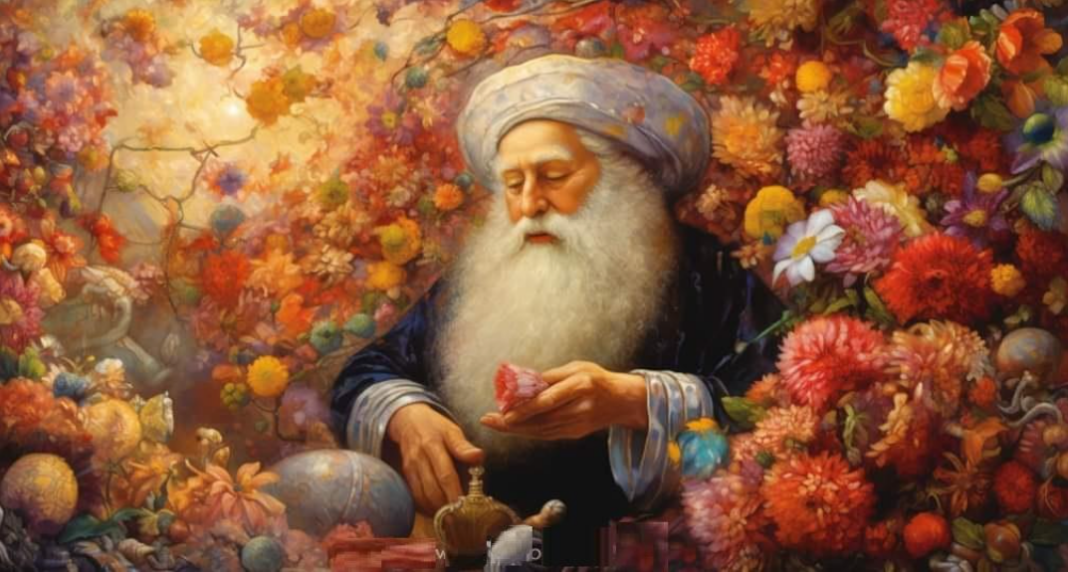


Wisdom of the Ages or Ageless Wisdom
As a kid growing up in Manhattan I remember when the “environment” became the important issue. Every Friday in 1968 I would stand with my mother next to the 59th street bridge at the City’s first recycling facility washing plastic bottles, the term “smog” had been coined and new phrases like pollution of the air and water became household terms.
Jump cut to over 55 years later and “environment” has become the big issue. New terms and new concerns have been introduced, but at the core the same urgency remains to get things done.
What if we could jump cut back through time 2,500 years ago to the city of Pumbedita, near the modern day Fallujah, Iraq. There we would find a large Jewish population famed for its Academy, whose scholarship, together with the city of Sura, gave rise to the Babylonian Talmud.
The Talmud, the central text of Rabbinic Judaism and the primary source of Jewish religious law and Jewish theology, would grow so large that a person who read a folio a day would complete one cycle of the Talmud in seven and half years.
To the surprise of many, buried among these pages are jewels of information about the “environment”.
The late Dutch-Israeli scholar, Dr. Manfred Gerstenfeld, was the first to map out environmental issues found in the Talmud:
| Environmental Elements | Legal Category |
| Relating to nature: | Wanton destruction (bal tashhit) |
| Constancy of Species | |
| Hunting | |
| Relating to animals: | Causing pain to animals |
| Animal welfare | |
| Constancy of Species | |
| The sacredness of taking a life | |
| Preservation of natural resources: | Wanton destruction (bal tashhit) |
| Agricultural support for the poor and needy | |
| Animal protection | |
| Community wellbeing – Shabbat | |
| National wellbeing – Dietary laws | |
| Nuisance/pollution: | Nuisance limitation |
| Health protection | |
| Allocation of space: | Refuge cities |
| Cities for teachers and educators (Levites) |
To paraphrase Dr. Gerstenfeld, he writes that the prohibition of wanton destruction, called in Hebrew bal tashhit (‘do not destroy’), is the principle in Jewish law that elaborates Judaism’s attitude toward the environment.
War has signaled a period of destruction from time immemorial, from the poisoning of wells in ancient times through policies of ‘scorched earth’, the nuclear destruction of humans and the ecosystem in the bombings of Hiroshima and Nagasaki, to Iraq’s intentional pollution of water with oil in the Gulf War.
Jewish laws of trees and war
Yet the Torah teaches that even in times of war, Divine commandments impose certain constraints concerning the environment: “In your war against a city, you must not destroy its trees. You may eat of them, but you must not cut them down. Only trees that you know do not yield food may be destroyed.”
Maimonides mentions further extensions of this principle, pointing out that bal tashhit refers not only to periods of war, but to all times. However, he also states that it is not considered destruction to cut down a fruit tree which is causing damage to other trees or a field.
One of the oldest collections of rabbinical traditions, the Sifrei, written around 300 CE., extends the legislation of wanton destruction to prohibit interference with water sources. The Talmud extends it to include an uneconomical use of fuel.
A far-reaching interpretation of bal tashhit is found in the Talmud: Rabbi Hisda says: “Whoever can eat bread made from barley and eats bread from wheat, transgresses the prohibition of bal tashhit.” Rabbi Papa says: “Whoever can drink beer and drinks wine, transgresses the prohibition of bal tashhit.”
The Talmud indicates, however, that these opinions are not accepted, as one should not eat inferior food, but rather care more for one’s body than for money.
This is because Jewish law forbids a person to damage his own health. The injunction goes beyond the conventional boundaries of environmental interest, which tends to limit itself to damage to third parties and not to what one does to oneself.
Hunting also deals with destruction. Hunting as a sport was addressed in Jewish society long before modern environmentalism emerged. The 18th century Rabbi Yechezkel Landau, when asked whether it is permitted to hunt game, was surprised that anyone should even ask this question and simply answered: “How can a person go out to kill a living creature only for pleasure?”
In recent years noise has increasingly come to be considered a problem of health protection as well as nuisance. The Mishnah states that neighbors can prevent the opening of a store in a common courtyard by claiming that they cannot sleep due to the noise of customers entering and exiting; however, they cannot object to the noise of a hammer or a grinding mill in a craftsman’s home; nor can they object to the noise children make if one of the courtyard’s residents is a school teacher.
Related: Slow Food chef revives food from Talmudic times
(The Mishnah or the Mishna is the first major written collection of the Jewish oral traditions that are known as the Oral Torah. It is also the first major work of rabbinic literature, with the oldest surviving material dating to the 6th to 7th centuries BCE.)

What we covered here is the tip of the iceberg on just one subject relating to environmental concerns. If you wish to read Dr. Gerstenfeld’s doctoral theses, please go here. If the wisdom of the Jewish ancients is of further interest, there is now a free, open-to-the-world platform of Talmudic wisdom launched in Dubai, UAE, in the winter of 2022 called The Peoples’ Talmud which makes the Talmud accessible to layman and scholar in user-friendly English.
About Gedaliah Gurfein
 Gedaliah has been involved in the high-tech world since 1994 both in Jerusalem, New York and Beijing. He has also been a teacher of the Talmud since 1974 and is currently the spiritual leader of two Igbo communities in Nigeria.
You can hear Gedalia on The Peoples’ Talmud here.
In one sampling on Animals, it is written: “Wild animals are usually called wild because they cannot be domesticated and used in labor. However, as Ben Gurion once said, “If an expert tells you it can’t be done, get another expert.”
The Talmud says that there were people who so understood animal nature that, despite the nature of wild donkeys, they were able to utilize wild donkeys to turn their millstones.