Bedouin Traditions to bring back a sustainable community with Project Wadi Attir

picture of the grounds at Project Wadi Attir

We pulled up into a barren plot of land that stretched for miles. I, and the rest of my Onward friends in my Israel internship program were utterly confused. Where were we? I remember thinking. We were quite literally in the middle of nowhere, just miles of open, dry land, the land of Israel.

Once we got off the bus we were brought into a room with tables and a board where we learned what we were here for. Project Wadi Attir, is a sustainable development organization that aims to farm through Bedouin traditions in an eco way. Fostered by The Sustainability Laboratory, the goal of this project and the other projects is to integrate sustainable practices of agriculture.

The property is located in the north Negev desert and it desires to bring back original Bedouin traditions like folk medicine that have been long forgotten from the past. Traditional Bedouin culture were nomad Arabs who farmed the land in a sustainable way. This project brings back this method of farming so that farmland is better preserved and taken care of, and this was very clear as we were taken on our tour of the property.

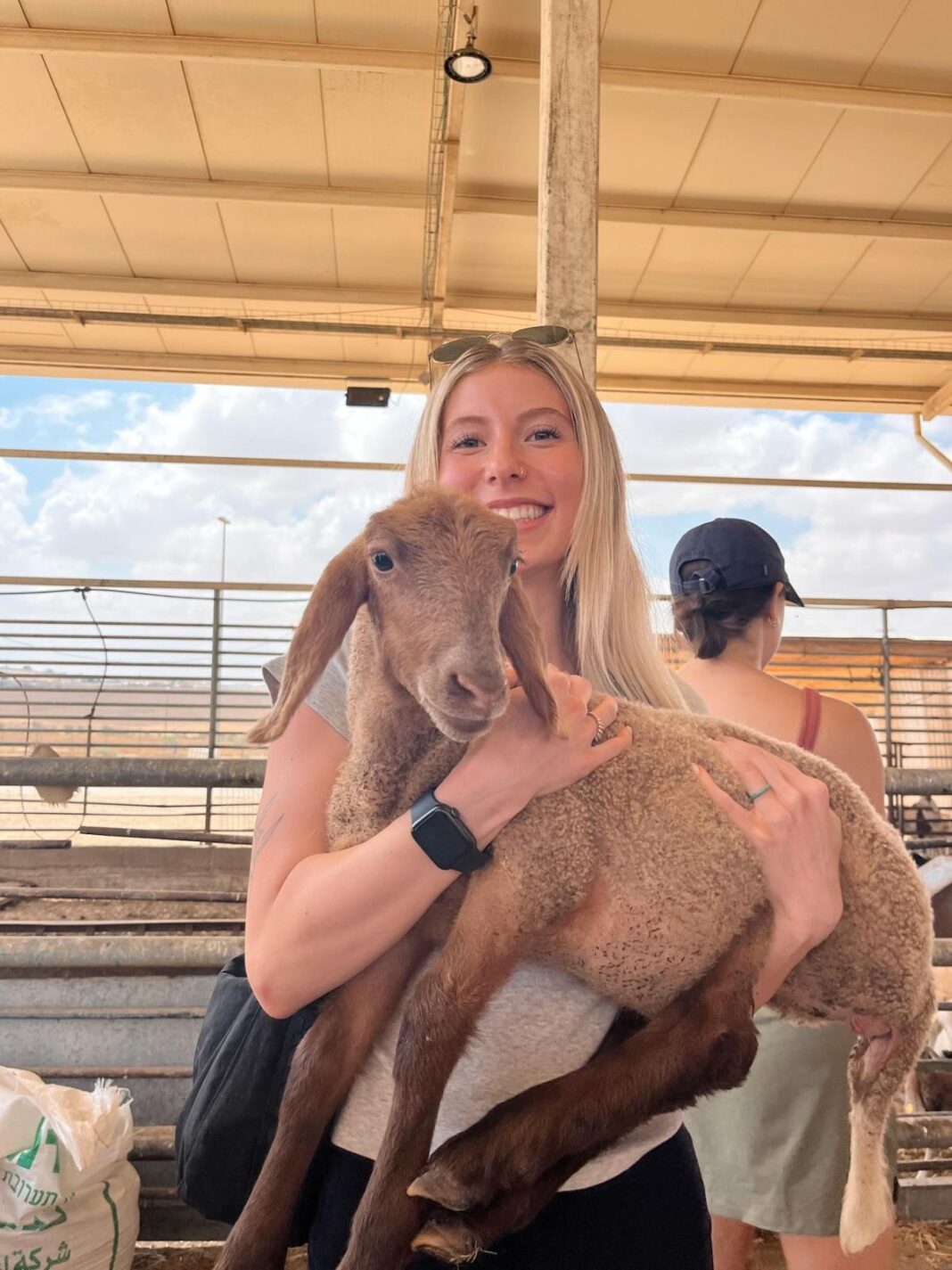
They showed us around the 100-acre land and showed us some of the goats and sheep. The goats are milked by hand only and we even were able to hold one of the goats. They also served us some labneh, which was goat cheese they made on-site. You can make your own labneh with our recipe here.

Hold a goat

picture of friend in program holding one of the goats

“This whole project is to take all the tradition and knowledge the Bedouins had for thousands of years in the desert and try to use it and bring it back with the most advanced technique and technology,” said Mohammed Alnabari, one of the founders of the project.

This project was also inspired to achieve a holistic approach back to a natural way of healing. Similarly to Tavlinsky and Cafe Levinsky crafting their ingredients on site, the project produces its own herbs, dairy products, and vegetables all made sustainably through an ancient Bedouin method of cultivation, and is supposed to provide a more natural way of living.

It is also hopeful to inspire other farmland to adopt this agricultural style in order to preserve the planet and support the Bedouin community and lifestyle. You can also buy their herbs and medicinal plants in the store they have on site.

Although it may seem like this place is all designed to be ancient and hand produced, there are solar fields on site that they use to generate electricity. In addition, the goat milking facility is one of the most advanced in Israel. Each goat has an ID bracelet, which tells them a lot of information like how much milk it yielded, how much time it milked, how old she is, and information on the milk cycle. “It can milk 48 items, goats or sheep at one time,” said Alnabari on the milking process. There are 100 goats and 100 sheep being milked right now on-site, giving about 3 liters of milk and being used to produce traditional Bedouin cheese.

What was so unique about my experience at Project Wadi Attir was that there were little kids there, learning, playing, and just experiencing the culture. When we arrived, the kids were staring at us like deer in the headlights. A group of modern, flashy young adults from America standing in front of tiny children that knew nothing of our lifestyles. I wasn’t able to speak to any of these children (mostly because they didn’t speak English), but it would be so interesting to know what they are thinking and get the perspective from their side.

picture of the site and some children that were there

The children that were at Project Wadi Attir

This Project not only builds a more sustainable Bedouin farm life, but also reestablishes a Bedouin tribe that brings people together from all over the world. As international relations is a complicated subject that is so heavily discussed in the Middle East, these projects are crucial in creating stronger bonds between people because it allows us to look each other in the eye and see different perspectives.

Seeing how other people live is the first step in forming peaceful relations and also grows our intellect just to see how other people live.

Danielle Meyers
Danielle Meyershttp://www.greenprophet.com
Danielle Meyers is an Environmental Science major at the University of Massachusetts Amherst interested in environmental law and policy. She took an interest in studying the environment once she learned about the worsening effects of climate change. Danielle enjoys going on adventures, the beach, shopping, and seeing friends and family. She is reporting from Tel Aviv in the Summer of 2023 to to learn, discover, and inspire change in the community and throughout the Middle East.

Hot this week

How Renewable Energy is Revolutionizing the Way We Power Our World

Solar has become the star of the transition thanks to modular hardware and straightforward installation. It fits dense cities and remote towns alike. Many companies are turning to rooftop arrays and carport systems - and exploring commercial solar installation as a practical way to lock in future savings.

How does one start prepping?

Faced with an extreme winter storm this year, Americans wonder how to be prepared for catastrophe. Miriam has lived through wars in the Middle East - so she's prepared on giving you a guide to prepping.

Fishermen sue tire manufacturers on behalf of the salmon

A federal trial in San Francisco has brought US tire manufacturers, fishing groups, and environmental scientists into court over a chemical most drivers have never heard of — but which scientists say may be silently reshaping aquatic ecosystems.

Listening to Water: Tarek Atoui’s Next Work for Tate Modern

Born in Beirut, Lebanon in 1980 and now living in Paris, Atoui has spent years building instruments that don’t sit comfortably in concert halls. Many of them involve water, glass, and ceramics — materials that react to sound instead of simply producing it.

Leading Through a Dual-Energy Transition: Balancing Decarbonisation with Energy Security

Experience in one area of the energy industry isn't enough to guarantee readiness across all the others. That's where a structured program like an MBA in energy can come in. Today's advanced curricula explore energy economics, finance, policy, and strategic management alongside the technical subjects. And when pursuing an energy MBA online, professionals can skill up and retrain without having to step out of the labor market -- an important perk at a time when skilled professionals are already in short supply.

Topics

How Renewable Energy is Revolutionizing the Way We Power Our World

Solar has become the star of the transition thanks to modular hardware and straightforward installation. It fits dense cities and remote towns alike. Many companies are turning to rooftop arrays and carport systems - and exploring commercial solar installation as a practical way to lock in future savings.

How does one start prepping?

Faced with an extreme winter storm this year, Americans wonder how to be prepared for catastrophe. Miriam has lived through wars in the Middle East - so she's prepared on giving you a guide to prepping.

Fishermen sue tire manufacturers on behalf of the salmon

A federal trial in San Francisco has brought US tire manufacturers, fishing groups, and environmental scientists into court over a chemical most drivers have never heard of — but which scientists say may be silently reshaping aquatic ecosystems.

Listening to Water: Tarek Atoui’s Next Work for Tate Modern

Born in Beirut, Lebanon in 1980 and now living in Paris, Atoui has spent years building instruments that don’t sit comfortably in concert halls. Many of them involve water, glass, and ceramics — materials that react to sound instead of simply producing it.

Leading Through a Dual-Energy Transition: Balancing Decarbonisation with Energy Security

Experience in one area of the energy industry isn't enough to guarantee readiness across all the others. That's where a structured program like an MBA in energy can come in. Today's advanced curricula explore energy economics, finance, policy, and strategic management alongside the technical subjects. And when pursuing an energy MBA online, professionals can skill up and retrain without having to step out of the labor market -- an important perk at a time when skilled professionals are already in short supply.

From Green Energy to Healthy Societies: Why old systems thinking is becoming relevant again

Across the Middle East and North Africa, large investments are being made in green hydrogen, renewable energy, water infrastructure and sustainability. Most of these efforts are discussed in the context of climate change, decarbonization and economic diversification. That framing is important, but it may not capture their full value.

We saw peace – an interreligious encounter deep in our eyes

They came from Israel, Palestine, Jordan, Iraq, Yemen, Morocco, Tunisia, Lebanon, Egypt… There are Sunni Muslims, Shiite Muslims, Jews (Orthodox and Reform), Orthodox Christians, Coptic Christians, Protestant Christians, Druze, Baha'is, a Scientologist.

Can biochar reduce ‘Forever Chemicals’ in food if it’s used in farms?

Biochar is produced by heating organic material in a low-oxygen environment so it does not burn. This process, known as pyrolysis, transforms plant matter into a stable, carbon-rich material.

Related Articles

Popular Categories