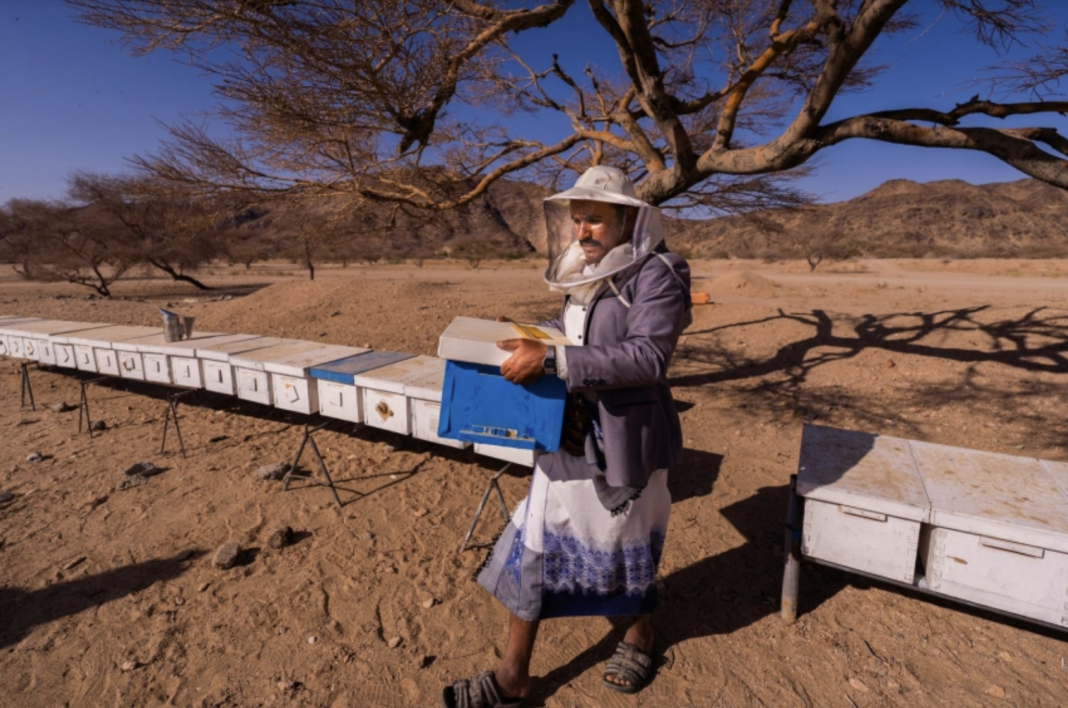


Yemeni honey has a history going far back into antiquity, tracing its origins to the tenth century BCE and gaining global fame for its quality. So not surprisingly, this golden liquid is found in practically every Yemeni home. It helps to sweeten many social events and is not only prized for its nutritional and social qualities but also regarded by Yemenis as having medicinal value. It is the first thing a woman eats after giving birth, while a patient usually licks honey before visiting a doctor.
But the production of Yemeni honey faces daunting challenges. In addition to the damage done by the country’s long-running conflict, honey producers like Salem Al-Diwali must also grapple with the unpredictable climate. In the dry season, pastures are depleted, and beekeepers must buy the pollen grains that are the main source of nutrients for the bees. When the beekeepers cannot afford to meet the high transport costs for these grains, hives are sometimes abandoned.
Although, at the age of 41, Salem has been keeping bees for more than 15 years in Abadan village in Shabwa Governorate, he has recently changed his approach, after taking part in trainings under the Smallholder Agricultural Production Restoration and Enhancement Project (SAPREP) of the Food and Agriculture Organization of the United Nations (FAO) and the World Bank. The initiative is part of the World Bank’s broader Global Agriculture and Food Security Program.
The SAPREP has helped beekeepers across Yemen to increase their productivity and nutrition through better beekeeping practices. These included more efficient handling of the bees and techniques for extracting honey.
The initiative also provided participating beekeepers with modern beehives and tools, allowing them to increase the quality and quantity of their production and earn more income to enhance their families’ food security.
Bees make a sweet business

For Salem, making the most of his honey business involves a significant daily commitment. He inspects his hives, observing bee movement and the amount of honey in the hive. Other crucial elements to monitor are the stock of pollen grains and nectar and the condition of the queen bees. By observing their activity, he can decide whether to transfer queens to different hives to increase output.
He must also juggle the responsibilities of being married with seven children and a lifestyle, which like many Yemeni beekeepers uphold, is partly nomadic. He spends a portion of his time trucking his hives around in search of the best bee pastures and avoiding the worst of the country’s harsh climate. Once he has found a suitable spot, he sets up his hives away from fields on which farmers have been using pesticides. But he often enlists the help of villagers to ensure the safety of his bees, turning the cultivation of honey into a “team effort.”
Salem has been able to grow his operation, though he admits it took a great amount of effort. He says he greatly benefited from the FAO training on how to extract raw wax and better monitor the production of pollen and amber.
As one of the beneficiaries of SAPREP, he received eight beehives, a water tank, a sorter to separate honey from wax and sheets of base wax on which bees can start building a honeycomb. This allowed him to upgrade his hives and increase the total number to 30, translating into increased yields of honey and wax.
Even so, Salem believes that despite the position which honey holds in Yemenis’ hearts, the lack of markets for it in the country does not reflect the high quality of the product. In fact, he keeps some of the honey collected at home due to the stagnation of the local market.
Confronting challenges as a beekeeper
Not surprisingly, one overwhelming factor influencing both supply and demand is the conflict, with explosions decimating many of Yemen’s beehives, especially at the beginning of the violence in 2015. Many of the obstacles faced by beekeepers, such as rough roads, are related to the conflict, making the transportation of honey, beehives and pollen a challenge. Then there are the additional challenges of poor rainfall, pests including bee flies, bee-eaters and wasps and the weak state of the Sidr trees, which provide a unique flavour to Yemen’s honey.
Despite these setbacks, the honey value chain plays a key role in food and nutrition security in Yemen and provides income for an estimated 100 000 beekeepers in the country. There is also huge potential for further development. FAO and the World Bank, under the Yemen Food Security Response and Resilience Project, are encouraging farmers to take beekeeping as an alternative income generating activity.
Thanks to such initiatives, smallholder beekeepers like Salem, are increasingly able to confront some of the challenges, continue producing the world-famous Yemeni honey and just perhaps look forward to sweeter times ahead.