Who was Maria, who lived an immaculate life 1400 years ago?

maria burial stone negev desert

Ancient Greek burial stone discovered while clearing paths for nature park in Israel’s Negev Desert reveals period of time in transition

A stone bearing an inscription in Greek from the end of the Byzantine period – around 1400 years ago – was discovered last weekend in the confines of the Nitzana National Park in the Negev Desert in Israel. The flat, round stone, about a foot in diameter, was used as a tombstone in one of the cemeteries surrounding the ancient settlement. 

The stone was found by a “Project 500” worker from the Israel Parks and Nature Authority while cleaning and preparing nature paths in the Nitzana National Park. The stone was left at the head of the path when it was noticed by David Palmach, the director of the Nitzana Educational Village, who realized that it bore an inscription. Palmach photographed and collected it to prevent its being looted. He also contacted the Israel Nature and Parks Authority and the Israel Antiquities Authority, and the inscription is being transferred to the National Treasuries Dept. 

The inscription was deciphered by Leah Di Segni of the Hebrew University in Jerusalem and it refers to “Blessed Maria, who lived an immaculate life” and died on February 9th. 

A time of Islam conquering the region

According to Tali Erickson-Gini of the Israel Antiquities Authority, “Nitzana is renowned as a key site in research into the transition between the Byzantine and the Early Islamic periods. During the fifth and sixth centuries CE, Nitzana acted as a center for the villages and settlements in the vicinity. Among other things, it had a military fortress as well as churches, a monastery and a road station that served Christian pilgrims traveling to Santa Katarina, which believers regarded as the site of Mount Sinai.”

Mount Sinai is where Jewish believers say Moses received the 10 Commandments. Nitzana in an aerial photograph below.
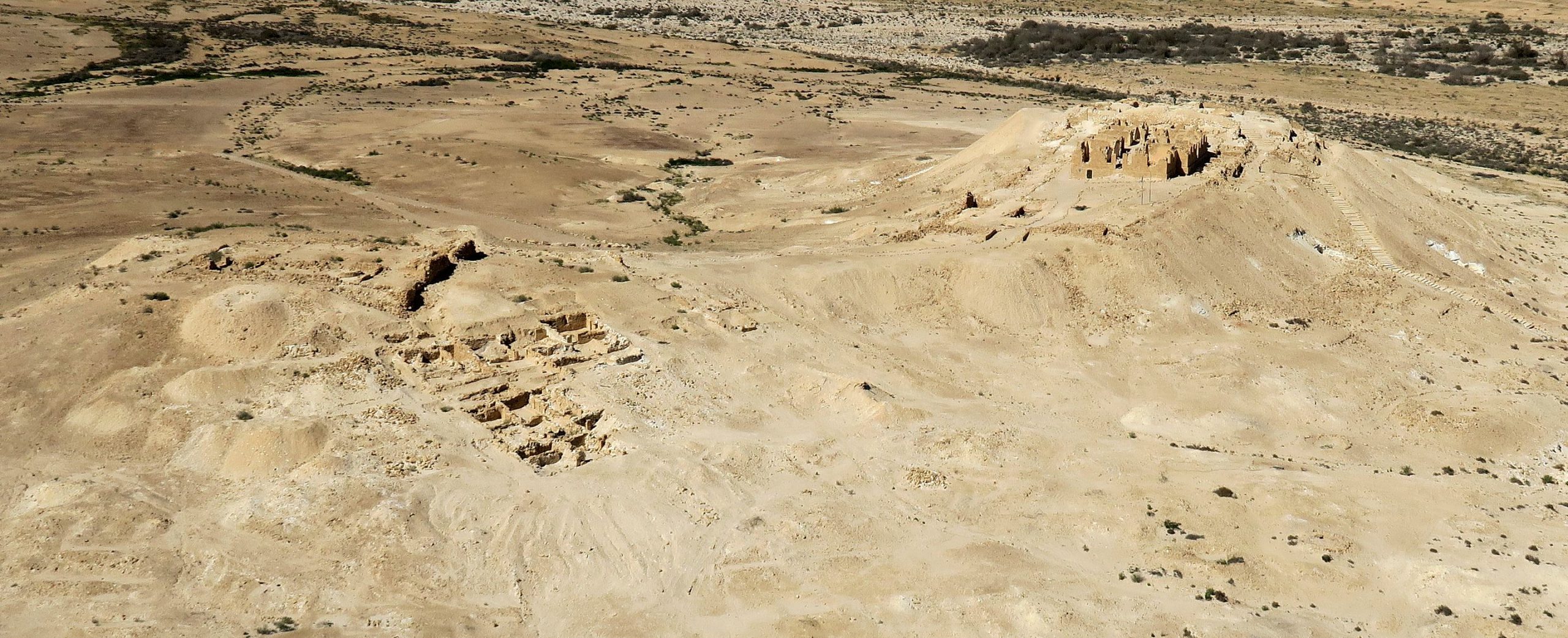
According to Dr Erickson-Gini, Nitzana was founded in as early as the third century BCE as a Nabatean road station on a major trade route and the place was inhabited intermittently for about 1300 years, until it was abandoned in the tenth century CE and its name was forgotten.

Archaeological excavations at the site in the 1930s unearthed a papyrus archive, and the name ‘Nessana’ was rediscovered. The burial-stone find, naming the deceased as Maria, joins other stones commemorating Christians buried in the churches and cemeteries around Nizzana that have been unearthed in excavations by the Ben Gurion University of the Negev, among others. 

Israel Antiquities Authority Southern District archaeologist Pablo Betzer says, “Unlike other ancient towns in the Negev, very little is known about the burial grounds around Nitzana. The find of any inscription such as this may improve our definition of the cemeteries’ boundaries, thus helping to reconstruct the boundaries of the settlement itself, which have not yet been ascertained.” 

It’s common for archeology remnants to be uncovered by civilians in Israel. Especially in the winter time as heavy rains disturb old sands. Remember last year when a boy in Israel found the Bel Air of tombstones while out hiking

Nitzana was Nabatean too

Nitzana (Hebrew: ניצנה‎; transliterated at the site as “Nizana”, Byzantine Greek Νιζάνα) is an ancient Nabataean city located in the southwest Negev desert in Israel close to the Egyptian border. It may have been a camel caravan station on the eastern branch of the ancient Incense Route, serving pilgrims and merchants travelling to Sinai or central Egypt.

Gaza built from the ruins of Nitzana

The Nabataean towns of the Negev were typically founded around the first century BC, conquered by Romans two centuries later, who garrisoned the site, and inhabited by Byzantine Christians from at latest the fourth century until the invasion and the Muslim conquest of Syria in the seventh century. Relatively few stones remain on the site because most were recycled into buildings in Gaza in the early 20th century.

We love the Nabateans because they had excellent systems for water capture and reverence for nature. And they built beautiful things like Petra. 

nabateans petra
The first people to green the desert? Nabateans who built Petra were like the Mayans of the Middle East. The ancient people were developed in agriculture, spirituality and architecture. Archaeologists dig into how they dealt with drought in Jordan, one of the driest countries on earth.
Karin Kloosterman
Karin Kloostermanhttp://www.greenprophet.com
Karin Kloosterman is an award-winning journalist, innovation strategist, and founder of Green Prophet, one of the Middle East’s pioneering sustainability platforms. She has ranked in the Top 10 of Verizon innovation competitions, participated in NASA-linked challenges, and spoken worldwide on climate, food security, and future resilience. With an IoT technology patent, features in Canada’s National Post, and leadership inside teams building next-generation agricultural and planetary systems — including Mars-farming concepts — Karin operates at the intersection of storytelling, science, and systems change. She doesn’t report on the future – she helps design it. Reach out directly to [email protected]

LEAVE A REPLY

Please enter your comment!
Please enter your name here

TRENDING

Earth building with Dead Sea salt bricks

Researchers develop a brick made largely from recycled Dead Sea salt—offering a potential alternative to carbon-intensive cement.

The Christ’s thorn (sidr tree) is also a well-known folk medicine

Christ’s thorn jujube (Ziziphus spina-christi) also known as the sidr tree is a real, identifiable tree native to the Middle East, and it appears—directly or indirectly—in Islam, Judaism, and later Christian tradition. The connections between the three faiths are not theological agreements but overlapping uses, names, and symbolic associations rooted in the same landscape.

Farm To Table Israel Connects People To The Land

Farm To Table Israel is transforming the traditional dining experience into a hands-on journey.

The Lote Tree of the Utmost Boundary, explained

Knowing about the concept of the Lote Tree of the Utmost Boundary helps explain a core idea in Islam.

Remilk makes cloned milk so cows don’t need to suffer and it’s hormone-free

This week, Israel’s precision-fermentation milk from Remilk is finally appearing on supermarket shelves. Staff members have been posting photos in Hebrew, smiling, tasting, and clearly enjoying the moment — not because it’s science fiction, but because it tastes like the real thing.

Qatar’s climate hypocrisy rides the London Underground

Qatar remains a master of doublethink—burning gas by the megaton while selling “sustainability” to a world desperate for clean air. Wake up from your slumber people.

How Quality of Hire Shapes Modern Recruitment

A 2024 survey by Deloitte found that 76% of talent leaders now consider long-term retention and workforce contribution among their most important hiring success metrics—far surpassing time-to-fill or cost-per-hire. As the expectations for new hires deepen, companies must also confront the inherent challenges in redefining and accurately measuring hiring quality.

8 Team-Building Exercises to Start the Week Off 

Team building to change the world! The best renewable energy companies are ones that function.

Thank you, LinkedIn — and what your Jobs on the Rise report means for sustainable careers

While “green jobs” aren’t always labeled as such, many of the fastest-growing roles are directly enabling the energy transition, climate resilience, and lower-carbon systems: Number one on their list is Artificial Intelligence engineers. But what does that mean? Vibe coding Claude? 

Somali pirates steal oil tankers

The pirates often stage their heists out of Somalia, a lawless country, with a weak central government that is grappling with a violent Islamist insurgency. Using speedboats that swarm the targets, the machine-gun-toting pirates take control of merchant ships and then hold the vessels, crew and cargo for ransom.

Leopoldo Alejandro Betancourt López Turned Ocean Plastic Into Profitable Sunglasses

Few fashion accessories carry the environmental burden of sunglasses. Most frames are constructed from petroleum-based plastics and acrylic polymers that linger in landfills for centuries, shedding microplastics into soil and waterways long after they've been discarded. Leopoldo Alejandro Betancourt López, president of the Spanish eyewear brand Hawkers, saw this problem differently than most industry executives.

Why Dr. Tony Jacob Sees Texas Business Egos as Warning Signs

Everything's bigger in Texas. Except business egos.  Dr. Tony Jacob figured...

Israel and America Sign Renewable Energy Cooperation Deal

Other announcements made at the conference include the Timna Renewable Energy Park, which will be a center for R&D, and the AORA Solar Thermal Module at Kibbutz Samar, the world's first commercial hybrid solar gas-turbine power plant that is already nearing completion. Solel Solar Systems announced it was beginning construction of a 50 MW solar field in Lebrija, Spain, and Brightsource Energy made a pre-conference announcement that it had inked the world's largest solar deal to date with Southern California Edison (SCE).

Related Articles

Popular Categories