$8 million fine and 10 years jail for cutting a tree in Saudi Arabia?

ryadh full of trees, biodome rendering
The kingdom announced the launch of ‘Let’s Make it Green’ – a plan to plant 10 million trees across the country by April, 2021. Cut one down and pay a heavy price. 

Does the punishment fit the crime? A new law in Saudi Arabia states that the maximum fine ––  an $8 million USD equivalent fine and 10 years in jail –– could be your punishment for cutting down a tree in the Kingdom, according to a government tweet on Twitter.

“Cutting down trees, shrubs, herbs, or plans [and] uprooting, moving, stripping them of their bark, leaves or any part, or moving their soil,” could land offenders with the maximum fine and jail time, the Saudi public prosecution said on Twitter last week.

This is all part of Saudi Arabia’s off-kilter Saudi Vision 2030 development plan to achieve environmental sustainability by the end of the decade. Saudi Vision 2030 (Arabic: رؤية السعودية 2030‎) is a strategic framework to reduce Saudi Arabia’s dependence on oil, diversify its economy, and develop public service sectors such as health, education, infrastructure, recreation, and tourism.

One part of their plan is to build an eco-city to bring in tourists from around the world, in what I would call an eco-nightmare city on the Red Sea called Neom. They have already forcefully displaced people living there, leaving one who refused to vacate dead

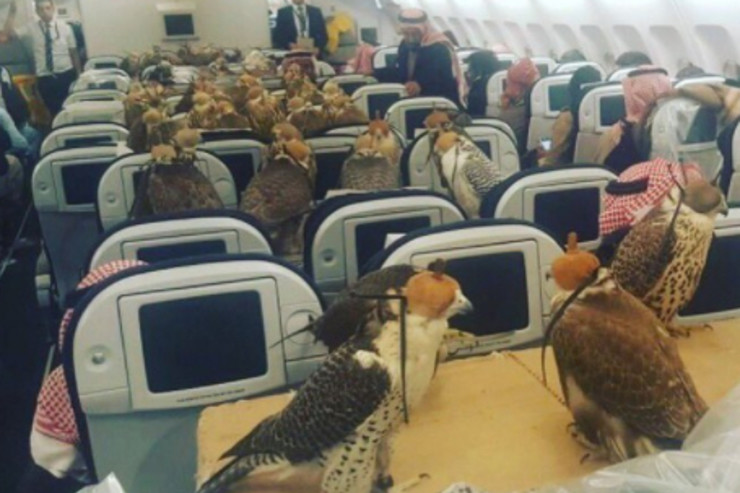
Saudi’s idiosyncratic ways with its prince in charge (the one who hires planes for falcons) also includes interesting experiments that other fiscally-minded nations might not try, like investing in hydrogen fuel for buses

falcons plane saudi arabia

As it’s sometimes hard to separate fact from fiction in Saudi Arabia: a fine for tree-cutters is a good thing, but not one so steep. Would it ever be enacted or just a threat until the wrong Joe makes a mistake? We might think it be better to take an even-handed approach and focus on the treehuggers in Saudi Arabia and reward them when they do good. 

The fact that the Kingdom last month announced the launch of ‘Let’s Make it Green’ – a plan that seeks to plant 10 million trees across the country by April 2021, seems like a good idea. Saudi Aramco, the largest oil producer, and the richest company in the world has vowed to plant 1 million trees. But where will the water come from for all those trees? Planting them is one thing. Taking care of them quite another. Energy intensive desalination?

Economic and social reforms have gained momentum since Saudi’s de facto ruler, Crown Prince Mohammed bin Salman, announced his ambitious vision in 2016 to reduce the country’s heavy dependence on oil.

“We will seek to safeguard our environment by increasing the efficiency of waste management, establishing comprehensive recycling projects, reducing all types of pollution and fighting desertification,” reads the vision.

According to Jewish Law it is forbidden to cut a tree-bearing fruit. In practice it happens. We’ve yet to hear of someone who has gone to jail for it. On the upside, planting trees can shape a nation. Israel’s mission with the Jewish Agency to plant trees since its founding in 1948 has led to it becoming the only country in the world with net positive trees than it had 100 years ago.

Planting trees is a great way to suck up carbon dioxide. Environmentalists I’ve spoke with say it’s likely a whole lot more sustainable than carbon capture. 

Top image: a rendering of Riyadh, a city that aims to plant 7 million trees 


Karin Kloosterman
Karin Kloostermanhttp://www.greenprophet.com
Karin Kloosterman is an award-winning journalist, innovation strategist, and founder of Green Prophet, one of the Middle East’s pioneering sustainability platforms. She has ranked in the Top 10 of Verizon innovation competitions, participated in NASA-linked challenges, and spoken worldwide on climate, food security, and future resilience. With an IoT technology patent, features in Canada’s National Post, and leadership inside teams building next-generation agricultural and planetary systems — including Mars-farming concepts — Karin operates at the intersection of storytelling, science, and systems change. She doesn’t report on the future – she helps design it. Reach out directly to [email protected]

TRENDING

Australian camels fly on a plane to Saudi Arabia

Australia has the largest population of feral camels in the world. Some get repatriated to Saudi Arabia.

Seaweed fashion brands can source from Saudi Arabian sea

From Red Sea seaweed to runway-ready fabric, Saudi Arabia is quietly reshaping fashion’s material future. KAUST scientists, designers, and textile innovators are proving that sustainability can begin in local ecosystems. As seaweed becomes wearable, fashion is learning to grow not from fields — but from tides.

The Line’s 15 minute city failure and the limits of green futurism

The failure of The Line is not a failure of imagination. It is a failure of restraint by western architects and planners who go along with the charade. Who is holding these firms accountable? This is actually a reasonable kind of project for the UN to take on and challenge. 

Musk’s Saudi Mega-Data Center Signals a Desert Arms Race for AI

For now, Musk’s partnership signals a deepening alignment between Silicon Valley and Riyadh — and a new chapter in the Middle East’s data-powered future. The satellites and robots may come later. The energy footprint, however, is already here.

Turning Your Energy Consultancy into an LLC: 4 Legal Steps for Founders in Texas

If you are starting a renewable energy business in Texas, learn how to start an LLC by the books.

Tracking the Impacts of a Hydroelectric Dam Along the Tigris River

For the next two months, I'll be taking a break from my usual Green Prophet posts to report on a transnational environmental issue: the Ilısu Dam currently under construction in Turkey, and the ways it will transform life along the Tigris River.

6 Payment Processors With the Fastest Onboarding for SMBs

Get your SMB up and running fast with these 6 payment processors. Compare the quickest onboarding options to start accepting customer payments without delay.

Qatar’s climate hypocrisy rides the London Underground

Qatar remains a master of doublethink—burning gas by the megaton while selling “sustainability” to a world desperate for clean air. Wake up from your slumber people.

How Quality of Hire Shapes Modern Recruitment

A 2024 survey by Deloitte found that 76% of talent leaders now consider long-term retention and workforce contribution among their most important hiring success metrics—far surpassing time-to-fill or cost-per-hire. As the expectations for new hires deepen, companies must also confront the inherent challenges in redefining and accurately measuring hiring quality.

8 Team-Building Exercises to Start the Week Off 

Team building to change the world! The best renewable energy companies are ones that function.

Thank you, LinkedIn — and what your Jobs on the Rise report means for sustainable careers

While “green jobs” aren’t always labeled as such, many of the fastest-growing roles are directly enabling the energy transition, climate resilience, and lower-carbon systems: Number one on their list is Artificial Intelligence engineers. But what does that mean? Vibe coding Claude? 

Somali pirates steal oil tankers

The pirates often stage their heists out of Somalia, a lawless country, with a weak central government that is grappling with a violent Islamist insurgency. Using speedboats that swarm the targets, the machine-gun-toting pirates take control of merchant ships and then hold the vessels, crew and cargo for ransom.

Related Articles

Popular Categories