
Falaj, also known as qanat or aflaj, is an ancient water management system, that has watered the Arabian Peninsula’s arid lands for centuries. Qanat comes from the Semetic word meaning to dig and some say that the qanat systems are as long as the distance from the earth to the moon. Long-ago tribesmen found underground springs in the foothills of the region, and engineered a technology that channels the water over the land, irrigating farms and oases and supplying households with water as needed. Although some say that falaj is a concept 3000 years old, others claim 5000 years. We reported on the Al-Baydha project for regenerative agriculture in Saudi Arabia with similar aims here.
What we do know is how admirable and sustainable the falaj system is, built entirely from local materials and hewed out of rock and earth by hand. First deep wells were dug, or underground springs redirected, to flow into tunnels that emerge on land and into stone channels containing the streaming water. The waterflow moves across miles of land, as determined by the ancients, entirely by gravity.

Shafts whose function is to regulate the flow of water are sunk in the channels about every 20 meters. Today, field irrigation is managed by government-appointed overseers, who monitor which fields receive water, and for how many hours. This is done in some areas by removing covers of brick, stones and sheep fleeces from the openings of the shafts to let the water run in another given direction, then replacing the covers to force the water back.
 The Aflaj Irrigation Systems of Oman are ancient water channels from 500 AD located in the regions of Dakhiliyah, Sharqiyah and Batinah. However, they represent a type of irrigation system as old as 5000 years in the region named as Qanat or Kariz as originally named in Persia. This one is in the UAE.
In other falaj, slab-like barriers are inserted into points built into the channel walls to divert the water, then put back as needed.

Falaj comes from the word aflaj, meaning split, or divided. As the photo above shows, the channels may be split to provide field irrigation on one side, and household water on the other.
Walk through a village in Oman, and you’ll see pure, channeled water flowing in the streets and between houses. Some channels may be partially covered with slabs of stone placed at regular intervals over the top, to prevent night animals that come to drink from falling in and polluting the water.
There might even be a bath house for the community, with the water provided by the falaj. In the 14th and 15th centuries, governments whose falaj systems had deteriorated rebuilt the tunnels and overland channels. Recognizing the huge value of the ancient waterways, today’s Emirati and Omani governments have repaired many and put them back in use. Some areas in Oman have over 50 working falaj.
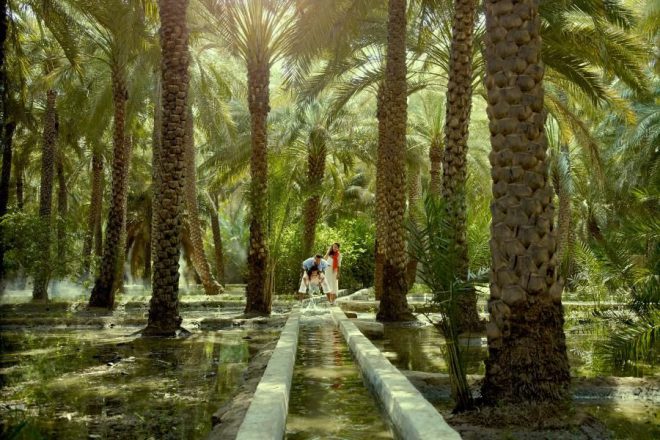
In the UAE there are seven oases, the largest in Al Ain. The stream rippling and burbling between thriving date palms and water greenery is a beautiful thing to see, and it also irrigates 1.200 acres of land, supplying over 550 farms.
Community areas were once cleared around the mouths of the channels, where the tribes met to take their share of the crop and hold festivities. Forts and castles were built around the Al Ain oasis to protect it from marauders, and important archaeological discoveries have been made there. UNESCO declared five of the UAE falaj systems to be heritage sites in 2011.
The falaj system is said to have originated in ancient Iran early in the first millennium BCE, spreading to China and India. Tribal laborers known as muqannis hand-built and maintained the water channels and shafts, as their descendants do to this day.