Israeli cities suck for air

Tel-Aviv-air-Pollution1

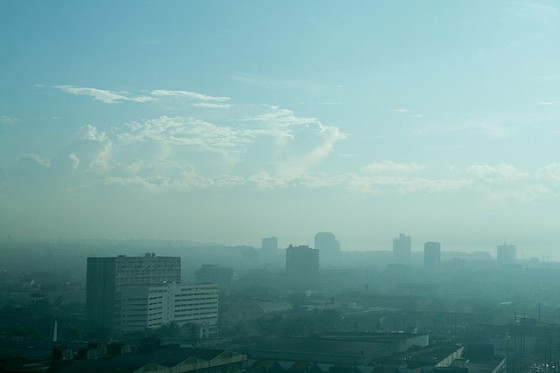
How green are Israeli cities, really? This question might be asked by many; especially in light of its largest city,  Tel Aviv (see photo), becoming so polluted that a tiny electric vehicle rental program is being tried out in an effort to reduce  air pollution.  Ground water in Tel Aviv and other parts of the country is polluted as well.

Overall air pollution in Israel has now reached a state that the World Health Organization WHO recently gave Israel the “distiction”  of having some of the world’s  most polluted air.

In a recent assessment. WHO’s Ambient (Outdoor) Air Pollution in Cities Database for the year 2014 ranked Israel as being one of the most air polluted countries with high concentrations of PM10 and PM2.5, or air particles  with a diameter of 10 microns and 2.5 microns or less. Israel tied with Chile and Sri Lanka as being 22nd out of 91 countries in which the assessment was made.

Afghanistan  topped the list, despite having large areas that are relatively remote from large  population centers.

The WHO survey gave the relatively new city of Modiin and coastal city of Ashkelon the worst air pollution scores.

Dr. Flavia Bustreo, WHO assistant director-general for family, children and women’s health, noted in the report that  “too many urban centers today are so enveloped in dirty air that their skylines are invisible.”

Dr. Bustreo added that  this type of environment is dangerous for persons with respiratory problems; especially for elderly people and children.

The highest levels of PM10 air pollution were measured in the eastern Mediterranean region, followed by southeast Asia.

Two industrialized Western countries that scored surprising good scores for PM10 and PM2.5 levels were the UK and the USA. The UK  registered  21 micrograms of PM10 and 14 micrograms of PM2.5 per cubic meter;  and  the US scored 20 micrograms of PM10 and 12  micrograms of PM2.5.

Israel, by contrast, has PM10 nationwide levels of 64 micrograms per cubic meter (more than three times the accepted WHO standard); and 23 micrograms of PM2.5 per cubic meter.

Both of these amounts are  many times higher than international accepted standards.

Despite WHO’s poor assessment of Israeli air, there is some encouraging news. The Israeli cites of Ashdod, Holon, Kfar Saba  and Rishon Lezion have won local awards as Israel’s largest green cities.  The designations were given during Israel’s International CleanTech 2014 conference.

During a two month study, 11 environmental categories were judged for Israeli cities  and local authorities. These categories included energy efficiency and reduction of greenhouse gasses, recycling and trash separation,  water and sewage, encouraging use of public transportation, green building construction, gardening; and environmental education.  Information gathered was combined with information already available from the Environment Ministry.

One questionable finding which confuses us is that in the category of the greenest small- to medium-sized cities included the city of Modiin, one of those  considered as having the worst levels of air pollution by the aforementioned WHO study.

Perhaps the WHO study’s samples of air in this city were taken during a particularly high pollution level day; or vice versa for the local environmental study.

In any case,  it appears that overall air quality in Israel, especially in major cities like Tel Aviv, Haifa, and Ashkelon, needs a lot of  improvement to meet standards in other industrialized countries; especially the USA and UK.

More on pollution:
New Renault Twizy Electric Car Being Tested in Tel Aviv Rental Share Plan
“Leasemobiles” Take Over Israel’s Crowded Roads
Tel Aviv water wells polluted from contamination


Maurice Picow
Maurice Picowhttps://www.greenprophet.com/
Maurice Picow grew up in Oklahoma City, U.S.A., where he received a B.S. Degree in Business Administration. Following graduation, Maurice embarked on a career as a real estate broker before making the decision to move to Israel. After arriving in Israel, he came involved in the insurance agency business and later in the moving and international relocation fields. Maurice became interested in writing news and commentary articles in the late 1990’s, and now writes feature articles for the The Jerusalem Post as well as being a regular contributor to Green Prophet. He has also written a non-fiction study on Islam, a two volume adventure novel, and is completing a romance novel about a forbidden love affair. Writing topics of particular interest for Green Prophet are those dealing with global warming and climate change, as well as clean technology - particularly electric cars.
1 COMMENT
  1. As a progressive nation that Israel is, I’m surprised they haven’t already established a system of recycling all or most of their pollution That would certainly be a great example to the World to do the same.

Comments are closed.

TRENDING

Eco organization offices destroyed by Iran missile

Tel Aviv's eco organization, the Heschel Center, was impacted by an Iranian missile.

What are AWG air-water generators, and why they aren’t a golden-bullet solution (yet)

Atmospheric water generators (AWGs) sound like magic: machines that can pull drinking water out of air. The idea is mentioned in the Bible, where the elders would pray for water collected as dew on plants and the catch on turning this into a machine is in the physics. To turn invisible vapor into liquid, you must remove heat, especially the latent heat of condensation.

Why does eczema so often begin in childhood and how can we prevent it?

The first years of life may represent a critical window when environmental exposures: dust, mold, indoor allergens, pollutants, microplastics, all shape immune trajectories in lasting ways. If scientists can find safe ways to calm this early-life immune pathway, it may be possible to prevent allergic disease before it spreads from the skin to the lungs or gut.

Jordan’s $6 Billion Aqaba–Amman Desalination Project from the Red Sea Moves Forward

In 2025, the Jordanian government signed agreements with a consortium led by Meridiam and SUEZ, alongside VINCI Construction and Orascom Construction. Under a 30-year concession agreement, the consortium will design, build, finance, operate, and maintain the system before transferring it back to the Jordanian government. The total investment is estimated at approximately $6 billion USD.

What Makes Artificial Turf Like AstroTurf Safe? University Research and Independent Testing Reveal Key Factors

A comprehensive analysis published by AstroTurf experts on turf field safety identifies several critical factors that separate premium synthetic surfaces from standard installations.

Should You Invest in the Private Market?

startustartup Unlike public stock exchanges, which offer daily trading, strict...

How to build a 100-year-company

Kongō Gumi is a Japanese construction company, purportedly founded in 578 A.D., making it the world's oldest documented company. What can we learn about building sustainable businesses from them?

From Pilot Plant to Global Stage: How Aduro Clean Technologies’ 2026 Expansion Signals a Turning Point for Chemical Recycling Investors Like Yazan Al Homsi

The company's Next Generation Process (NGP) Pilot Plant in London, Ontario, has officially moved into initial operating campaigns, generating the kind of structured, repeatable data that separates laboratory promise from commercial viability.

How AI Helps SaaS Companies Reduce Repetitive Customer Support Work

SaaS products are designed for large numbers of users with different levels of experience, and also in renewable energy.

Pulling Water from the Air

Faced with water shortage in Amman, Laurie digs up...

Turning Your Energy Consultancy into an LLC: 4 Legal Steps for Founders in Texas

If you are starting a renewable energy business in Texas, learn how to start an LLC by the books.

Tracking the Impacts of a Hydroelectric Dam Along the Tigris River

For the next two months, I'll be taking a break from my usual Green Prophet posts to report on a transnational environmental issue: the Ilısu Dam currently under construction in Turkey, and the ways it will transform life along the Tigris River.

6 Payment Processors With the Fastest Onboarding for SMBs

Get your SMB up and running fast with these 6 payment processors. Compare the quickest onboarding options to start accepting customer payments without delay.

Related Articles

Popular Categories