
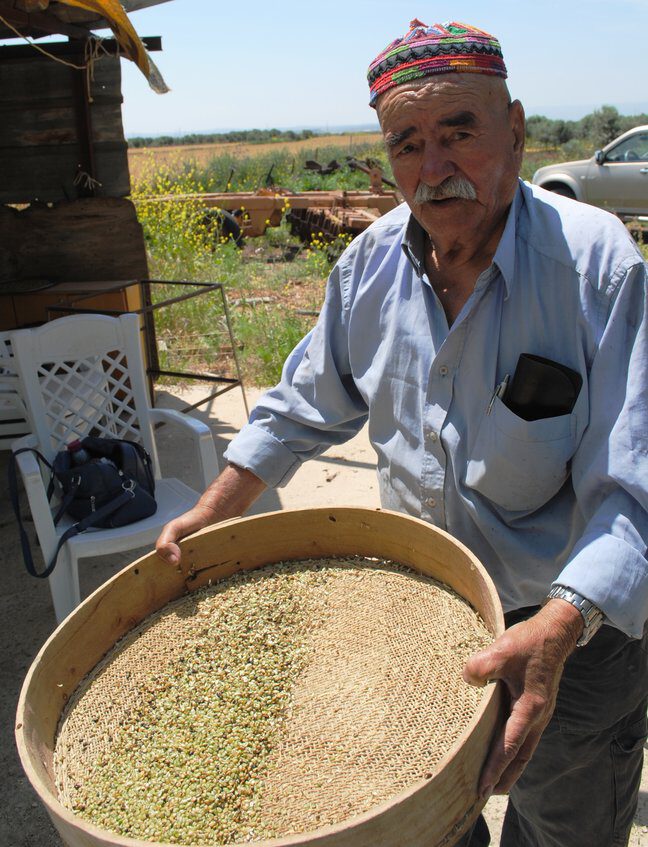

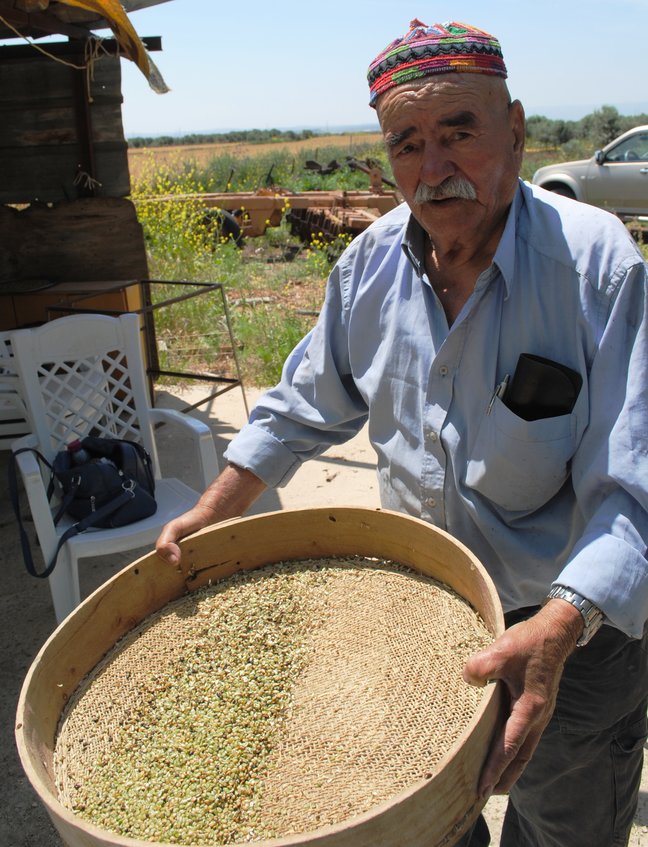
I stood in a golden wheat field some five miles north of Acre in Israel. Paul Nirens of the Galileat organization had arranged a demonstration with a local farmer, to show us how the Druze traditionally roast green wheat for freekeh.
To reach the field, we’d driven over a ditch of teeth-rattling bumpiness, part of the foundation for a railroad that will soon divide that field. Spring lingers in the cool Galilee. There was still enough green wheat to make freekeh worthwhile.
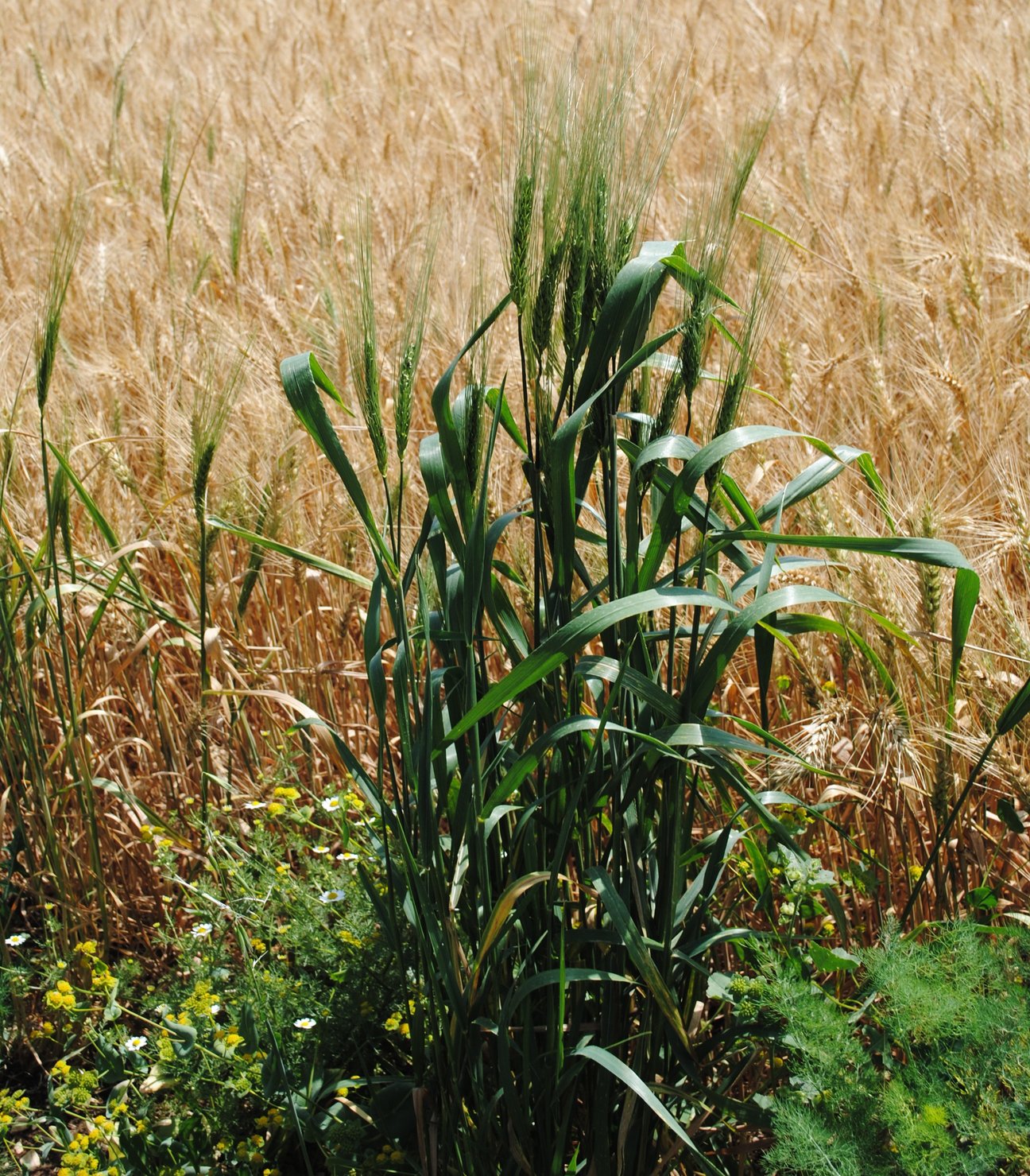
Golden oats, blue chicory and lacy green fennel made colorful spots among yellow mustard flowers in the verges of the field. A breeze rustled the swaying wheat. In the distance, a grove of olive trees completed the perfect picture of a small Druze farm.
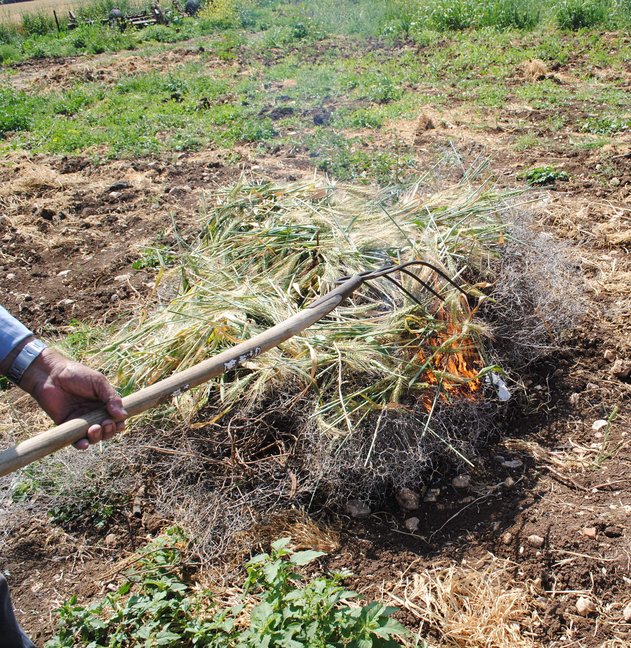
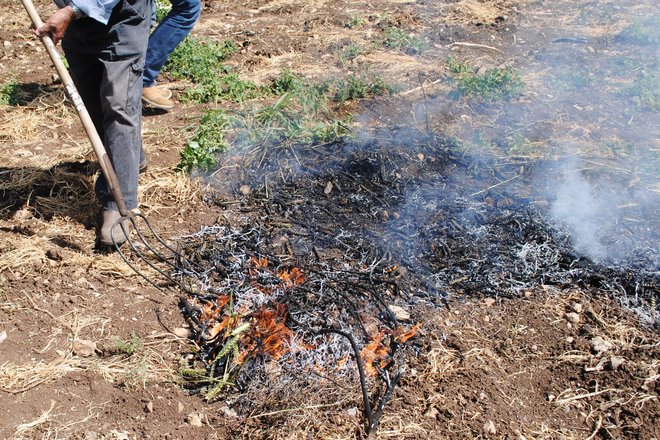
Salman Nijim Abu Heissam dragged a pitchfork full of dry thorns to a bare patch of earth, away from danger to the growing crops.
Thorns catch fire easily, make a high flame and plenty of smoke, but it burns out quickly. This is necessary to avoid burning the wheat past the point where it’s edible. It should come out of the fire only somewhat charred.
The green wheat had dried in the sun for several days. Heaping it on top of the thorns, Abu Heissam set it on fire with a cigarette lighter.
I was surprised to know that the Druze also roast green oats, just as they do wheat. “But oats yield less grain than wheat, so we plant less of them,” explained Abu Heissam.
The Druze take their wheat, whether roasted or fresh, to the mill to make – not flour, but bulgur. “Wheat is our basic food,” Abu Heissam said. “We Druze can’t exist without bulgur, and olive oil. Just as King Solomon’s throne was protected by a lion at the right and at the left, so we have bulgur and olive oil. Every Druze family stores enough olive oil and bulgur for two years.”
Make freekeh for the future
Some say that making freekeh is a way to guarantee that at least part of the crop is saved for the future. The fire drives out insects and field pests, and kills insect eggs too. The kernels’ high moisture content prevents them from burning, but the fire dries them. So they’re less likely to rot in long-term storage. According to chef and food historian Moshe Basson, this is how Joseph of the Bible kept seven year’s worth of wheat in good shape for the seven lean years to come after.
Abu Heissam explained that this small demonstration of how to make freekeh is just a sample of the real harvest. “About a month before the wheat matures, we harvest a determined percent of our crop with the combine harvester. Then we set the green wheat in the sun to dry for several days, and it shrinks. We light our bonfire with a gas torch. It’s a big family project, with everyone out in the field.”
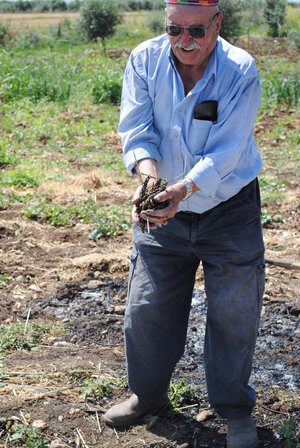
The freekeh fire burned down in a few minutes, leaving ashes and the charred wheat stalks.
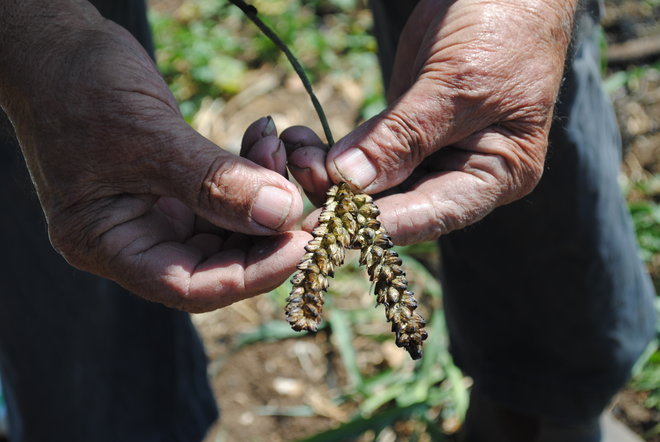
 The stalks cooled down quickly. We picked them out of the ashes with our bare hands and threw them onto a tarp.There were some stalks that had burnt through, and those we left on the ground. The good ones with future freekeh looked like this:
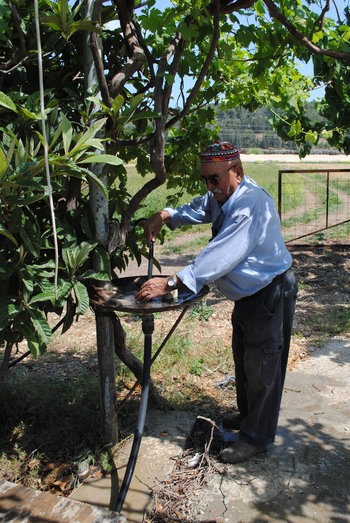
 We carried the tarp full of roasted wheat to a field shed where a mulberry and fig sycamore tree provided leafy beauty and more shade over a water point. Abu Heissam washes his hands with his own home-made soap made from olive oil.
In the shade there, Abu Heissam showed us that to become freekeh the wheat gets rubbed through a series of sieves, first the finest sieve and proceeding to the ones with coarser and coarser weaves.
I was surprised again, thinking that it would be the other way around, but understood when I saw how the straw and chaff separate from the kernels as they’re rubbed on the surface of the sieves.
“Freekeh” means “rubbed.” The English word “friction” comes from the Latin fricare, but I wonder if it goes back even further, to the Arabic freekeh. It was a pleasant thing to think of.
But the work of rubbing wheat stalks onto the harsh fabric of the sieves to make freekeh isn’t easy on the hands.
The farmer wore heavy gloves to work the stalks back and forth over the old hand-made sieves.
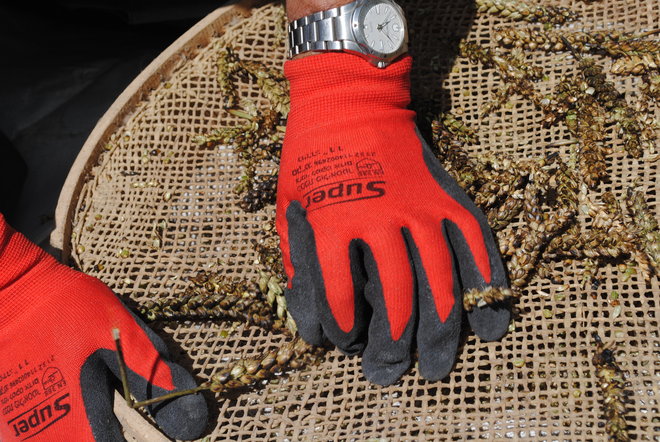 The freekeh kernels, freed from their stalks, fell through the sieve’s holes. We collected them and turned the sieve over to receive them from the deep side.
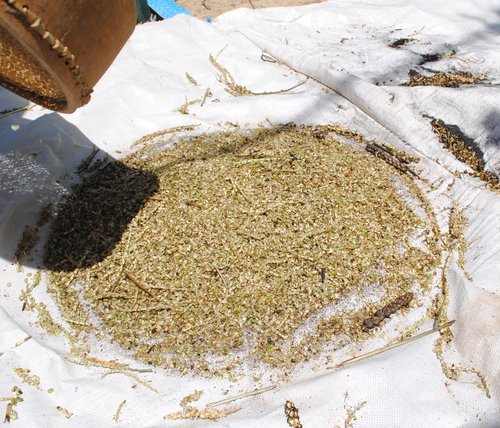 I ate some freekeh kernels. They were nutty and chewy, with the expected smoky flavor. The freekeh wheat’s sweetness came through a second later. The occasional charred kernel tasted like popcorn.
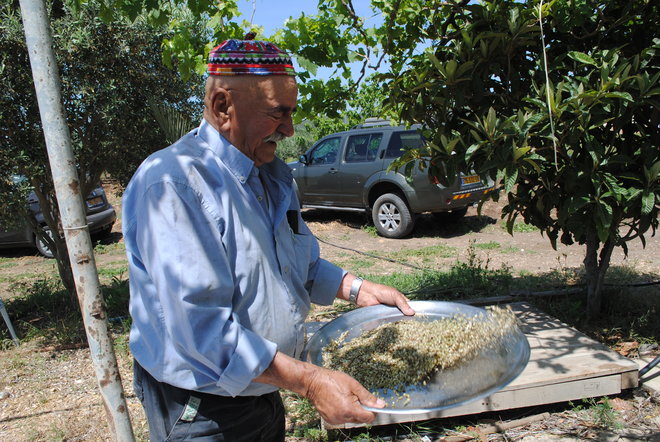
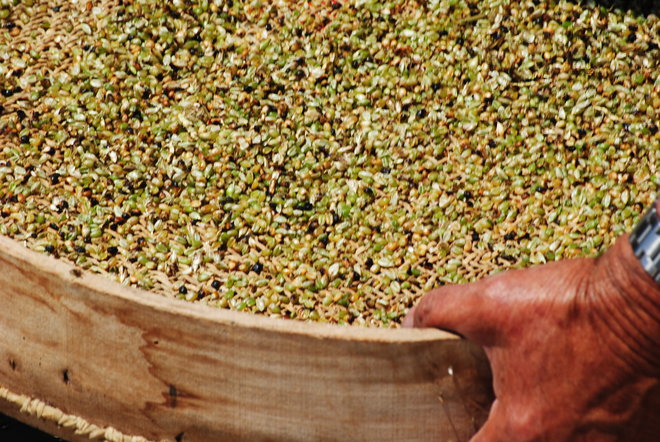 The next step was winnowing the freekeh kernels by moving them around a tray while standing downwind. The regular motion of wheat bouncing around made a rough sound, like fine gravel on the tray. It seemed to say, chaff, chaff, chaff.
“I’m not very good at this,” said Abu Heissam. “This is women’s work.”
But I thought he winnowed very well.
 The railroad works crosses Abu Heissam’s fields. It will cut off access to the fields from the highway, unless a bridge is built over it. The community has requested a bridge many times, but no one in the government has taken notice, not even the Druze MK. In the meantime, a neighboring farm has two bridges to allow their cows to cross its property. Abu Heissam also needs a second water point for irrigation, but the water company hasn’t responded to his requests.
 Just about now, or in a week, the farmer will walk to his field again and taste the ripe wheat to judge if it’s ready for harvest. He’ll sell most of it, but the small amount left for home use, his womenfolk will process for bulgur.
Abbu Heissam is an ex-army officer and besides Arabic speaks fluent Hebrew. Like most Druze men who have served in the Israeli army, he’s well versed in the various cultures of Israel, comfortable in the company of any well-meaning person. But his soul is rooted in the earth, which in the Druze religion is considered holy in and of itself.
“The Druze learned that an army career grants benefits and a pension,” he said. “But we don’t eat from that income. We eat from the money we make selling what we grow in our own fields.”
Need it be said that GMO doesn’t come near the fields of the Druze and their freekeh?
Why is freekeh uncool?
Freekeh, like many traditional Druze foods, is considered uncool by the younger generation. It’s sad, but the art and craft of freekeh is mostly in the hands of old folks these days. I hope that the young ones wake up to the beauty of the seasonal food traditions and love of the earth that their grandparents are keeping alive.
Read more from our archives on freekeh:
The ancient grain freekeh spurs boutique recipes
Freekeh recipes from around the world
More about Druze culture in the Galilee, Israel:
- Celebrating The Olive
- Foraged Wild Greens And Fatayer Turnovers
- Cherry Tomato Tabbuleh And Eating With The Druze In The Galilee
- Gamila, Druze Soapmaker
All photos by Miriam Kresh



It’s good to learn about this.
Thanks.