

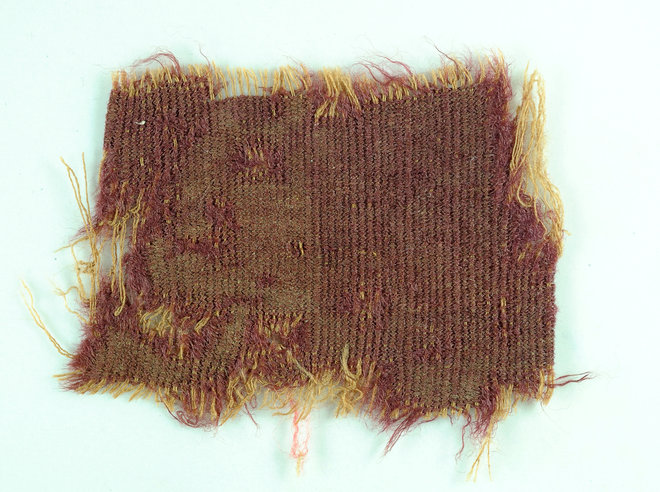
 See the images: These very rare textiles were found in the Wadi Murabba’at caves south of Qumran, where the Dead Sea Scrolls were discovered. Why is this ancient find so exciting for the Jews?
Ancient Jews had dyed their holy garments purple, crimson and indigo blue, the most prestigious clothes colors in ancient times – so prestigious that fabrics dyed those colors were as valuable as gold.
Read more about ancient dyes in our post about the holy blue techelet.
Some reds, purples and blues were processed out of plants, but the most brilliant, steadfast colors came from varieties of the marine Murex snail or the cochineal bug.
Until recently, only two fabric swatches from the Roman period had been positively identified as bearing Murex dye, out of thousands found in the Judean Desert, the Negev and the Arava. But research now proves that three other fabric pieces were dyed with ancient world’s most expensive colors. Read about another exciting discovery – 3000-year-old public water works in Jerusalem.
 One hundred and eighty specimens were analyzed with advanced instruments for identifying dyes (using HPLC). Most were dyed with plant extracts, but two, apparently parts of tunics, were double-dyed with Murex trunculus and the cochineal insect.
A third was first dyed, then exposed to sunlight in order to produce a deep blue. This is the same process used to make the sacred techelet color, which was lost for centuries and only recently re-discovered.The wool of this same blue piece was spun locally, while the purple and crimson have characteristic marks of imported wool.
An entire garment dyed this color would have been expensive indeed. To us, 2000 or even 3000 years later, the mere discovery of a piece of it, and confirmation of the dye, is exciting.
“The importance of this fabric is extremely significant as there are practically no parallels for it in the archaeological record,” stated Yoli Shwartz, Israel Antiquities Authority spokeswoman.

Na’amat Sukenik, of the Israel Antiquities Authority, conducted the research with Prof. Zohar Amar of the Dept. of the Land of Israel Studies and Archaeology, David Illuz of the Dept. of Life Sciences at Bar-Ilan University, and Orit Shamir, curator of organic materials at the Israel Antiquities Authority.
 Purple was the color with the highest status among the Greeks and Romans. There were times when only Caesars and their families wore purple and anyone who dared to wear the royal color was punished by law. Brilliant blues and crimsons also indicated status and wealth, and became so profitable that ancient rulers monopolized the manufacture of these colors.
The Murabba’at caves were the refuge of Jews resisting the Roman army during the time of the Bar-Kochba revolt, 132-136 A.D.. While it’s not certain, it might be that the fabrics found there belonged to some of them. Another theory is that Roman soldiers who occupied the caves after the Bar-Kochba revolt had bought some of the fabrics locally, or brought them from Italy.
Although I’m no scholar of antiquity, the first theory makes the most sense to me. How could a common soldier have afforded such expensive clothing, unless it was stolen or looted? Because surely army commanders wouldn’t have been living in the caves.
On the other hand, I can easily imagine a harried Jewish woman, about to cross the desert, hoping to survive in a cave with a crowd of other determined refugees, stuffing the best of her possessions – the things she couldn’t bear to part with – into bags. A beautiful tunic would have folded up easily and not taken much space in her luggage. It would have been a reminder of better times. It would have been the sign of her hope to wear it again, in freedom, someday.
More Archaeological Discoveries In Israel:
- King David’s Palace Discovered
- Mysterious Ancient Underwater Mound In Sea of Galilee
- Ancient Wine Press Uncovered
- New Stone Age Figurines For the Hunt in Jerusalem
Photographs by Clara Amit, courtesy of the Israel Antiquities Authority




[…] Fabrics dyed in those colors were so expensive and prestigious that only the very wealthy and aristocrats were allowed to wear them. They were a staple of the ancient world’s trade, like gold and silver. Read about discovered Roman-era dyed textiles here. […]
They used HPLC to determine the makeup of THAT piece of wool which is NOT the fringe of a prayer shawl. It is a leap to say that ALL sacred techelet was made from the same source. No ritual fringes have ever been found made with murex. It is an interesting find, but it without a link to the fringes, it does not shed much light on the mystery.
As stated, the Israel Antiquities Authority established that by means of advanced analysis instruments.
This article makes a huge leap from a single scrap of wool that may have been dyed with murex to “This is the same process used to make the sacred techelet color”.
Where is the proof of this statement?