

Guest writer Brian Blum is an owner of a Better Place car in Israel. Now faced with uncertainty as to how he can charge his car for long range drives, he says that Better Place failed because drivers bought a car, but really it’s more like a personal bus.
In September 2012, we received our new Renault Fluence ZE, the 100 percenr electric car from Better Place, the now bankrupt, former high-flying electric vehicle startup. Despite the uncertainties of what’s to come next for Better Place, we love our car.
As anyone who has driven one will tell you, it’s the best ride they’ve ever had; smooth, powerful, sophisticated, quiet. We will be devastated (although at this point, not entirely surprised) if the results of the current court-driven process of securing a buyer for the company ends up with it being sold for parts, thereby canceling any long-term solution for us to continue using the service and drive our car as we once did.
But it wasn’t exactly love at first sight. In fact, for the first few months we had the car, I would regularly rue our decision to go electric every time I had to pull into a swapping station because the range wasn’t quite enough for me to get home from wherever I was (for example to the airport and back). The extra 5 minutes from the highway to the station, 5 minutes for the swap (if there wasn’t someone waiting already in front of me), and 5 minutes back to the highway, was frustrating, even though I “knew” that in the big picture I was probably spending less time “filling up” than I would if I had a gas burning vehicle (since most of the time, with my electric car, I charge overnight and don’t drive beyond the range).
An even bigger frustration, though, was that, with an electric car, you have to meticulously plan out your route before you set out for the day. You need to know how much energy you’ll have when you get to your first destination, then your second, and where the swapping stations are in-between. Better Place makes this easy – the car’s OSCAR GPS system does all the calculations for you.
Still, it might entail taking a route different than the one you want – for example, there are no swap stations on Highway 443 that goes via Modi’in to Jerusalem, where we live, so we are forced to take the generally slower, more traffic-choked Highway 1. Similar issues and trade offs occur when going to the Galilee or to Eilat.
And sometimes, even planning doesn’t help – on several occasions when I was in Tel Aviv, I didn’t have enough battery left to add a spontaneous side trip to the Port – I needed to go straight to the nearest swapping station to ensure I didn’t get stuck.
So how did I learn to love the car in the end? After I realized that it’s not really a “car.” Rather, Better Place made a kind of “personal bus” system. Let me explain.
When you take the bus, you also need to plan out your route. You have to check schedules and maybe not go exactly the way you would if you were doing the same trip door to door in a car of your own. A Better Place electric car is more akin to that kind of transportation, except that it’s just you (and a few other passengers, perhaps) in your space.
This kind of thinking is antithetical to the whole idea of a car as the embodiment of the Great American Dream, exported around the world. A “car” is a mode of personal expression. You can go anywhere, anytime, however you like; just hit the open road and drive freely. Gas was cheap (when I was growing up in the U.S., at least) and you never worried much about where the next station would be.
A Better Place vehicle is not a “car” in that sense. It gets you from place to place but you have to plan and be ready to compromise. If you want to “just drive,” this isn’t the mode of transportation for you. Once I got my head around that, I stopped fighting and was able to appreciate all the benefits – from the car’s performance to its positive environmental and geo-political impact.
If you ask most people, though, their biggest concern about electric vehicles remains “range anxiety.” It’s, I suspect, the reason why Israelis – who love the freedom a car provides as much as Americans – never got on board big time and why only 1,000 or so Better Place cars were sold in the end. Swapping stations or not, Better Place is not really a “car” in the traditional sense of the term.
Will 100% electric cars ever be able to provide the Great American Dream? Yes, but we’re not there yet. Once it’s possible to drive several hundred kilometers on a single charge, then re-charge by plugging in (not swapping batteries) in 5 minutes or less, and when those plug-in recharging spots become ubiquitous, at malls, on the sides of roads, at home (of course), then the barriers will be breached and electric cars (whether they’re from Better Place or another manufacturer) will rapidly reach a tipping point.
Better Place made a lot of mistakes for sure – and its fate as of this writing is still not sealed – but the inherent problem of “car” vs. “personal bus” will be with us for some time to come.
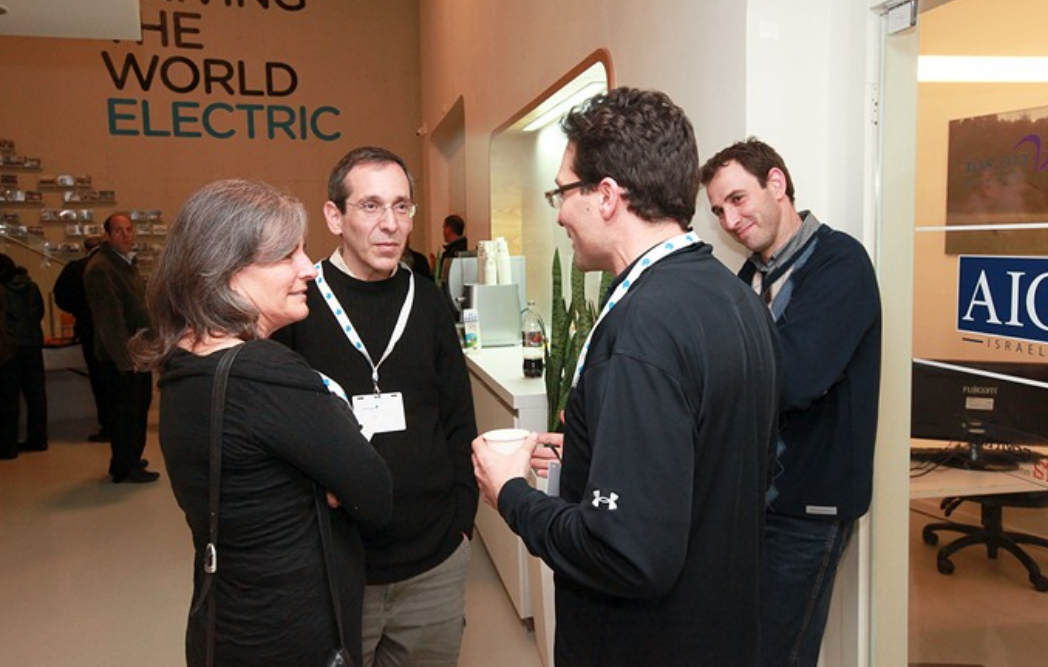
By Brian Blum; in above image Brian Blum is second from left



Now, if Tesla could separate the battery from the car, it could reduce the sticker price by $12,000 and sell “electric miles” like Better Place. It might even spin off a “Tesla Transport Support” service to supply batteries, charging, and swapping services to car owners.
Jerru,
This evening (PST), Tesla will be demoing their Model S battery pack swap technology. Let’s see what they’ve come up with. Maybe they will split off the battery from the car…
Here’s the link to tonight’s demo: http://t.co/3YJuE1kysW (We’ll probably see it tomorrow)
I am similarly very disappointed that Better Place was not successful.
However, I believe they were stymied by going with a traditional auto-maker who attempted to re-engineer a traditional oil-burning car into an electric car (and stealing most of the valuable trunk space for the battery).
This past week, I had the pleasure of test-driving the Tesla Model-S, a stunning automotive achievement and in my opinion, heralding the arrival of a real EV alternative, with much, much reduced range-anxiety.
In addition to voluminous trunk space (back AND front!), it has up to a 300 mile range, can recharge to half-capacity in 30mins, and tonight, Tesla are demonstrating Battery Swap for this vehicle! What form the battery swap will take – I’m not sure yet, but it sounds promising.
Tesla just raised their 2013 production target from 20,000 units to 21,000.
Impressive.
I agree with the bus observation.
There are other problems with this car also, first and foremost, the fear that betterplace will not live to see another day, and you’ll be stuck with a personal petunia.
As a person who anxiously waited for the car to be become available to the public, can generally afford it, but ended up not buying it, I can tell you why Israelis (at least one of them) didn’t buy this car: company greed.
The car is great, the vision was grand, and the execution was impressive. They ended up with a really nice piece of machinery. However, the major problem was that betterplace wanted their prospective customers to take all the risks with them, while paying the full price of a normal sedane. For the same price as you might pay for a Gasoline operated Renault Fluence, you will get a “personal bus” that may or may not work reliably (no history to rely on), that you may or may not be able to sell as a second hand vehicle later on (I admit I didn’t even foresee bankruptcy as an option this early in the game. What they did to their customers is outrageous). For the normal middle-class person, this is a risk that is irresponsible to take around the family car, while paying a full price for it.
At the end of the day, this is why most people didn’t take the risk and buy this car. Unfortunately, it is also the reason why not very many cars were sold, and the company went bankrupt. Greed is a powerful thing.
I agree. When the company first launched its vision Shai was selling the promise that they would cost less, much less, and that users basically would pay for miles driven, not the car itself. He sold the current cell phone model: sign up for a plan, talk as much as you want, pay for the minutes, but get the device for free. That was exciting. To ask the public to take on a financial risk with the company: idiotic.
Ha! I thought I was the only one who noticed the dissonance between Shai’s original presentation of the idea and the actual pricing…
Nope. I was covering the Better Place news since day one.
[…] a guest post today on Green Prophet, a Middle East green website, Blum […]
Other features of the Better Place solution that do not much press are: 1) the possibility of battery switching for flat format batteries as well as the Fluence ZE vertical format batteries, by altering the robotics software parameters and 2) the possibility of replacing a battery with a new, improved one as these become available. The latter, I liken to one of those intravenous medical devices that is is worn by some hospital patients and enables the introduction of anesthesia and nutrition by just plugging in. Too bad Better Place will not have a chance to test out these features.