Israeli Teens Bottle Algae in “Algeed” Superfood Project for a Hungry Africa

israel teens bottle algae algeed

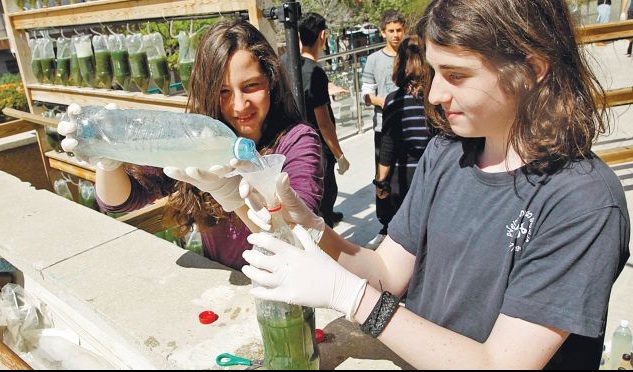
Liquid algae may taste like sushi which is unknown in poor parts of Africa, but it is easy to grow with basic equipment like old plastic bottles, and it is packed full of protein – a veritable superfood. Just ask the Japanese who consume algae and algae derivatives as a way of life. Now, kids from an Israeli highschool are perfecting an algae growing system started in Kibbutz Ein Shemer (and which we reported on here) so that algae farms can made in communities in Africa to wipe out malnutrition in areas where desertification claims land and livestock. The local Israeli newspaper Haaretz reports that the project will be multiplied by ten and replicated at Jewish and Arab highschools in the region.

According to Haaretz pupils at the Herzliya Hebrew Gymnasium are working on a growth system for Spirulina, an algae that’s been dubbed the “superfood” because it contains 70% protein.

Algae isn’t filling the stomach, but at least it’s nutritious, say the students growing the algae medium in old plastic soda bottles (see more on the original algae project here). Aerating the mixture with a bubbler, it prevents the need for them to take the bottles home and shake them by hand – as algae needs ample sunlight, and carbon dioxide to grow.

The kids’ project is so promising that UNESCO, Rotary International, and international education organizations and dozens of African schools are interested to know more about how it’s done.

The pupils are working on a system so that it can be done in areas in Africa where food is scarce. The algae, which is a plant-based micro-organism, and the slime you find on the inside of your swimming pool, could potentially feed millions of people. (This article here suggests that eating algae is what has made Homo sapiens human).

To grow the project the kids have set up an NGO called Algeed. Soon they will replicate the project in other schools and within a year hope to take their bottles and bubblers to the world market.


Image from the Kibbutz Ein Shemer algae project

Overseers include Boris Zlotnikov who has a Spirulina farm in the Negev and Yaron Yehoshua, who is the founder of the Algae Biotechnology Center at Bar-Ilan University. Both volunteer to help out the kids.

“We still have a series of experiments in front of us: Temperature differences, different concentrations of the food that’s the basis for the algae, [amounts of] light and different growing methods − in plastic bags, for instance,” Yehoshua says.

At the end of the process, he says, “We’ll reach the optimal growing conditions and build a model that will increase the protein concentration in the algae.”

Israel has a pile of algae companies that are trying to grow the green stuff as a biofuel stock and for the nutraceutical and fish farming market. I’ve personally interviewed most of them (like Isaac Berzin), including leaders at research universities. If a little more professional guidance and investment is put into this project it could very well change the face of hunger.

::Haaretz (subscription may be required to access article)

Karin Kloosterman
Karin Kloostermanhttp://www.greenprophet.com
Karin Kloosterman is an award-winning journalist, innovation strategist, and founder of Green Prophet, one of the Middle East’s pioneering sustainability platforms. She has ranked in the Top 10 of Verizon innovation competitions, participated in NASA-linked challenges, and spoken worldwide on climate, food security, and future resilience. With an IoT technology patent, features in Canada’s National Post, and leadership inside teams building next-generation agricultural and planetary systems — including Mars-farming concepts — Karin operates at the intersection of storytelling, science, and systems change. She doesn’t report on the future – she helps design it. Reach out directly to [email protected]
1 COMMENT
  1. Now that the most extreme forms of descrimination have been mostly ended, the only reason there are hungry people anywhere on Earth is because there are too many, and that too can be ended with family planning education in which every woman is given the legally protected right to decide if and when to conceive and birth her children. Given that freedom the vast majority would choose to birth no more than 1, 2 or 3, in which case there would be plenty of food and other resources for everyone around the World.

Comments are closed.

TRENDING

Earth building with Dead Sea salt bricks

Researchers develop a brick made largely from recycled Dead Sea salt—offering a potential alternative to carbon-intensive cement.

Farm To Table Israel Connects People To The Land

Farm To Table Israel is transforming the traditional dining experience into a hands-on journey.

Remilk makes cloned milk so cows don’t need to suffer and it’s hormone-free

This week, Israel’s precision-fermentation milk from Remilk is finally appearing on supermarket shelves. Staff members have been posting photos in Hebrew, smiling, tasting, and clearly enjoying the moment — not because it’s science fiction, but because it tastes like the real thing.

An Army of Healers Wins the 2025 IIE Goldberg Prize for Peace in the Middle East

In a region more accustomed to headlines of loss than of listening, the Institute of International Education (IIE) has chosen to honor something quietly radical: healing. The 2025 Victor J. Goldberg Prize for Peace in the Middle East has been awarded to Nitsan Joy Gordon and Jawdat Lajon Kasab, the co-founders of the Army of Healers, for building spaces where Israelis and Palestinians — Jews, Muslims, Christians, Druze, and Bedouins — can grieve, speak, and rebuild trust together.

Peace hospital opens between Jordan and Israel

The proposed medical centre, described by Emek HaMaayanot Regional Council head Itamar Matiash as “a centre for cancer treatment, so that people from Jordan or further away could come and receive treatment,” would become the flagship of a wider cluster of medical, academic and innovation-based services planned for the Israeli half of the zone.

Turning Your Energy Consultancy into an LLC: 4 Legal Steps for Founders in Texas

If you are starting a renewable energy business in Texas, learn how to start an LLC by the books.

Tracking the Impacts of a Hydroelectric Dam Along the Tigris River

For the next two months, I'll be taking a break from my usual Green Prophet posts to report on a transnational environmental issue: the Ilısu Dam currently under construction in Turkey, and the ways it will transform life along the Tigris River.

6 Payment Processors With the Fastest Onboarding for SMBs

Get your SMB up and running fast with these 6 payment processors. Compare the quickest onboarding options to start accepting customer payments without delay.

Qatar’s climate hypocrisy rides the London Underground

Qatar remains a master of doublethink—burning gas by the megaton while selling “sustainability” to a world desperate for clean air. Wake up from your slumber people.

How Quality of Hire Shapes Modern Recruitment

A 2024 survey by Deloitte found that 76% of talent leaders now consider long-term retention and workforce contribution among their most important hiring success metrics—far surpassing time-to-fill or cost-per-hire. As the expectations for new hires deepen, companies must also confront the inherent challenges in redefining and accurately measuring hiring quality.

8 Team-Building Exercises to Start the Week Off 

Team building to change the world! The best renewable energy companies are ones that function.

Thank you, LinkedIn — and what your Jobs on the Rise report means for sustainable careers

While “green jobs” aren’t always labeled as such, many of the fastest-growing roles are directly enabling the energy transition, climate resilience, and lower-carbon systems: Number one on their list is Artificial Intelligence engineers. But what does that mean? Vibe coding Claude? 

Somali pirates steal oil tankers

The pirates often stage their heists out of Somalia, a lawless country, with a weak central government that is grappling with a violent Islamist insurgency. Using speedboats that swarm the targets, the machine-gun-toting pirates take control of merchant ships and then hold the vessels, crew and cargo for ransom.

Related Articles

Popular Categories