Egypt’s Pyramid Builders Succumbed to Climate Change

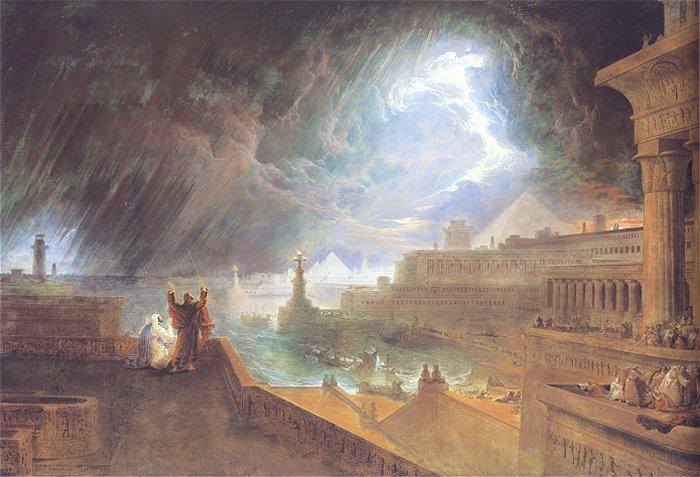
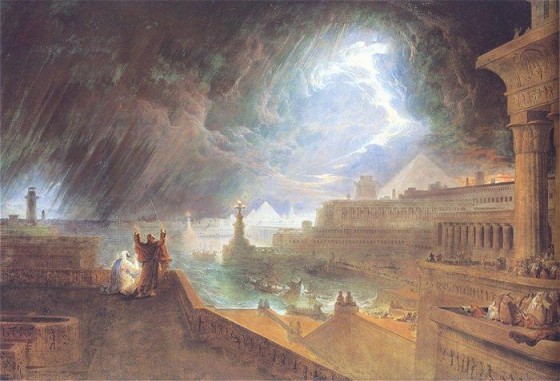
Martin_John_The_Seventh_Plague_1823

Pollen and ash in Nile river delta sediment provides evidence of ancient climactic events including mega-droughts and wildfires which wiped out pyramid-building civilizations, says a study published in the recent July 2012 edition of Geology.

They waited seventy days for her to reappear. Finally she came. For a moment just before sunrise, the bright star Sirius, daughter of Ra, shimmered over the pyramids of Cairo. For generations she had always appeared as a sign that the Nile would soon flood, bringing water, fertile sediment and life to the people of Egypt. But one year her promise of sustenance failed.  Something happened around the year 2200 BCE.  Perhaps the snow melt from the highlands of Ethiopia never arrived. Or the infrequent rains stopped coming altogether.

Whatever the cause, a once-great river became mud.  Parts of its fertile delta turned to dust. Then the fires came. They swept through the valley destroying homes, trees and crops. The people who had built the great pyramids were powerless against the climate change which led to a global drought 4200 years ago. Egypt’s pyramid-building Old Kingdom met its demise. Was climate change to blame?
sandstorm_pyramid The study entitled Nile delta response to Holocene climate variability,was authored by Christopher Bernhard of the US Geological survey (USGS), Benjamin Horto of the University of Pennsylvania, and Jean-Daniel Stanley of the Smithsonian Institution.

These researchers found that during various times throughout history, the proportion of wetland pollens in Nile Delta sediment decreased and the proportion of charcoal ash increased.

The sediment layer suggested that climate change caused severe drought conditions 3000, 4200, 5000 and 6000 years ago. Some of these drought sediment layers correspond with human records of severe droughts and the collapse of civilizations.

The Uruk Kingdom in modern Iraq collapsed about 5000 years ago. The drought 3000 years ago is associated with the fall of the Ugarit Kingdom and famines in the Babylonian and Syrian Kingdoms. The drought 4200 years ago corresponds with the end of the Old Kingdom, the pyramid builders of Egypt.

In a USGS press release, Christopher Bernhardt said, “Humans have a long history of having to deal with climate change. Along with other research, this study geologically reveals that the evolution of societies is sometimes tied to climate variability at all scales – whether decadal or millennial.”

Benjamin Horton added that, “The study geologically demonstrates that when deciphering past climates, pollen and other micro-organisms, such as charcoal, can augment or verify written or archaeological records – or they can serve as the record itself if other information doesn’t exist or is not continuous.”

Sudan, Djibouti, Eritrea, Somalia, Ethiopia, Kenya, Syria, the UK, the US and northeastern Brazil  have all faced droughts this year. Blogs around the world are writing about it.

Australia faced a series of severe droughts and wildfires just in the last few years.  Most of the Middle East and North Africa live precariously with scarcely enough water during a normal year, much less a drought. Much has changed over the past 6000 years, but when a drought hits and wildfires rage, we can imagine how such events might have ended civilizations.

Public domain image of The Seventh Plague (Old testament bible story, “plague of hail and fire”, Exodus 9:13-35.) by John Martin via Wikimedia.

Photo of sandstorm over Egyptian pyramids via Shutterstock

Brian Nitz
Brian Nitzhttp://www.greenprophet.com
Brian remembers when a single tear dredged up a nation's guilt. The tear belonged to an Italian-American actor known as Iron-Eyes Cody, the guilt was displaced from centuries of Native American mistreatment and redirected into a new environmental awareness. A 10-year-old Brian wondered, 'What are they... No, what are we doing to this country?' From a family of engineers, farmers and tinkerers Brian's father was a physics teacher. He remembers the day his father drove up to watch a coal power plant's new scrubbers turn smoke from dirty grey-back to steamy white. Surely technology would solve every problem. But then he noticed that breathing was difficult when the wind blew a certain way. While sailing, he often saw a yellow-brown line on the horizon. The stars were beginning to disappear. Gas mileage peaked when Reagan was still president. Solar panels installed in the 1970s were torn from roofs as they were no longer cost-effective to maintain. Racism, public policy and low oil prices transformed suburban life and cities began to sprawl out and absorb farmland. Brian only began to understand the root causes of "doughnut cities" when he moved to Ireland in 2001 and watched history repeat itself. Brian doesn't think environmentalism is 'rocket science', but understanding how to apply it within a society requires wisdom and education. In his travels through Europe, North America, Asia and the Middle East, Brian has learned that great ideas come from everywhere and that sharing mistakes is just as important as sharing ideas.
2 COMMENTS

LEAVE A REPLY

Please enter your comment!
Please enter your name here

TRENDING

Earth building with Dead Sea salt bricks

Researchers develop a brick made largely from recycled Dead Sea salt—offering a potential alternative to carbon-intensive cement.

Farm To Table Israel Connects People To The Land

Farm To Table Israel is transforming the traditional dining experience into a hands-on journey.

Huge Fish Nursery Discovered Under Freezing Arctic Seas

In 2019, an underwater robot camera exploring the seabed...

Remilk makes cloned milk so cows don’t need to suffer and it’s hormone-free

This week, Israel’s precision-fermentation milk from Remilk is finally appearing on supermarket shelves. Staff members have been posting photos in Hebrew, smiling, tasting, and clearly enjoying the moment — not because it’s science fiction, but because it tastes like the real thing.

An Army of Healers Wins the 2025 IIE Goldberg Prize for Peace in the Middle East

In a region more accustomed to headlines of loss than of listening, the Institute of International Education (IIE) has chosen to honor something quietly radical: healing. The 2025 Victor J. Goldberg Prize for Peace in the Middle East has been awarded to Nitsan Joy Gordon and Jawdat Lajon Kasab, the co-founders of the Army of Healers, for building spaces where Israelis and Palestinians — Jews, Muslims, Christians, Druze, and Bedouins — can grieve, speak, and rebuild trust together.

Qatar’s climate hypocrisy rides the London Underground

Qatar remains a master of doublethink—burning gas by the megaton while selling “sustainability” to a world desperate for clean air. Wake up from your slumber people.

How Quality of Hire Shapes Modern Recruitment

A 2024 survey by Deloitte found that 76% of talent leaders now consider long-term retention and workforce contribution among their most important hiring success metrics—far surpassing time-to-fill or cost-per-hire. As the expectations for new hires deepen, companies must also confront the inherent challenges in redefining and accurately measuring hiring quality.

8 Team-Building Exercises to Start the Week Off 

Team building to change the world! The best renewable energy companies are ones that function.

Thank you, LinkedIn — and what your Jobs on the Rise report means for sustainable careers

While “green jobs” aren’t always labeled as such, many of the fastest-growing roles are directly enabling the energy transition, climate resilience, and lower-carbon systems: Number one on their list is Artificial Intelligence engineers. But what does that mean? Vibe coding Claude? 

Somali pirates steal oil tankers

The pirates often stage their heists out of Somalia, a lawless country, with a weak central government that is grappling with a violent Islamist insurgency. Using speedboats that swarm the targets, the machine-gun-toting pirates take control of merchant ships and then hold the vessels, crew and cargo for ransom.

Leopoldo Alejandro Betancourt López Turned Ocean Plastic Into Profitable Sunglasses

Few fashion accessories carry the environmental burden of sunglasses. Most frames are constructed from petroleum-based plastics and acrylic polymers that linger in landfills for centuries, shedding microplastics into soil and waterways long after they've been discarded. Leopoldo Alejandro Betancourt López, president of the Spanish eyewear brand Hawkers, saw this problem differently than most industry executives.

Why Dr. Tony Jacob Sees Texas Business Egos as Warning Signs

Everything's bigger in Texas. Except business egos.  Dr. Tony Jacob figured...

Israel and America Sign Renewable Energy Cooperation Deal

Other announcements made at the conference include the Timna Renewable Energy Park, which will be a center for R&D, and the AORA Solar Thermal Module at Kibbutz Samar, the world's first commercial hybrid solar gas-turbine power plant that is already nearing completion. Solel Solar Systems announced it was beginning construction of a 50 MW solar field in Lebrija, Spain, and Brightsource Energy made a pre-conference announcement that it had inked the world's largest solar deal to date with Southern California Edison (SCE).

Related Articles

Popular Categories