
Dancing With Hayatuna’s Creativity in Amman, Jordan

dance amman jordan kidsSwedish NGO uses Hayatuna – creative arts to provide new perspectives to kids in the Middle East

As a Dance and Anthropology double major and an Arabic minor at Montclair State University, my interests slip right into the mission of Spiritus Mundi, a Swedish NGO that sees the arts as forces in social change and whose chief operations are in the Middle East.

Hayatuna, or “Our Lives” in Arabic, is the name of a project that was launched by the organization this summer in Amman, Jordan and is set to be initiated next in Cairo, Egypt.

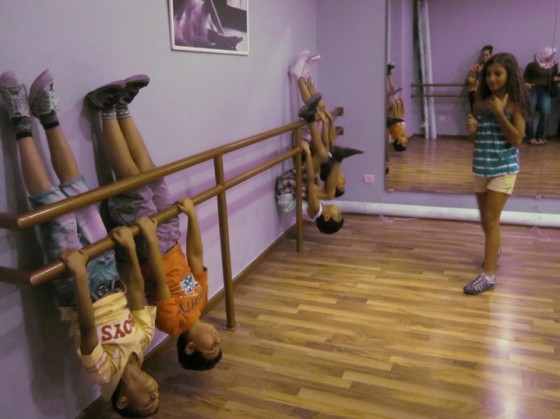
Dancing, singing, and songwriting workshops were held several times per week for children from local orphanages at Freeway Dance Studios and Stardust Academy, to expose them to the performing arts and to build their confidence. During my internship with Spiritus Mundi, I helped to facilitate those workshops.

I mainly participated alongside the students, giving the occasional nod of encouragement or gentle reprimand when due.

But when the regular dance pedagogue, Jordanian-Ukrainian Maxeem Ayyad, couldn’t make it to class, I stepped in to teach two hour-long dance classes to children ages 7 to 10.

In preparation for the class, I memorized directional Arabic phrases which I thought might come in handy, Stand Up, Sit Down, Look at me, and Listen among them.

Although I did use these phrases and a translator was also provided for the rest, verbal communication was limited.

Still, I managed to lead an activity in which the children themselves created a short dance combination: I sought their input by asking them to demonstrate movement that depicted their favorite sports, and then I helped them to turn that movement into choreography by setting it against sets of eight-count musical phrases.

They were empowered in knowing that they were artists who could contribute in the collaborative creative process for dance, and ultimately, that they were being recognized for their talent and creativity rather than their life circumstances.

If teachers only told students what to do, then there would be no sign of value placed on students’ imagination or intuition.

Teachers and students are both producers and consumers of knowledge; knowledge flows in both directions.

In a greater context, this principle can aid in the sustainability of the Hayatuna – a feeling of empowerment and ownership on the part of the beneficiaries will render the project desirable and worthwhile.

Kelly Milone
Kelly Milonehttp://www.greenprophet.com
Kelly Milone holds an MA in cultural heritage management (Johns Hopkins University), BA in anthropology, BFA in dance and Arabic minor (Montclair State University). She is a dance teacher and choreographer, quick-study interior designer, and aspiring creative and travel writer.

TRENDING

The Next New Cosmetic: Human Fat Known as Alloclae

In this Ozempic age, a person may diet themselves...

What are AWG air-water generators, and why they aren’t a golden-bullet solution (yet)

Atmospheric water generators (AWGs) sound like magic: machines that can pull drinking water out of air. The idea is mentioned in the Bible, where the elders would pray for water collected as dew on plants and the catch on turning this into a machine is in the physics. To turn invisible vapor into liquid, you must remove heat, especially the latent heat of condensation.

Jordan’s $6 Billion Aqaba–Amman Desalination Project from the Red Sea Moves Forward

In 2025, the Jordanian government signed agreements with a consortium led by Meridiam and SUEZ, alongside VINCI Construction and Orascom Construction. Under a 30-year concession agreement, the consortium will design, build, finance, operate, and maintain the system before transferring it back to the Jordanian government. The total investment is estimated at approximately $6 billion USD.

Earth building with Dead Sea salt bricks

Researchers develop a brick made largely from recycled Dead Sea salt—offering a potential alternative to carbon-intensive cement.

Why Health Systems Are Reaching a Turning Point

Health emerges from a continuous energy and material flow from water through food to human physiology. Technical energy systems support this cycle through water treatment, agriculture, and infrastructure.

Should You Invest in the Private Market?

startustartup Unlike public stock exchanges, which offer daily trading, strict...

How to build a 100-year-company

Kongō Gumi is a Japanese construction company, purportedly founded in 578 A.D., making it the world's oldest documented company. What can we learn about building sustainable businesses from them?

From Pilot Plant to Global Stage: How Aduro Clean Technologies’ 2026 Expansion Signals a Turning Point for Chemical Recycling Investors Like Yazan Al Homsi

The company's Next Generation Process (NGP) Pilot Plant in London, Ontario, has officially moved into initial operating campaigns, generating the kind of structured, repeatable data that separates laboratory promise from commercial viability.

How AI Helps SaaS Companies Reduce Repetitive Customer Support Work

SaaS products are designed for large numbers of users with different levels of experience, and also in renewable energy.

Pulling Water from the Air

Faced with water shortage in Amman, Laurie digs up...

Turning Your Energy Consultancy into an LLC: 4 Legal Steps for Founders in Texas

If you are starting a renewable energy business in Texas, learn how to start an LLC by the books.

Tracking the Impacts of a Hydroelectric Dam Along the Tigris River

For the next two months, I'll be taking a break from my usual Green Prophet posts to report on a transnational environmental issue: the Ilısu Dam currently under construction in Turkey, and the ways it will transform life along the Tigris River.

6 Payment Processors With the Fastest Onboarding for SMBs

Get your SMB up and running fast with these 6 payment processors. Compare the quickest onboarding options to start accepting customer payments without delay.

Related Articles

Popular Categories