EcoBasalt’s Volcanic Rock Fabric to Clean Oil Spills

lizard on volcanic rock
Volcanic basalt is a rock which can be turned into oil-absorbent fibers.

A company named EcoBasalt was founded in Israel in February of 2012.  Its founders are leveraging Russian space technology to create a new product for cleaning up oil spills.  Their product is named SB-1 and is based on the absorbent properties of basalt.  Basalt is a common kind of dark volcanic rock which has been used in everything from the floors of Egyptian pyramids to the insulation of Soyuz spacecraft and now it might help us clean up oil spills.
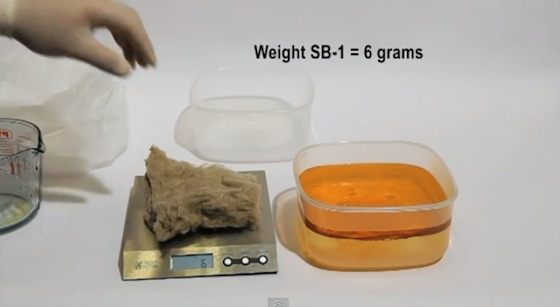
ecobasalt fabric before sucking up oilEcobasalt fabric before sucking up oil

More than 70,000 barrels of oil are produced every day and all of it must be transported to the consumers.  We hear about the spectacularly large oil spills which occur at the well-head or aboard supertankers, but given the amount of oil produced and consumed every day, spills along the entire supply chain are inevitable.  Therefore, oil spill containment is an important problem to solve.
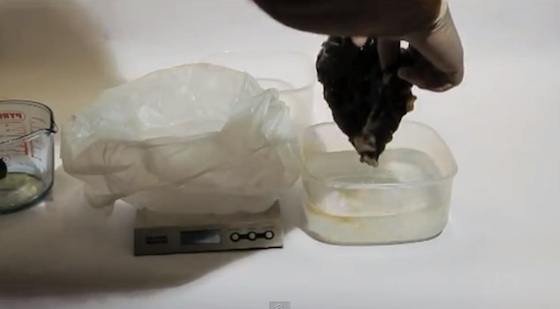
ecobasalt fabric
Ecobasalt after sucking up oil 

In the case of BP’s Deepwater Horizon oil spill and Egypt’s Jebel al-Zayt oil spill, chemical dispersants worked quickly to sweep some of the long-term problems beneath the waves where they won’t effect this quarter’s stock prices, but the cosmetic application of millions of gallons of toxic dispersants may cause more long-term damage than the oil-spill they were intended to cure.

[youtube]http://www.youtube.com/watch?v=eGGkWIIreCA[/youtube]

Clay, sand, oil-based synthetics and even human hair can be used to absorb oil spills, but EcoBasalt’s SB-1 basalt fibers have some advantages.  EcoBasalt’s tests show that one gram of SB-1 can absorb up to 72 grams of oil, at least twice as much as typical carbon-based absorbants and it can do it faster.

SB-1 is a non-toxic, natural, fire, alkali and acid-resistant substance, so it is possible to burn absorbed oil without extracting it from the basalt.  Extraction is also possible by simply compressing the SB-1 and as a third alternative, SB-1 can be mixed with asphalt and used in road construction

Robert Barzelay, the CEO of EcoBasalt tells Green Prophet that the product has not yet been tested on oil spills.

He says: “We have developed an oil sorbent made of basalt fibers. It has been a result of decades of R&D, and years of testing. It has been tested and proven (by independent labs in the USA and Israel) to perform far better than anything else on the market. Plus it is non-toxic, constitutes no health hazards, is ecofriendly, and the removed oil, can be recuperated from the sorbent, whereafter the sorbent can be recycled in asphalt for roads.

“There is nothing like it on the market.”

“At the moment we are at the stage to design oil sorbent booms with our basalt fiber sorbent material. In addition, we are in the process of setting up our own production lines. Once the end-product (oil boom) has been developed and produced, it will be tested by OHMSETT in the USA, and by (at least) ten oil and gas companies and so-called oil spill responders, companies and organizations that contain oil spills and do the cleanup.”

::EcoBasalt

Image of lizard on volcanic rock from Shutterstock

Brian Nitz
Brian Nitzhttp://www.greenprophet.com
Brian remembers when a single tear dredged up a nation's guilt. The tear belonged to an Italian-American actor known as Iron-Eyes Cody, the guilt was displaced from centuries of Native American mistreatment and redirected into a new environmental awareness. A 10-year-old Brian wondered, 'What are they... No, what are we doing to this country?' From a family of engineers, farmers and tinkerers Brian's father was a physics teacher. He remembers the day his father drove up to watch a coal power plant's new scrubbers turn smoke from dirty grey-back to steamy white. Surely technology would solve every problem. But then he noticed that breathing was difficult when the wind blew a certain way. While sailing, he often saw a yellow-brown line on the horizon. The stars were beginning to disappear. Gas mileage peaked when Reagan was still president. Solar panels installed in the 1970s were torn from roofs as they were no longer cost-effective to maintain. Racism, public policy and low oil prices transformed suburban life and cities began to sprawl out and absorb farmland. Brian only began to understand the root causes of "doughnut cities" when he moved to Ireland in 2001 and watched history repeat itself. Brian doesn't think environmentalism is 'rocket science', but understanding how to apply it within a society requires wisdom and education. In his travels through Europe, North America, Asia and the Middle East, Brian has learned that great ideas come from everywhere and that sharing mistakes is just as important as sharing ideas.

LEAVE A REPLY

Please enter your comment!
Please enter your name here

TRENDING

Earth building with Dead Sea salt bricks

Researchers develop a brick made largely from recycled Dead Sea salt—offering a potential alternative to carbon-intensive cement.

Farm To Table Israel Connects People To The Land

Farm To Table Israel is transforming the traditional dining experience into a hands-on journey.

Remilk makes cloned milk so cows don’t need to suffer and it’s hormone-free

This week, Israel’s precision-fermentation milk from Remilk is finally appearing on supermarket shelves. Staff members have been posting photos in Hebrew, smiling, tasting, and clearly enjoying the moment — not because it’s science fiction, but because it tastes like the real thing.

An Army of Healers Wins the 2025 IIE Goldberg Prize for Peace in the Middle East

In a region more accustomed to headlines of loss than of listening, the Institute of International Education (IIE) has chosen to honor something quietly radical: healing. The 2025 Victor J. Goldberg Prize for Peace in the Middle East has been awarded to Nitsan Joy Gordon and Jawdat Lajon Kasab, the co-founders of the Army of Healers, for building spaces where Israelis and Palestinians — Jews, Muslims, Christians, Druze, and Bedouins — can grieve, speak, and rebuild trust together.

Ethiopians are Looking to Somaliland for Red Sea Access as Global Powers Move In

Somaliland, for its part, has operated as a de facto independent state since 1991. It has its own government, elections, currency, and security forces. It’s often described as one of the more stable and democratic political systems in the region, despite never being formally recognized internationally. 

Qatar’s climate hypocrisy rides the London Underground

Qatar remains a master of doublethink—burning gas by the megaton while selling “sustainability” to a world desperate for clean air. Wake up from your slumber people.

How Quality of Hire Shapes Modern Recruitment

A 2024 survey by Deloitte found that 76% of talent leaders now consider long-term retention and workforce contribution among their most important hiring success metrics—far surpassing time-to-fill or cost-per-hire. As the expectations for new hires deepen, companies must also confront the inherent challenges in redefining and accurately measuring hiring quality.

8 Team-Building Exercises to Start the Week Off 

Team building to change the world! The best renewable energy companies are ones that function.

Thank you, LinkedIn — and what your Jobs on the Rise report means for sustainable careers

While “green jobs” aren’t always labeled as such, many of the fastest-growing roles are directly enabling the energy transition, climate resilience, and lower-carbon systems: Number one on their list is Artificial Intelligence engineers. But what does that mean? Vibe coding Claude? 

Somali pirates steal oil tankers

The pirates often stage their heists out of Somalia, a lawless country, with a weak central government that is grappling with a violent Islamist insurgency. Using speedboats that swarm the targets, the machine-gun-toting pirates take control of merchant ships and then hold the vessels, crew and cargo for ransom.

Leopoldo Alejandro Betancourt López Turned Ocean Plastic Into Profitable Sunglasses

Few fashion accessories carry the environmental burden of sunglasses. Most frames are constructed from petroleum-based plastics and acrylic polymers that linger in landfills for centuries, shedding microplastics into soil and waterways long after they've been discarded. Leopoldo Alejandro Betancourt López, president of the Spanish eyewear brand Hawkers, saw this problem differently than most industry executives.

Why Dr. Tony Jacob Sees Texas Business Egos as Warning Signs

Everything's bigger in Texas. Except business egos.  Dr. Tony Jacob figured...

Israel and America Sign Renewable Energy Cooperation Deal

Other announcements made at the conference include the Timna Renewable Energy Park, which will be a center for R&D, and the AORA Solar Thermal Module at Kibbutz Samar, the world's first commercial hybrid solar gas-turbine power plant that is already nearing completion. Solel Solar Systems announced it was beginning construction of a 50 MW solar field in Lebrija, Spain, and Brightsource Energy made a pre-conference announcement that it had inked the world's largest solar deal to date with Southern California Edison (SCE).

Related Articles

Popular Categories