
Beeologics Tests Its Antivirals on Collapsing Bee Populations

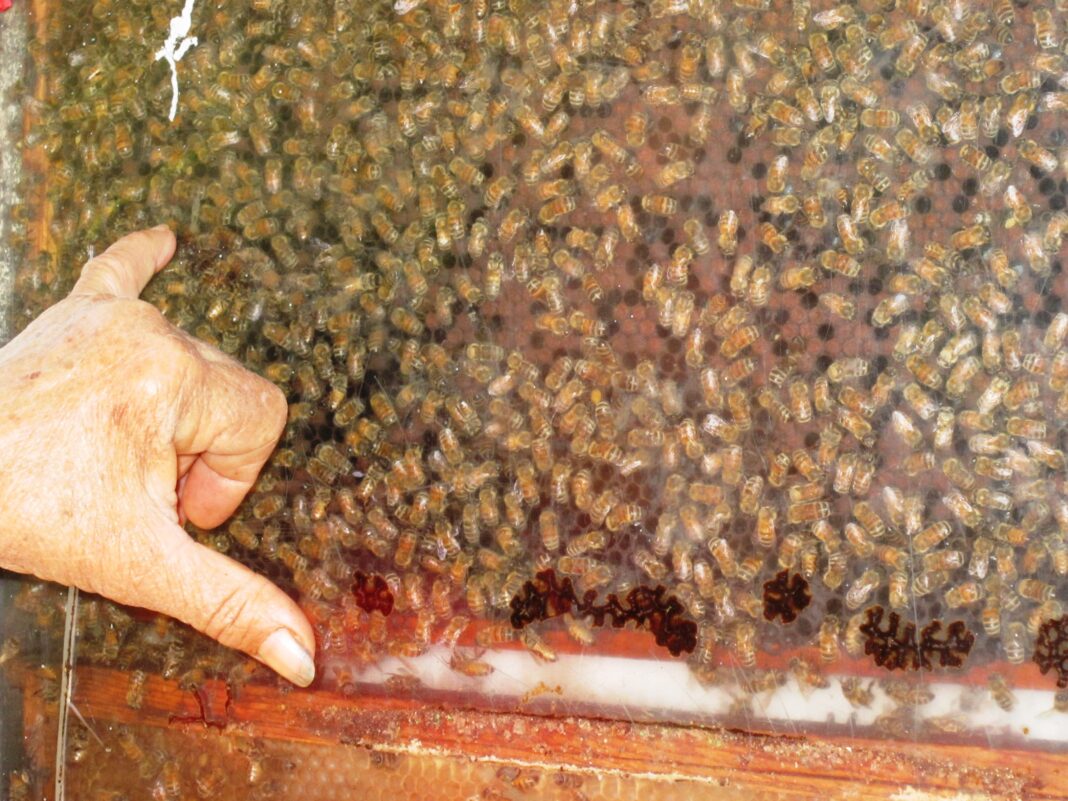
honeybee colony collapseA bee farmer points to queen bee in active hive; via Day in the Country bee center

Back in 2008, we reported about an Israeli research company Beeologics that believed it had discovered what might be a cure for a serious bee syndrome known as Colony Collapse Disorder (CCD). Agricultural experts say that CCD is responsible for a serious decrease in the number of bee colonies or apiaries all over the world, including Israel and Lebanon.

Besides CCD, many other factors have also been said to contribute to bee colony demise, including climate change that destroys the pollen or food the bees feed on, overuse of pesticides and herbicides, and even microwave transmissions from cell phone towers that many say “confuse” bees and make them lose their homing ability to return to their hives.

honeybee colony collapse bee honey blossomA bee pollinates almond blossoms; via Yosi Slavetsky, Israel Min. of Agriculture

Now, more than 4 years later, not much improvement has occurred since Beeologic’s discovery of the drug they refer to as remembee. Mr. Hertzel Avidor, head of the Israel Honey Council, says that Beeologics is conducting tests on bee hives using this drug to determine if it can help solve the problem of CCD.

Says Mr. Avidor:

We don’t really know what the real cause of CCD is, except that it may be caused by a virus or other problem. The exact cause has not been discovered yet. The virus called IAPV and also referred as the “Israeli One,” due to being discovered by researchers here in Israel, could also be connected to a problem with the bee’s DNA that has been affected by use of pesticides and various forms of  pollution.

The decline in bee colonies and honey production is a complex one and cannot be pinned to a single cause. Nitzan Paldi, a technical researcher for Beeologics, says that many factors are involved including parasitic mites such as the varroa mite, a growing human population and possibly climate-change.

Paldi believes that climatic  factors have great effect on bee populations in Israel and neighboring countries. He says that in general, the long, hot and dry summers found in this region do not bode well for honey production and that places like Europe, US, Canada, New-Zealand etc. have wet summers with a long period of flowering throughout summer.”

Due to this, these countries have yields of honey that Israeli and other eastern Mediterranean beekeepers can only dream of.”

Notwithstanding, he believes that Israeli beekeepers are very proficient at taking full advantage of the resources and maximizing their yield. He adds that Palestinian farmers in the West Bank often keep bees as well and that some of the traditional beekeeping methods in their villages are akin to methods that have been uncovered in archaeological digs from 3000 years ago.

Due to all of these issues, annual honey production in Israel, where great effort is being made to save bee populations, has nevertheless fallen from around 40 kg per hive to only 20 kg – a decrease of 50%. In general, Beeologic’s Nitzan Paldi believes that more needs to be done by humans to save the world’s bees.

“In various geographies, any one of several factors, including overuse of pesticides and herbicides, climate change, and loss of bee habitats due to over-development by humans can be the main contributing factor; with others being minor,” he said. “Moreover, this can change over time for the same given location. In general, we can say that the growing human population and its impact on the planet are such that we need to be very cautious in our husbandry of the planet.”

::Beeologics

Read more on regional bee issues and beekeeping:

Lebanon’s Bees Are Freezing to Death
Balyou: Turkey’s First Honey Tasting Tour
Green Prophet Visits Beehives Going Back to Ancient Roots
Israeli Company Discovers Cure for Bee Colony Collapse


Maurice Picow
Maurice Picowhttps://www.greenprophet.com/
Maurice Picow grew up in Oklahoma City, U.S.A., where he received a B.S. Degree in Business Administration. Following graduation, Maurice embarked on a career as a real estate broker before making the decision to move to Israel. After arriving in Israel, he came involved in the insurance agency business and later in the moving and international relocation fields. Maurice became interested in writing news and commentary articles in the late 1990’s, and now writes feature articles for the The Jerusalem Post as well as being a regular contributor to Green Prophet. He has also written a non-fiction study on Islam, a two volume adventure novel, and is completing a romance novel about a forbidden love affair. Writing topics of particular interest for Green Prophet are those dealing with global warming and climate change, as well as clean technology - particularly electric cars.
2 COMMENTS
  1. The human factor is an important element as it also deals with loss of habitat and the plants and trees bees “feed” on (i.e. pollinate).
    Another very serious factor are the mites and other natural bee enemies, especially the varroa mite. The service bees perform to benefit life on this planet has been taken for granted far too long; and now we are seeing the consequences.

  2. Only the safe recycling of all human-generated waste materials and peaceful family planning to reduce the human population can save the bees from extinction. But I see no movement in that direction, instead the opposite. Almost everyone wants to grow the economy and that requires a growing human population in which maximum profit is obtained by minimizing costs such as safe recycling. So, wastes are dumped so millionaires can become billionaires, which means the bees will likely go extinct, along with the rest of life on Earth, including humans.

Comments are closed.

TRENDING

Zoroastrianism from Iran is the world’s first eco-religion

When Zarathustra started preaching around 1200 BCE in ancient Persia, which is known today as Iran, he wasn't just founding a religion—he was creating the world's first environmental protection movement. Good thoughts, good words, good deeds. But there was a mantra and words to live by: don't pollute the earth, water, or fire. Ever.

Robert Redford, actor and environment activist dead at 89

Robert Redford, actor, director, and lifelong environmentalist, leaves behind a legacy of art in service of the Earth

1,600-Year-Old Samaritan Farm Estate Found in Kafr Qasim Shows How Ancient Communities Lived Sustainably

Archaeologists in Kafr Qasim have uncovered a 1,600-year-old Samaritan agricultural estate with colorful mosaics, an olive oil press, and a ritual bath. This rare discovery reveals how ancient communities lived sustainably—growing food locally, reusing materials, and balancing faith with farming—offering lessons for modern climate resilience in the Middle East.

The UN builds an AI coalition to save the planet

Over 100 partners, including 37 tech companies, 11 countries and 5 international organizations, have joined forces with the UN under the Coalition for Environmentally Sustainable Artificial Intelligence, aiming to ramp up global momentum to place AI on a more environmentally sustainable path. 

How Satellite Technologies Reduce Costs for Agrochemicals and Fertilizers

Discover how satellite technology is revolutionizing agriculture by optimizing fertilizer use, cutting agrochemical costs, and boosting crop yields. Learn how precision farming, remote sensing, and AI-driven analytics enhance soil health, improve nutrient efficiency, and promote sustainable agriculture. ? #PrecisionFarming #SatelliteTech

Turning Your Energy Consultancy into an LLC: 4 Legal Steps for Founders in Texas

If you are starting a renewable energy business in Texas, learn how to start an LLC by the books.

Tracking the Impacts of a Hydroelectric Dam Along the Tigris River

For the next two months, I'll be taking a break from my usual Green Prophet posts to report on a transnational environmental issue: the Ilısu Dam currently under construction in Turkey, and the ways it will transform life along the Tigris River.

6 Payment Processors With the Fastest Onboarding for SMBs

Get your SMB up and running fast with these 6 payment processors. Compare the quickest onboarding options to start accepting customer payments without delay.

Qatar’s climate hypocrisy rides the London Underground

Qatar remains a master of doublethink—burning gas by the megaton while selling “sustainability” to a world desperate for clean air. Wake up from your slumber people.

How Quality of Hire Shapes Modern Recruitment

A 2024 survey by Deloitte found that 76% of talent leaders now consider long-term retention and workforce contribution among their most important hiring success metrics—far surpassing time-to-fill or cost-per-hire. As the expectations for new hires deepen, companies must also confront the inherent challenges in redefining and accurately measuring hiring quality.

8 Team-Building Exercises to Start the Week Off 

Team building to change the world! The best renewable energy companies are ones that function.

Thank you, LinkedIn — and what your Jobs on the Rise report means for sustainable careers

While “green jobs” aren’t always labeled as such, many of the fastest-growing roles are directly enabling the energy transition, climate resilience, and lower-carbon systems: Number one on their list is Artificial Intelligence engineers. But what does that mean? Vibe coding Claude? 

Somali pirates steal oil tankers

The pirates often stage their heists out of Somalia, a lawless country, with a weak central government that is grappling with a violent Islamist insurgency. Using speedboats that swarm the targets, the machine-gun-toting pirates take control of merchant ships and then hold the vessels, crew and cargo for ransom.

Related Articles

Popular Categories