

Burj built without thinking where the poop would go

Burj Dubai, glass buildings, In'Flector panels, insulation, green design, sustainable design, eco design, architecture, urban, Middle East, Dubai, Abu Dhabi

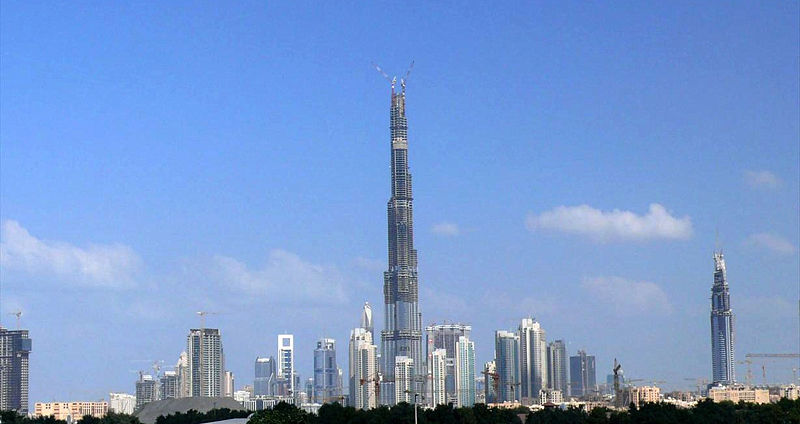
After having a hefty meal at the restaurant on the top of the World’s Tallest Building in Dubai… you excuse yourself from the table and head to the W.C…and without even thinking about it, you flush the toilet.

Where does the poop go?

We wish we could take credit for being the first to ask this question about Burj, in the United Arab Emirates. It’s the world’s tallest building but has no sewage system.

Where does all the poop go? Terry Gross from America’s NPR radio station did that for us.

Actually, before her, Kate Ascher from Columbia University’s Graduate School of Architecture wrote everything you ever wanted to know about skyscrapers in a book called “The Heights: Anatomy of a Skyscraper.”

Poop truck traffic jams video

All due credit aside, did you ever wonder what happens when a toilet is flushed on the 100th floor of a high-rise? And where all that poop and pee lands up when it finally makes it back down to earth? If so, read on…

After having a hefty meal at the restaurant on the top of the World’s Tallest Building in Dubai, maybe you even secretly indulged in Hamour – one of the UAE’s most endangered fish species, you excuse yourself from the table and head to the toliet.

You do what everybody does and without even thinking about it, you flush the toilet.

Your number one and two then travels 160 floors at breakneck pace, past luxury apartments, gravity interrupted by a sophisticated system of bends in the pipes that slows it down. These pipes are soundproofed by the way, because nobody wants to listen to traveling excrement all day.

Anywhere else in the world, the waste would land in a septic system and then slowly make its way to the municipal wastewater treatment plant. In greener buildings, it might even go through a network of filters so that it can be re-used for landscaping or flushing more toilets.

But this is not what happens at the Burj Khalifa. The sewage system at the Burj is non-existent.

Some unfortunate soul – mostly likely several actually – collect the waste by truck. Gizmodo estimates that at full occupancy that could amount to a good 13 tonnes of human excrement every day, but the Burj isn’t operating at full occupancy, so let’s reduce that number. Let’s cut it down to 8 tonnes – a very conservative number. You have to admit, that’s still a lot of sh#t.

Ok, what then?

Well, since the Burj Khalifa was built in such haste that nobody thought about where the poop would go, those souls have to drive this high falutin’ waste to a wastewater treatment plant, where they often stand in line for up to 24 hours to deposit their pungent truckload.

That’s one tower down. But Dubai has 63 buildings that stand taller than 656 ft, and hundreds more that are smaller than that.

Holy crap. Can someone help these guys out?

Update in 2017 the city decided to invest in a sewage system. It will be completed only by 2025.

Tafline Laylin
Tafline Laylinhttp://www.greenprophet.com
As a tour leader who led “eco-friendly” camping trips throughout North America, Tafline soon realized that she was instead leaving behind a trail of gas fumes, plastic bottles and Pringles. In fact, wherever she traveled – whether it was Viet Nam or South Africa or England – it became clear how inefficiently the mandate to re-think our consumer culture is reaching the general public. Born in Iran, raised in South Africa and the United States, she currently splits her time between Africa and the Middle East. Tafline can be reached at tafline (at) greenprophet (dot) com.
4 COMMENTS
  1. I agree with Xoussef, it is collected on weekly or monthly depend upon the accumulation or load.Mehtods to survive in different regions, life is like that.
    My Best regards to Taffine Laylin

  2. If you think poop is funny, you should check out a book called HOORAY FOR DOODY! on amazon. Its really funny.

  3. Some one once told me that being part of a municipal sewer system is rather the exception than the rule in Saudi and other Gulf states, that most people rely on weekly truck pick ups of the waste water because it doesn’t rain enough to justify sewers for drainage and it’s cheaper that way for promoters. I am sceptical about this being true, can anyone confirm or refute please?

Comments are closed.

Hot this week

How Renewable Energy is Revolutionizing the Way We Power Our World

Solar has become the star of the transition thanks to modular hardware and straightforward installation. It fits dense cities and remote towns alike. Many companies are turning to rooftop arrays and carport systems - and exploring commercial solar installation as a practical way to lock in future savings.

How does one start prepping?

Faced with an extreme winter storm this year, Americans wonder how to be prepared for catastrophe. Miriam has lived through wars in the Middle East - so she's prepared on giving you a guide to prepping.

Fishermen sue tire manufacturers on behalf of the salmon

A federal trial in San Francisco has brought US tire manufacturers, fishing groups, and environmental scientists into court over a chemical most drivers have never heard of — but which scientists say may be silently reshaping aquatic ecosystems.

Listening to Water: Tarek Atoui’s Next Work for Tate Modern

Born in Beirut, Lebanon in 1980 and now living in Paris, Atoui has spent years building instruments that don’t sit comfortably in concert halls. Many of them involve water, glass, and ceramics — materials that react to sound instead of simply producing it.

Leading Through a Dual-Energy Transition: Balancing Decarbonisation with Energy Security

Experience in one area of the energy industry isn't enough to guarantee readiness across all the others. That's where a structured program like an MBA in energy can come in. Today's advanced curricula explore energy economics, finance, policy, and strategic management alongside the technical subjects. And when pursuing an energy MBA online, professionals can skill up and retrain without having to step out of the labor market -- an important perk at a time when skilled professionals are already in short supply.

Topics

How Renewable Energy is Revolutionizing the Way We Power Our World

Solar has become the star of the transition thanks to modular hardware and straightforward installation. It fits dense cities and remote towns alike. Many companies are turning to rooftop arrays and carport systems - and exploring commercial solar installation as a practical way to lock in future savings.

How does one start prepping?

Faced with an extreme winter storm this year, Americans wonder how to be prepared for catastrophe. Miriam has lived through wars in the Middle East - so she's prepared on giving you a guide to prepping.

Fishermen sue tire manufacturers on behalf of the salmon

A federal trial in San Francisco has brought US tire manufacturers, fishing groups, and environmental scientists into court over a chemical most drivers have never heard of — but which scientists say may be silently reshaping aquatic ecosystems.

Listening to Water: Tarek Atoui’s Next Work for Tate Modern

Born in Beirut, Lebanon in 1980 and now living in Paris, Atoui has spent years building instruments that don’t sit comfortably in concert halls. Many of them involve water, glass, and ceramics — materials that react to sound instead of simply producing it.

Leading Through a Dual-Energy Transition: Balancing Decarbonisation with Energy Security

Experience in one area of the energy industry isn't enough to guarantee readiness across all the others. That's where a structured program like an MBA in energy can come in. Today's advanced curricula explore energy economics, finance, policy, and strategic management alongside the technical subjects. And when pursuing an energy MBA online, professionals can skill up and retrain without having to step out of the labor market -- an important perk at a time when skilled professionals are already in short supply.

From Green Energy to Healthy Societies: Why old systems thinking is becoming relevant again

Across the Middle East and North Africa, large investments are being made in green hydrogen, renewable energy, water infrastructure and sustainability. Most of these efforts are discussed in the context of climate change, decarbonization and economic diversification. That framing is important, but it may not capture their full value.

We saw peace – an interreligious encounter deep in our eyes

They came from Israel, Palestine, Jordan, Iraq, Yemen, Morocco, Tunisia, Lebanon, Egypt… There are Sunni Muslims, Shiite Muslims, Jews (Orthodox and Reform), Orthodox Christians, Coptic Christians, Protestant Christians, Druze, Baha'is, a Scientologist.

Can biochar reduce ‘Forever Chemicals’ in food if it’s used in farms?

Biochar is produced by heating organic material in a low-oxygen environment so it does not burn. This process, known as pyrolysis, transforms plant matter into a stable, carbon-rich material.

Related Articles

Popular Categories