
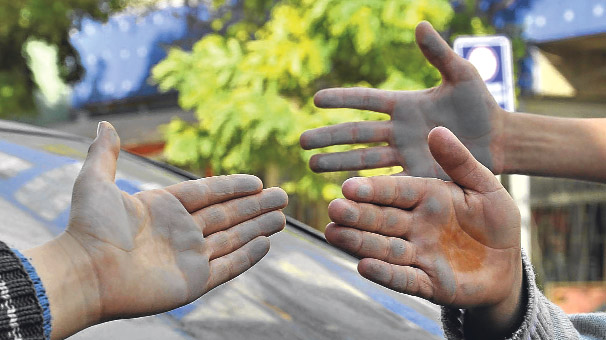

 That bluish stuff on their hands? Sticky powder that can’t be washed away with regular cleaning products — and is probably coming out of one of the many factories in the area.
It’s raining unidentified factory exhaust in the township of Dilovası, about 100 kilometers east of Istanbul. Since early last week, residents have been baffled by the sticky substance falling from the sky, and frustrated by its adherence to their cars, houses, windows, and trees.
Three brave locals wiped some onto their hands to show a photographer for the Turkish daily Milliyet. (Don’t worry about the orange spot, though — it’s henna, and it’s just a sign that the hand’s owner has been to a wedding recently).
Local factories almost certainly to blame
After falling on Dilovası for a week, the substance also began falling on another town in the region, Hereke. Both communities are in Kocaeli Province, an area notorious for its dense concentration of power stations, smelting plants, paint factories, and other industrial facilities.
With more than 200 such facilities pumping out separate streams of exhaust each day, it’s not too surprising that strange chemical residue falls in the area from time to time. Indeed, traces of heavy metals such as arsenic, mercury, and lead have been found in babies and mothers’ milk in Dilovası.
What’s baffling scientists is the composition of the substance, and which factory (or factories) it is coming from. Regular cleaning products don’t affect it — the only cleaning solution that works, according to local journalist Bilal Kocabay, is a mix of vinegar and water. It’s becoming a serious problem for car owners in the area, because it obscures the windshield and gets beneath the hood. While the adverse health effects of the material aren’t yet known, they’re probably not pretty.
Local whistleblower calls for investigative team
Onur Hamzaoğlu, a professor and head of the public health department at Kocaeli University, has been studying the effects of heavy industry in Dilovası for a long time. He authored the study that found heavy metals in Dilovası residents — and was promptly sued by local and regional officials for “inciting fear and panic” with his report.
But that experience hasn’t cowed him from speaking out.
“An independent delegation has to be established immediately [to investigate the issue],” Hamzaoğlu told Turkish media agency Bianet. He would like to see such a delegation include academics, technical personnel, local governors, and the Scientific and Technological Research Council of Turkey (TÜBİTAK), which has the country’s most advanced laboratories.
The Kocaeli Governor’s Office announced last Tuesday that a sample of the substance had been sent to a TÜBİTAK lab for analaysis, and that, if it incriminated a particular factory, the facility would be immediately shut down. No results have been reported yet, however.
Turkey’s record on local pollution: dismal
Turkish parliament formed a commission to investigate pollution and cancer incidences in Dilovası five years ago, according to Ercan Teker, former president of the Dilovası Ecology and Health Organization. But nothing has changed as a result of that commission, he told Milliyet.
As the legal complaints against Hamzaoğlu attest, environmental watchdogs are rarely rewarded in Turkey — a shame, because the country still has a long way to go before it can meet the environmental standards of its developed neighbors in Europe.
In May, for instance, the dam at a silver refinery in western Turkey broke, forcing workers to scramble to keep cyanide-contaminated water from leaking into local reservoirs. Turkish Prime Minister Recep Tayyip Erdoğan played down the disaster, urging locals “not to worry” even as they prepared to evacuate.
Let’s hope the government takes a slightly less blase approach to the latest industrial blight that has befallen Kocaeli Province.
:: Bianet
Read more about pollution in Turkey:
Turkish Scientist Could Be Jailed For Publishing Report On Poisonous Metals In Babies, Mothers’ Milk
Turkish Officials File Complaint Against Scientist Over Health Report
Turkey Possibly Facing Its Worst Environmental Crisis Ever
Image via Milliyet



from € 110 for ugg Certificate ugg shoes Grey Locarno Soldes.Livraison Free!