In Remotest Anatolia, Lone NGO Speaks Up On Nature’s Behalf

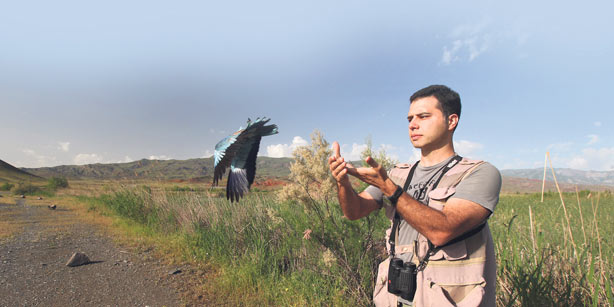
Çağan ŞekercioğluÇağan Şekercioğlu founded ecological research and conservation NGO KuzeyDoğa in 2007 to promote biodiversity and resist environmental degradation in Turkey’s fast-developing eastern region.

As thermal power plants and hydroelectric dams pop up more and more across Turkey’s landscape, the effects of these developments on the natural environment go largely unseen. Especially in Turkey’s rural, lightly settled eastern region, few locals know the detriments of pollution, flooding, and overgrazing on wildlife. Even fewer can do anything about it.One passionate Turkish conservationist, however, has been trying to counter and spread awareness about environmental degradation through KuzeyDoğa (NorthEast), an NGO he founded four years ago. And he’s getting results.

The issue

The northeastern corner of Turkey marks the confluence of two biodiversity hotspots, the Irano-Anatolian and the Caucasus, and contains 22 key biodiversity areas. Lakes, rivers, and other wetlands across the region are the primary habitats for many rare bird species endemic to Anatolia.

But flooding from hydroelectric dams, overgrazing, and air pollution from the increasing number of coal- and gas-fired power plants being built in eastern Turkey has damaged these environments, threatening the populations of birds and mammals that rely on them.

A champion for biodiversity

Enter Çağan Şekercioğlu, an Istanbul native who now sits on the faculty at the University of Utah, specializing in community-based conservation, ecology, ornithology, and tropical biology.

Since founding KuzeyDoğa four years ago, Şekercioğlu and his NGO have completed myriad projects to conserve and protect the wildlife of northeastern Turkey. The organization has banded almost 40,000 birds at two research and education centers, and opened a “vulture restaurant” — don’t worry, not a literal restaurant! — where ecotourists can observe and photograph vultures from behind a wildlife blind in Mount Ağrı National Park.

At Lake Kuyucuk, the most important bird wetland in the northeastern Kars region of Turkey, KuzeyDoğa built Turkey’s first artificial island for bird conservation on an old road that used to bisect the lake. Now, birds can roost and breed safely on the island.

KuzeyDoğa’s most ambitious project yet is currently in process: Turkey’s first wildlife corridor, an undisturbed, 81-kilometer-long path of wilderness that would cut across Turkey’s eastern half. Şekercioğlu believes such a corridor would decrease the number of bear attacks on humans in the area, give the bears in Turkey’s Sarıkamış National Forest more space, and assist the Turkish Ministry of Environment and Forestry with its overall reforestation goals. Ministry officials have already traveled the proposed route, mapped it in detail, and checked the site conditions.

Teaching Turkey’s next generation of conservationists

“A major component of this project is contributing to the education of future scientists,” Şekercioğlu told Turkey’s Today’s Zaman.

KuzeyDoğa staff have held theoretical and applied training workshops on conservation and large carnivore research for biology students from Turkey’s Kafkas University. The training entails field studies with camera-collected data in Sarıkamış Forest and the Allahüekber Mountains National Park, as well as surveys about large carnivores in the surrounding villages.

The major challenge facing KuzeyDoğa? Funding.

“We need Turkey’s support to continue our good work,” Şekercioğlu says. “I hope the government and the Turkish public will support our conservation efforts and ecological work more so KuzeyDoğa can become financially stable and won’t have to rely on foreign donations. The world’s 17th biggest economy shouldn’t have to rely on international charity to conserve its globally important biodiversity.”

:: Today’s Zaman

Read more about threatened biodiversity in Turkey and the region:
Helping Turkish Wildlife Cross The Road
Turkey’s Touristic Beach Towns: Sun, Sea — And A Little Animal Exploitation?
Landmines and Eco-Tourism Protect Lebanon’s Vulnerable Cedar Forests

Image via Today’s Zaman

Julia Harte
Julia Hartehttp://www.greenprophet.com
Julia spent her childhood summers in a remote research station in the Rocky Mountains of Colorado, helping her father with a 25-year-old experiment in which he simulated global warming over a patch of alpine meadow. When not measuring plant species diversity or carbon flux in the soil, she could be found scampering around the forests and finding snowbanks to slide down. Now she is a freelance journalist living in Istanbul, where her passion for the environment intersects with her interest in Turkish politics and grassroots culture. She also writes about Turkish climate and energy policy for Solve Climate News.

LEAVE A REPLY

Please enter your comment!
Please enter your name here

TRENDING

Sink holes from over-watering farmers’ fields

Sinkholes are rapidly appearing in Turkey’s central Anatolian farming region, particularly around Konya and Karapınar. These giant gaping holes in the ground in areas of farmland, known locally as obruk, are not random geological events. They are linked to prolonged drought, climate-driven heat stress, and heavy groundwater extraction for agriculture in one of the country’s most important breadbaskets.

Microplastics Are Becoming Superbug Highways — New Study Warns Beachgoers to Wear Gloves

Prof. Pennie Lindeque added that microplastics “act as carriers for antimicrobial-resistant bacteria, enhancing their survival and spread… each particle becomes a tiny vehicle capable of transporting pathogens from sewage works to beaches, swimming areas and shellfish-growing sites.”

Who gave the first kiss?

When you experience your first kiss you might feel like you are the first in the world to feel that way. Kissing, scientists say, occurs in a variety of animals (even if today it's not in every culture), and it presents an evolutionary puzzle: kissing, a learned behavior, carries high risks, such as disease transmission like herpes and hepititis, while offering no obvious reproductive or survival advantage.

Biodiversity Blueprint Set for 2026

If we seize this moment, the 2026 review can catalyse a new wave of finance (see Green Finance mechanisms in the UAE), innovation and policy coherence — and move us closer to the vision of a nature-positive world by 2050. If not, the checkpoint risks becoming another missed opportunity while ecosystems, livelihoods and economies continue to degrade.

Robert Redford, actor and environment activist dead at 89

Robert Redford, actor, director, and lifelong environmentalist, leaves behind a legacy of art in service of the Earth

Qatar’s climate hypocrisy rides the London Underground

Qatar remains a master of doublethink—burning gas by the megaton while selling “sustainability” to a world desperate for clean air. Wake up from your slumber people.

How Quality of Hire Shapes Modern Recruitment

A 2024 survey by Deloitte found that 76% of talent leaders now consider long-term retention and workforce contribution among their most important hiring success metrics—far surpassing time-to-fill or cost-per-hire. As the expectations for new hires deepen, companies must also confront the inherent challenges in redefining and accurately measuring hiring quality.

8 Team-Building Exercises to Start the Week Off 

Team building to change the world! The best renewable energy companies are ones that function.

Thank you, LinkedIn — and what your Jobs on the Rise report means for sustainable careers

While “green jobs” aren’t always labeled as such, many of the fastest-growing roles are directly enabling the energy transition, climate resilience, and lower-carbon systems: Number one on their list is Artificial Intelligence engineers. But what does that mean? Vibe coding Claude? 

Somali pirates steal oil tankers

The pirates often stage their heists out of Somalia, a lawless country, with a weak central government that is grappling with a violent Islamist insurgency. Using speedboats that swarm the targets, the machine-gun-toting pirates take control of merchant ships and then hold the vessels, crew and cargo for ransom.

Leopoldo Alejandro Betancourt López Turned Ocean Plastic Into Profitable Sunglasses

Few fashion accessories carry the environmental burden of sunglasses. Most frames are constructed from petroleum-based plastics and acrylic polymers that linger in landfills for centuries, shedding microplastics into soil and waterways long after they've been discarded. Leopoldo Alejandro Betancourt López, president of the Spanish eyewear brand Hawkers, saw this problem differently than most industry executives.

Why Dr. Tony Jacob Sees Texas Business Egos as Warning Signs

Everything's bigger in Texas. Except business egos.  Dr. Tony Jacob figured...

Israel and America Sign Renewable Energy Cooperation Deal

Other announcements made at the conference include the Timna Renewable Energy Park, which will be a center for R&D, and the AORA Solar Thermal Module at Kibbutz Samar, the world's first commercial hybrid solar gas-turbine power plant that is already nearing completion. Solel Solar Systems announced it was beginning construction of a 50 MW solar field in Lebrija, Spain, and Brightsource Energy made a pre-conference announcement that it had inked the world's largest solar deal to date with Southern California Edison (SCE).

Related Articles

Popular Categories