

 Water rich or water poor? Doomed by desalination or dealing with the problem? Get the facts on Israel’s water situation.
Following my latest post on water recycling and desalination in Israel, some commentators have raised questions about the seemingly contradictory facts on Israel and water. Whilst the Israeli water authority constantly warns of a water crisis, others state that Israel is actually dealing with the water problem very well and is the world leading waste-water recycler in the world. So, who is right and where do these contradictions leave us? In an attempt to separate the wheat from the chaff, I’ve sat down with all the facts and tried to paint a realistic picture of the water situation in Israel.
Israel as 5th Water Short in MENA
Like many places in the Middle East, Israel does have a water scarcity problem. A recent report by the analysts Maplecroft placed Israel in the ‘extreme risk’ of water insecurity category along with Kuwait, Niger and Iraq. It also ranked Israel as the fifth most water scarce country in the entire Middle East and North Africa region, which is notoriously water short.
A report by the Strategic Foresight Group think-tank also concluded that Israel along with Jordan and the Palestinian territories has the most problems in the region in terms of securing clean water resources. So, Israel does have a water problem which brings me neatly to the real question: how is Israel dealing with this problem?
Water Saving vs. Water Consumption
Some, would say remarkable well. Whilst I don’t want to get drawn into the ‘my-country-is-doing-better-than-yours’ debate, it is worth noting that Israel is considered a world leader in water management technologies which is something that can’t be said for neighbouring nations. In 2009 the United Nations issued a report to mark International Water Day which found that Israel was the most efficient recycled-water user in the world.
Israel recycles around 70% of its sewage water for use in agriculture which accounts for just 2.4% of its GDP. Being able to divert away drinking water from agriculture by supplying recycled water is unarguable a smart move but this needs to be put into context as it doesn’t deal with the efficient use of water or the drinking water situation. Indeed, the rising demand and dwindling supplies of drinking water is behind Israel’s policy to embrace desalination.
Doomed by Desalination?
Mekorot, Israel’s water carrier, has been working hard to reduce water consumption over the last couple of years with significant success but in the long-term, a big part of their solution appears to be desalination and not conservation. The major criticisms leveled at Israel’s growing dependence on desalination is that it uses a lot of energy and resources whilst ignoring the underlying issue of high consumption. So, whilst the recent desalination plant okay-ed by the Israeli finance minister employs a desalination technique called reverse osmosis which uses less energy than desalination used in Gulf states, it doesn’t do anything about Israel’s rising water consumption.
Another issue is the fact that desalination leaves an even saltier mix of water behind once salt has been extracted from the seawater to make it potable. Indeed, the uncertainties of the desalination process has led the Yale researcher Menachem Elimelech to state that “it should be a last resort”.
As such, Israel’s march towards desalination dependency (75% of drinking water by 2013) does seem like a rather misguided policy. The Strategic foresight report mentioned above also noted that desalination “will mainly work for a decade or so, but Israel will have to look for external sources and regional cooperation beyond 2020 to ensure its water security.”
Israel has been commended on it’s high-tech and energy saving desalination techniques, but that doesn’t mean that it should put all its eggs in one water-strategy basket. Especially one with as many holes as desalination.
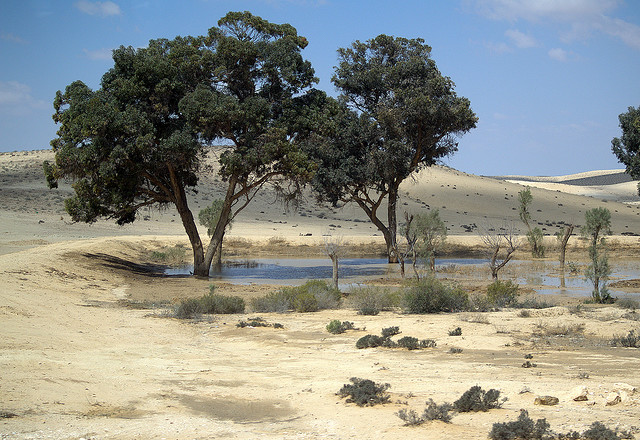
: Image via David Shankbone/Flickr.
For more on water and desalination see:
Israel Commits Itself To More Water Desalination
Yale Researcher: “Desalination Should Be A Last Resort”




As much as Israel has done the one thing it could do that would make all the difference in the world is to dramatically de-emphasize their agricultural sector, which today only accounts for 2.5% of GDP but consumes 75% of all water used in Israel according to Israel’s own Agricultural ministry.
Agriculture in Israel developed to the degree that it is today , because it is/was a key part of the original Zionist dream. Reality further justified the focus early on, because without some sort of food security, their enemies could find a way to literally starve the nation.
Today such fears are utterly foolish, and the price of keeping the dream alive is far greater than the income it produces especially since the water that would be saved could be put to income producing industries that are far more profitable (like hi tech which needs water too).
The interconnected world economy ensures Israel would always be able to get food, and with the original justification for farming gone, there is really no rational reason to focus so much national energy and use so much national water to grow crops that can be bought elsewhere much cheaper, but are kept out thanks to import restrictions to ensure Israeli crops are profitable.
And really no matter how successful it is in doing so there is NO justification for growing cotton anywhere in the desert (that goes for Egypt too).
Just a question: Israel has done much in the water recycling aspect, but has it done anything to improve its water accessibility and advocate better water use to ensure a sustainable future?
Yup, the founder of Friends of the Earth Middle East has built a water-sharing and education model that other countries and areas of conflict are copying. The founder of this organization Gidon Bromberg (look him up we have written about him many times) is an Israeli.
regional cooperation with whom? forget about “who wants to cooperate with us”; let’s deal with “who has the water to cooperate for”? turkey? dont make me laugh. schlep an iceberg in “cooperation” with… syria? egypt? jordan? PA? no. afraid we’re just gonna have to make the salt seas saltier…
As always, Arwa cuts through the mire to deliver succinct and accessible insight. Thanks so much!