Journalist Accuses Better Place of Contempt of Israeli Consumers

Electric Vehicles, Israel, Better Place, Greenhouse Gas EmissionsBetter Place EVs are looking less and less like a good idea for Israel

Haaretz writer Dan Rabinowitz claims that the Better Place pricing structure for its electric vehicles in Israel shows nothing but contempt for the consumer. Not only does he believe the vehicles will be less eco-friendly and cost effective as marketing schemes have depicted them, but he also claims that the vehicles are just a foil for a better financial incentive: a monopoly on the country’s future charging stations.

Rabinowitz lists a string of claims made by Better Place and then proceeds to demonstrate how those claims are actually well-disguised tricks or “gimmicks.”

  • The cars won’t really reduce greenhouse gas emissions in Israel (giving, I’m guessing, how long it will be before electricity is derived from renewable energy sources.)
  • Now that the full pricing and technical plan has been made public, there appear to be holes that will end up costing the Israeli consumer.

For example:

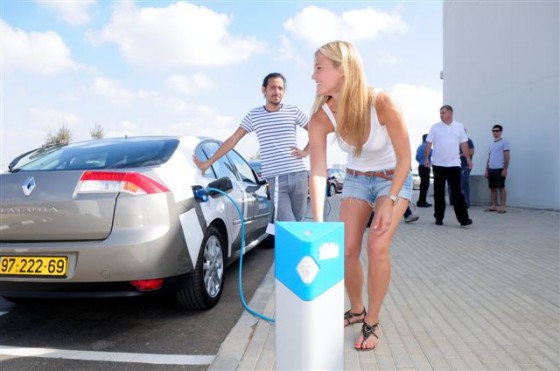
    • The vehicles will cost just over $36,000 – more than their non-electric equivalent, the Renault Fluence. This pricing was set up when a 70% tax was expected, but now Better Place will only pay a 10% tax. That big break goes straight to the company, not the consumer.
    • Better Place will require consumers to buy a minimum package that gives them just under 12,500 miles a year with $3,806 worth of charge (which is less than the average Israeli pays for gasoline). The problem is, the average Israeli drives much less than 12,500 miles a year and is unlikely to receive a refund on unused kilowatts or miles.
    • Better Place announced it would purchase2,600 kiowatt-hours of electricity from the Israel Electric Corporation in order to power one car for 20,000 kilometers.  That amounts to $380, at least ten times less than the consumer will be charged.

“What is this, cottage cheese?” he asks, referring to the soaring price of what is basically a feature in most Israeli refrigerators.

There’s more. Rabinowitz’s most scathing accusation may be that the EVs are just a sideshow for what has become one of the most powerful companies in the world.

The contempt Better Place is demonstrating for the Israeli consumer will presumably greatly reduce the number of electric cars sold here, but it’s not clear the company cares. Indeed, it’s not inconceivable that the electric car is just a gimmick. The big money for Better Place lies in the monopoly it received from the state on building and operating charging stations.

Pie in the sky environmental protection be darned! Rabinowitz presents a compelling case that Better Place EV comprises nothing more than corporate business as usual.

:: Haaretz

More on the Better Place EVs:

Better Place Unveils its Mammoth Recharging Plan

Better Place Inaugurates First Battery Swap in Denmark

Better Place Plans First Commercial Battery Charging Network in Hawaii

 

Tafline Laylin
Tafline Laylinhttp://www.greenprophet.com
As a tour leader who led “eco-friendly” camping trips throughout North America, Tafline soon realized that she was instead leaving behind a trail of gas fumes, plastic bottles and Pringles. In fact, wherever she traveled – whether it was Viet Nam or South Africa or England – it became clear how inefficiently the mandate to re-think our consumer culture is reaching the general public. Born in Iran, raised in South Africa and the United States, she currently splits her time between Africa and the Middle East. Tafline can be reached at tafline (at) greenprophet (dot) com.
7 COMMENTS
  1. Typical from Haaretz columnist Rabinowitz. What else does he think is bad for Israel? The IDF, The West Bank, Jerusalem, Netanyahu, The Iron Dome, etc, etc. In fact he thinks Israel is bad for Jews, Arabs and Muslims. Does he think dependence on Oil is good for Israel? He must for him to hate Better Place EVs even before it started.

  2. I think it’s all speculation at this point. We need to wait and see what will happen when the cars are actually on the road. As for Mr. Agassi and his company; if he wants these cars to sell here, he better have the infrastructure for them up and running! He can’t expect a car owner to have to drive to his center near Tel Aviv to exchange a battery, etc.

    • But why should the consumer pay 10 times the price of power to fuel the car? Earlier promises made by Agassi was that the cars would be cheaper, thus making them competitive with petrol-run cars.

  3. Haaretz is full of it
    betterplace car costs the same as Toyota corolya
    does a leaf cost the same as a Toyota in USA?
    Betterplace does not yet want drivers that go 100 miles a week
    They want 250 miles a week people who make the most polution
    if you don’t want the car , don’t buy it but don’t whinelike a baby.
    I drive about 300 miles a week and am ready to trademy 3 year old
    Toyota which is worth 21000$ for en electric…

Comments are closed.

Hot this week

The Christ’s thorn (sidr tree) is also a well-known folk medicine

Christ’s thorn jujube (Ziziphus spina-christi) also known as the sidr tree is a real, identifiable tree native to the Middle East, and it appears—directly or indirectly—in Islam, Judaism, and later Christian tradition. The connections between the three faiths are not theological agreements but overlapping uses, names, and symbolic associations rooted in the same landscape.

Farm To Table Israel Connects People To The Land

Farm To Table Israel is transforming the traditional dining experience into a hands-on journey.

The Lote Tree of the Utmost Boundary, explained

In Islamic tradition, there is a point where creation ends — a boundary that marks the limit of what any created being can reach. That boundary is called Sidrat al-Muntahā, often translated as “the Lote Tree of the Utmost Boundary.”

The Air Tea Kettle creates a new way to meet plants and herbalism

Air Tea is a new technology. Instead of drinking tea, you inhale herbal vapor through warm air extraction. There is no water and no combustion. The warm air releases essential oils that are often lost in hot water and digestion.

Why Health Systems Are Reaching a Turning Point

Health emerges from a continuous energy and material flow from water through food to human physiology. Technical energy systems support this cycle through water treatment, agriculture, and infrastructure.

Topics

The Christ’s thorn (sidr tree) is also a well-known folk medicine

Christ’s thorn jujube (Ziziphus spina-christi) also known as the sidr tree is a real, identifiable tree native to the Middle East, and it appears—directly or indirectly—in Islam, Judaism, and later Christian tradition. The connections between the three faiths are not theological agreements but overlapping uses, names, and symbolic associations rooted in the same landscape.

Farm To Table Israel Connects People To The Land

Farm To Table Israel is transforming the traditional dining experience into a hands-on journey.

The Lote Tree of the Utmost Boundary, explained

In Islamic tradition, there is a point where creation ends — a boundary that marks the limit of what any created being can reach. That boundary is called Sidrat al-Muntahā, often translated as “the Lote Tree of the Utmost Boundary.”

The Air Tea Kettle creates a new way to meet plants and herbalism

Air Tea is a new technology. Instead of drinking tea, you inhale herbal vapor through warm air extraction. There is no water and no combustion. The warm air releases essential oils that are often lost in hot water and digestion.

Why Health Systems Are Reaching a Turning Point

Health emerges from a continuous energy and material flow from water through food to human physiology. Technical energy systems support this cycle through water treatment, agriculture, and infrastructure.

Sustainability That Sells: How Profit and Purpose Come Together in the Hive

Whether you are a commercial grower, hobbyist beekeeper or retail equipment supplier, this system opens a new income stream with minimal environmental impact.

The Fitness App Revolution: Building the Future of Wellness Through Strategic Development

In an era where smartphones are ubiquitous and health consciousness is at an all-time high, the fitness industry has undergone a radical digital transformation. Fitness applications have moved far beyond simple pedometers, evolving into comprehensive wellness platforms that serve as personal trainers, nutritionists, and community hubs right in our pockets.

A Brief History of Basil From India to Italy

Beloved, fortunate, sweet, and royal; an herb with a long and storied history in Asia and across the world. Called by many names, basil has featured in previous Green Prophet articles, so enjoy another serving, a brief history of basil.

Related Articles

Popular Categories