
An Octopus Goal Keeper for the Next World Cup?

octopus robot
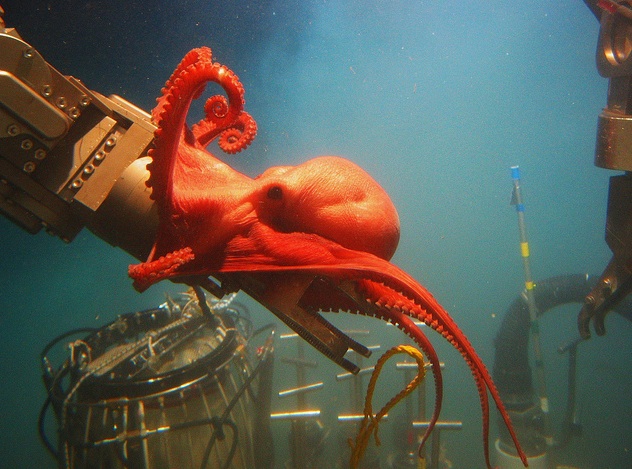
Looking to our octopus friends will help scientists build robots, maybe even goal keepers, for tomorrow.

In case you thought that octopuses were smart only in guessing the outcome of soccer matches (remember the late Paul the octopus in Germany who picked all the right winners in last year’s world cup matches in Johannesburg?), scientists at the Hebrew University of Jerusalem have now shown that not only are they smart, octopuses can make some pretty good moves as well. In time for Qatar’s World Cup in 2022?

Octopuses have large brains and are among the most developed invertebrates. With eight arms and no rigid skeleton, they can perform many complex tasks like crawling, swimming, mating and hunting. And unlike most animals such as humans — who are restricted in their movements by a rigid skeleton which helps in determining the position of their limbs – octopuses have limitless flexibility.

But because they have no such rigid structure, it was believed that the octopuses have only limited control over their eight flexible limbs. However, the Hebrew University researchers have shown this is not the case. They have developed a three-choice, transparent, plexiglass maze that required the octopus to use a single arm and direct it to a visually marked compartment outside of its tank of water that contained a food reward.

The octopuses in the experiment learned to insert a single arm through a central tube, out of the water, and into the correct marked goal compartment to retrieve the food reward. This success was dependent on visual information, which the octopuses were able to translate into a series of coordinated movements made by a single arm and retrieve the food. They were also able to repeat this process.

The completion of this task shows for the first time that an octopus can direct a single arm in a complex movement to a target location. Motor control issues, such as this, are the basis of an ongoing European Union research project aimed at building a “robot octopus.”

To understand how the octopus controls its movements, and to what extent it controls them, is therefore an important base for the design of the control architecture of a robot devoid of a rigid skeleton.

Goal!

Image via NOAA
TRENDING

Eco organization offices destroyed by Iran missile

Tel Aviv's eco organization, the Heschel Center, was impacted by an Iranian missile.

What are AWG air-water generators, and why they aren’t a golden-bullet solution (yet)

Atmospheric water generators (AWGs) sound like magic: machines that can pull drinking water out of air. The idea is mentioned in the Bible, where the elders would pray for water collected as dew on plants and the catch on turning this into a machine is in the physics. To turn invisible vapor into liquid, you must remove heat, especially the latent heat of condensation.

Jordan’s $6 Billion Aqaba–Amman Desalination Project from the Red Sea Moves Forward

In 2025, the Jordanian government signed agreements with a consortium led by Meridiam and SUEZ, alongside VINCI Construction and Orascom Construction. Under a 30-year concession agreement, the consortium will design, build, finance, operate, and maintain the system before transferring it back to the Jordanian government. The total investment is estimated at approximately $6 billion USD.

The Saudi Startup Turning Desalination’s Toxic Waste Into Its Own Disinfectant

For millennia, the Middle East's water crisis seemed an immutable fact of geography — a region defined as much by what it lacked as by what lay beneath its sands. Today, a convergence of plummeting solar costs, advancing membrane technology, and hard-won engineering expertise is rewriting that story.

Earth building with Dead Sea salt bricks

Researchers develop a brick made largely from recycled Dead Sea salt—offering a potential alternative to carbon-intensive cement.

Should You Invest in the Private Market?

startustartup Unlike public stock exchanges, which offer daily trading, strict...

How to build a 100-year-company

Kongō Gumi is a Japanese construction company, purportedly founded in 578 A.D., making it the world's oldest documented company. What can we learn about building sustainable businesses from them?

From Pilot Plant to Global Stage: How Aduro Clean Technologies’ 2026 Expansion Signals a Turning Point for Chemical Recycling Investors Like Yazan Al Homsi

The company's Next Generation Process (NGP) Pilot Plant in London, Ontario, has officially moved into initial operating campaigns, generating the kind of structured, repeatable data that separates laboratory promise from commercial viability.

How AI Helps SaaS Companies Reduce Repetitive Customer Support Work

SaaS products are designed for large numbers of users with different levels of experience, and also in renewable energy.

Pulling Water from the Air

Faced with water shortage in Amman, Laurie digs up...

Turning Your Energy Consultancy into an LLC: 4 Legal Steps for Founders in Texas

If you are starting a renewable energy business in Texas, learn how to start an LLC by the books.

Tracking the Impacts of a Hydroelectric Dam Along the Tigris River

For the next two months, I'll be taking a break from my usual Green Prophet posts to report on a transnational environmental issue: the Ilısu Dam currently under construction in Turkey, and the ways it will transform life along the Tigris River.

6 Payment Processors With the Fastest Onboarding for SMBs

Get your SMB up and running fast with these 6 payment processors. Compare the quickest onboarding options to start accepting customer payments without delay.

Related Articles

Popular Categories