


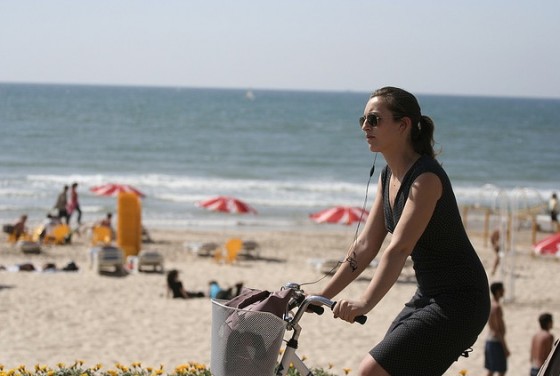
 If bike riding or jogging in Tel Aviv, the sea front is less polluting
Ever wonder why you feel dizzy or have acute shortage of breath when engaging in moderate outdoor exercise like bike riding or jogging in cities where air pollution is higher than normal – especially in heavily polluted Middle Eastern cities like Tehran and Cairo? New medical studies are finding out that too much exposure to air pollution during your younger life will result in brain damage later on in life. The studies, which include MRI brain scans, are finding out that diseases such as multiple sclerosis, dementia, Parkinson’s disease, and strokes are the result of exposure to air pollution particles, especially “extra fine” particles. What makes matters worse, this exposure is even more debilitating if it occurs when engaging in stressful body activities like sports or exercise.
Cairo on a “black cloud” day
These findings are not good news for people living in heavily air-polluted urban environments especially large cities in the Middle East like Cairo, Tehran, and even Tel Aviv.
The above mentioned studies correlate large concentrations of exhaust fumes from various kinds of vehicles as being some of the most dangerous to people who breathe them in from being outside – especially those under physical stress from strenuous exercise.
Conclusions are that people engaging in strenuous exercise such as jogging or bike riding in a heavily air polluted environment is actually dangerous to their health and that they may not even be aware of this fact. As noted in the article Pollution and the Brain:
“This is because (during strenuous exercise) your tissues, including the brain, are low on oxygen, and free radicals are generated by the exercise and you may have low energy levels. Most of these pollution particles damage tissue through inflammation and high free-radical generation.”
Western population areas have managed to reduce air pollutions levels somewhat by requiring the installation of air pollution reductions devices like catalytic converters on new cars.
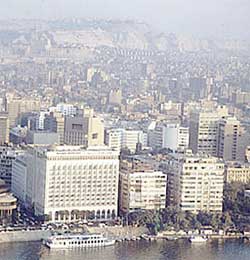 A “good” air pollution day in Cairo
This air pollution problem is aggravated immensely in Middle Eastern cities, like Cairo where more than 60% of its 4.5 million cars, trucks, and other vehicles (including motor cycles and bikes) are more than 10 years old and not equipped with catalytic converters and other anti-pollution devices. Not only that, Cairo has additional air pollution problems from unauthorized copper and lead smelters, which release toxic fumes into the air.
Although previous Green Prophet articles have called for a “cycling revolution” in Cairo, and also offer guides to traveling by bicycle in the Middle East, it’s a good idea to avoid the heavily polluted cities.
Tehran, with 3 million cars and other vehicles (some of them dating back the pre-revolutionary days) is close behind on the air pollution scale. When it was recently reported that 27 people die from the effects of air pollution in Tehran every day and that Tehran residents are constantly complaining about the air and water pollution in their city, their complaints usually fall of deaf ears.
Extremely high levels of ozone(O3), one of the main components of photo chemical pollution or smog as well as other dangerous pollutants such as sulfur dioxide (SO2), Nitrogen Oxide (NO2), Carbon Monoxide (CO), and various particles make Tehran’s air very difficult to breath on a normal basis, much less while engaging in stressful exercise.
If one still wants to engage in stressful outside exercise activities in these cities, it might be a good idea to be where the wind is blowing, and most of the air pollution is behind you instead of the other way around. Therefore, in either Tehran or Cairo, or Tel Aviv for that matter, try to be on the west side of these cities in order to breathe less polluting westerly winds.
And when the air pollution is exceptionally high, like in Cairo every autumn when the so-called “black cloud” forms over the city it is best to stay indoors.
Read more on heavily polluted Mid East cities and other locations:
Israeli Study: Smog Bad for Wall Street
The Compact City as Sustainable Urban Form Can Reduce Air Pollution



Like I wrote above – have the wind in your face when you exercise. Less free radicals that way.
Thanks for presenting this incredibly useful article! I’ve been hardly aware of the level of air pollution present in cities such as those you mentioned. One would think that by now the communities would have ceased to bear it… hopefully findings like the medical studies you mentioned and others will sound bells of alarm with increasing frequency and prominence.
Can we protect our brains from free radicals by wearing a helmet? One coated in aluminum perhaps? 🙂