

Iraqi Sheikh Threatens To Demonstrate If Kurds Don’t Share Water

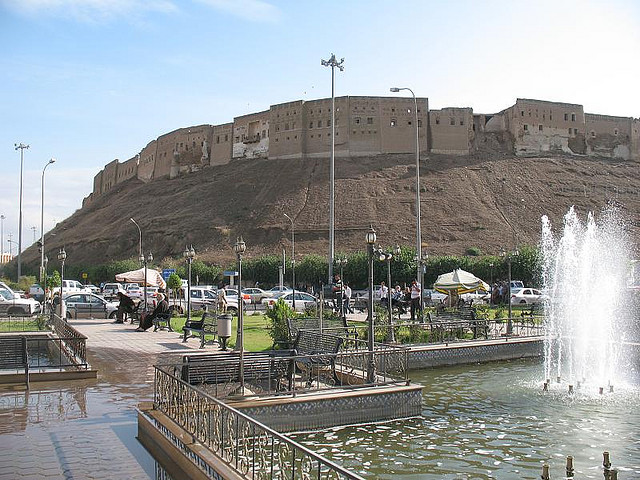
kurdistan-iraq-water-fountainDespite this water fountain in Kurdistan, water there is scarce. This is not how poor Iraqis perceive their own shortages.

We have long suspected that in the coming years, as climate change and population expansion put pressure on natural resources, conflicts will arise. The ongoing Egyptian protests demonstrate how repressed rage eventually surfaces when autocrats rule and people are deprived of basic goods and services. It is also interesting how such suffering can skew perception. Iraqis living in the oil-rich Kirkuk province near Kurdistan believe that their Kurdish neighbors are maliciously depriving them of water via the Dukan Dam, though that is not the case. Water scarcity in the entire Middle East region is putting pressure on everyone, but already tense Sunnis seek to pin the blame. Sheikh Khaled al Mafraji told Al Arabiya that their Kurdish neighbors are closing off the dam valves during winter, which means that they do not have enough water to drink or for irrigation. UN figures show that of the 900,000 inhabitants of Kirkuk, 16% rely on agriculture.

They farm wheat and corn in the winter and sesame, tomatoes, and watermelon in the summer.

Sheikh Mafraji added that he was prepared to organize demonstrations if the situation doesn’t improve.

Cooler heads show a different perspective. One landowner describes how in 2005, peasants were forced to give up 1/3 of their land. They claimed that Kurds then exerted pressure through water deprivation.

In Abdul Rahman al-Obeidi’s view, officials in Baghdad and the Sulaimaniyah province are not doing enough to avert what is a potential crisis.

At present, the region is receiving half of its usual annual rainfall. And the dam, which currently holds 1.3 million cubic meters of water, is dangerously low. Of that amount, only 600,000 may be used, since the rest is being held as an emergency reserve.

And the dam on the lesser Zab river has been closed every year during winter in order to preserve water for spring farming.

Tahseen Kader is the former Minister of water resources for the Kurdistan government. Given that many of Kirkuk’s residents are in fact Kurdish, he suggests it is absurd to suggest that they would deliberately harm their neighbors.

With a long history of ethnic tensions between Kurds and Iraqis, both governments would do well to arrest this problem before it gets out of control.

:: Al Arabiya

More on water shortages in the Middle East:

Yemen’s Water Shortage Could Worsen Security

In The Face Of Nile-lessness, Egyptians Protest Water Shortages

Thailand To Help Jordan Make Artificial Rain

image via martijn.munneke
Tafline Laylin
Tafline Laylinhttp://www.greenprophet.com
As a tour leader who led “eco-friendly” camping trips throughout North America, Tafline soon realized that she was instead leaving behind a trail of gas fumes, plastic bottles and Pringles. In fact, wherever she traveled – whether it was Viet Nam or South Africa or England – it became clear how inefficiently the mandate to re-think our consumer culture is reaching the general public. Born in Iran, raised in South Africa and the United States, she currently splits her time between Africa and the Middle East. Tafline can be reached at tafline (at) greenprophet (dot) com.

LEAVE A REPLY

Please enter your comment!
Please enter your name here

TRENDING

Farm To Table Israel Connects People To The Land

Farm To Table Israel is transforming the traditional dining experience into a hands-on journey.

Solar power brings life to Kurdish village decades after chemical attack

Survivors and their descendants welcomed the new panels as a tangible sign that their suffering has not been forgotten. “We lost entire families to the gas,” said one resident who asked not to be named. “Now our children study under electric light and we can store our produce all year round. This is justice in the form of sunlight.”

Iran’s holiest city about to run dry as terror chosen over water management

Iran’s second-largest city, Mashhad, is facing an acute water emergency after dam reservoirs feeding the city fell below three percent capacity, according to Iranian state and local media. Officials warn that without rainfall or improved inflows from neighboring Afghanistan, the city’s supply could soon collapse.

Arab agricultural land is on the brink

Across the Arab world, croplands face a perfect storm of stressors. Excessive fertilizers and pesticides erode soil ecology. Poor drainage and over-irrigation drive salinization, leaving fields crusted with salt. Rising temperatures, dwindling groundwater, and more frequent sand-and-dust storms—all amplified by climate change—compound the crisis.

Jordan turns to ancient fire and mines volcanic soil to solve water crisis

In the volcanic highlands of northern Jordan, north of Amman engineers are mining a natural resource not for energy, but for agriculture. The material: crushed volcanic rock, now processed into a mineral-rich soil that may hold the key to reducing water and fertilizer demand in arid regions.

Qatar’s climate hypocrisy rides the London Underground

Qatar remains a master of doublethink—burning gas by the megaton while selling “sustainability” to a world desperate for clean air. Wake up from your slumber people.

How Quality of Hire Shapes Modern Recruitment

A 2024 survey by Deloitte found that 76% of talent leaders now consider long-term retention and workforce contribution among their most important hiring success metrics—far surpassing time-to-fill or cost-per-hire. As the expectations for new hires deepen, companies must also confront the inherent challenges in redefining and accurately measuring hiring quality.

8 Team-Building Exercises to Start the Week Off 

Team building to change the world! The best renewable energy companies are ones that function.

Thank you, LinkedIn — and what your Jobs on the Rise report means for sustainable careers

While “green jobs” aren’t always labeled as such, many of the fastest-growing roles are directly enabling the energy transition, climate resilience, and lower-carbon systems: Number one on their list is Artificial Intelligence engineers. But what does that mean? Vibe coding Claude? 

Somali pirates steal oil tankers

The pirates often stage their heists out of Somalia, a lawless country, with a weak central government that is grappling with a violent Islamist insurgency. Using speedboats that swarm the targets, the machine-gun-toting pirates take control of merchant ships and then hold the vessels, crew and cargo for ransom.

Leopoldo Alejandro Betancourt López Turned Ocean Plastic Into Profitable Sunglasses

Few fashion accessories carry the environmental burden of sunglasses. Most frames are constructed from petroleum-based plastics and acrylic polymers that linger in landfills for centuries, shedding microplastics into soil and waterways long after they've been discarded. Leopoldo Alejandro Betancourt López, president of the Spanish eyewear brand Hawkers, saw this problem differently than most industry executives.

Why Dr. Tony Jacob Sees Texas Business Egos as Warning Signs

Everything's bigger in Texas. Except business egos.  Dr. Tony Jacob figured...

Israel and America Sign Renewable Energy Cooperation Deal

Other announcements made at the conference include the Timna Renewable Energy Park, which will be a center for R&D, and the AORA Solar Thermal Module at Kibbutz Samar, the world's first commercial hybrid solar gas-turbine power plant that is already nearing completion. Solel Solar Systems announced it was beginning construction of a 50 MW solar field in Lebrija, Spain, and Brightsource Energy made a pre-conference announcement that it had inked the world's largest solar deal to date with Southern California Edison (SCE).

Related Articles

Popular Categories