
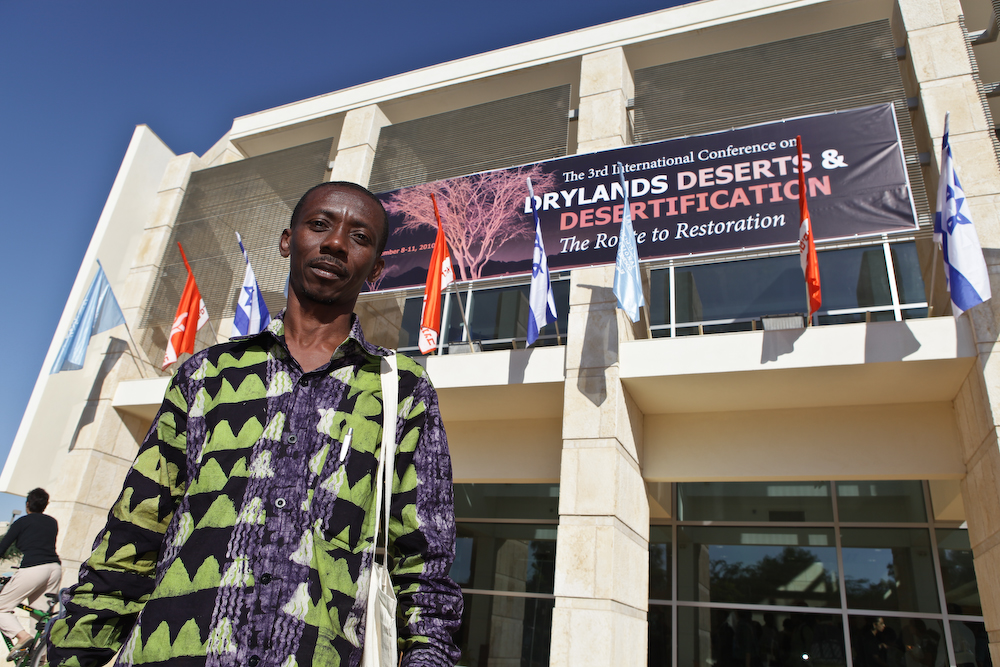

 Dr. Gotlieb reports from the the Drylands, Deserts and Desertification Conference in Israel – an event drawing hundreds from ten countries. With a species extinct every 20 minutes the problem is more severe than we might think.
Dire predictions, and new approaches, described the tenor of presentations made during the opening day of the Drylands, Deserts and Desertification Conference last week held at the Sde Boker campus of Ben-Gurion University in Israel.
The conclave, the third annual international conference organized by the University’s Jacob Blaustein Institutes for Desert Research in cooperation with UNESCO was devoted to the theme “The Route to Restoration.” Organized by BGU professor Alon Tal, a leading environmental figure in Israel, over five hundred participants from fifty countries were expected to have participated at the four-day conference. The theme of restoration was presented at the very start of the meeting where the plenary lecture was given by Professor Michael Rosenzweig of the University of Arizona (Tuscon).
Speaking on the subject of ecological restoration in the drylands, evolutionary biologist Prof. Rosenzwei began his talk by citing the unprecedented peril posed by the biodiversity crisis.
He stated that the crisis “is much, much greater than recognized by the international community.”
Prof. Michael Rosenzweig (below right) differs with a major school of ecology that advocates the closing off from human activity of territories that are particular rich in biodiversity. These areas include approximately thirty ecological “hot spots” around the world.
Hot spots, which together cover just over two percent of the earth’s land mass are characterized by such a great endowment of biomass that by protecting them upward of fifty percent of all plant species and 34 percent of vertebrate animals species could be safeguarded (see Conservation International’s Biodiversity Hot Spots).
The biodiversity crisis is characterized by species loss including extinction due to habitat destruction. It is now estimated that a species becomes extinct every twenty minutes and that a large proportion of bird and mammal species will become extinct in the next 200-300 years as a result of climate change and habitat loss deriving from deforestation, the reef crisis and other forms of environmental degradation.
While the elimination of species is a natural part of evolution, the current rate of extinction is believed to be 100-1000 times greater than expected, a situation that qualifies the current reality as an age of mass extinctions.
At risk is not only the number of species but the diversity of genetic characteristics that survive (see Levin and Levin, American Scientist The Real Biodiversity Crisis).
A further concern that has been less clearly established is that the rate of speciation, the process by which new species arise, may also be in decline.
Reconciliation Ecology
Rather than closing off hot spots and other ecologically vulnerable areas from human activity, Prof. Rosenzweig advocates another approach, reconciliation ecology which he pioneered in such books as Win-Win Ecology and in the journal Evolutionary Ecology Research.
Essentially, reconciliation ecology posits that it is possible to protect biodiversity in areas of human occupancy if the economic activities undertaken foster rather than harm diverse species. Areas where species loss and other damage to flora and fauna has taken place can actually be revived by carefully controlled regimes that enhance and promote the regeneration of biological stocks and species restoration.
Reconciliation ecology envisions designing “ways we use the land for living, for profit, for recreation and for producing our food, fuel, fiber, minerals and building materials,” in a manner that “supports many other species. Sharing our land and having it, too,” as described by the Alliance for Reconciliation Ecology.
Living Laboratory
Michael Rosenzweig and his group have a living laboratory at Tumamoc Hill in Tucson, Arizona. The site has been home to successive settlements including a village established there some 2300 years ago. Today it is a recreational site for hiking and its unique ecosystem is maintained as a nature reserve by a partnership of the University of Arizona and the Pima County. Activities for adults, students and school children ranging from astronomical observation, instruction in soil science and topology, cactus cultivation and surveying plant species take place at Tumamoc Hill.
At Tumamoc reconciliation ecology the approach is applied. It entails inventorying existing species and establishing and maintaining new habitats to conserve species diversity. This is done in a way that integrates, rather than excludes human occupancy and activity.
Nest Towers in Portugal, A Salt Marsh in Eilat
Prof. Rosenzweig also described a case he is familiar with in Castro Verde, Portugal where the restoration of a dwindling bird population, kestrels (a type of small falcon) was revived through the invigoration of agriculture in the region. Emphasis was placed on cultivating crops that the birds could use as food. Nest towers were erected to provide new homes for the birds whose original arboreal nesting grounds had been denuded. The agricultural restoration countered pervasive soil erosion in the area by ninety percent and increased yields in the region by a factor of fifty.
Prof. Rosenzweig also cited the case of the International Birding and Research Centre where a salt marsh was established by ornithologists Dr. Reuven Yosef on a garbage dump in northern Eilat.
The natural marsh, used by migratory birds flying the air lane between Europe and southern Africa and that passes directly over Israel provides ecological service (a rest area and food source) to an estimated half a billion to one billion birds representing 230 species each year.
After the original salt marsh was destroyed in order to make way for hotels and other infrastructure for Eilat’s tourist industry, Dr. Yosef created a new ecosystem by involving volunteers from all over the world, including a program conducted in cooperation with the Earthwatch Institute (for further reading see An Oasis Builder In A Land Of Strife).
The creation of the new habitat in the midst of a densely populated urban center fostered new sets of flora and fauna in a system that is scientifically designed and maintained. It has enabled the great avian migration to continue over Israel. The wellbeing of this migration has myriad ecological implications throughout three continents.
The Tumamac, Castro Verde and Eilat cases offer a new view to ecological restoration. Rather than leading to the closure of the regions from human settlement it promotes creating an optimal relationship between people and the natural involving adaptive practices that, aside from enhancing biodiversity serve to create employment opportunities and increase incomes in marginal areas. The approach is to reconcile human activity with the maintenance and enhancement of new habitats or the restoration of diminished ones.
Photo by Wolfgang Motzafi-Haller courtesy Ben-Gurion University.


Comments are closed.