Honey Is Bittersweet In The Middle East

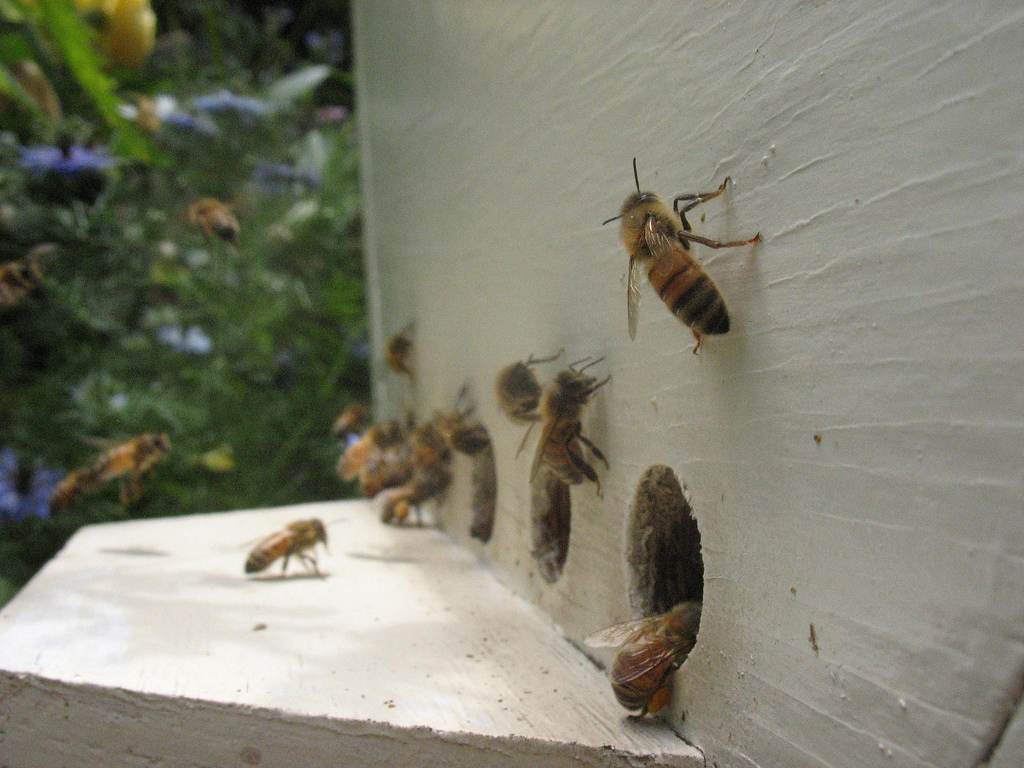
apiary beehive israel lebanonThe Honey Council, Hive Thievery and Bee Ecology education in Arabic:  In Israel and Lebanon, honey is both a problem and a solution. Image via orinrobertjohn

Archeologists have uncovered beehives in northern Israel that date back 3 000 years.  A courtyard in the  ancient city of Rehov was home to bees producing honey in at least 30, possibly as many as 100, hives. The discovery firmly establishes the fact that beekeeping was known and practiced here in the Middle East since Biblical times. Honey and beeswax, precious commodities then, are still valuable crops. You would think that everyone’s gotten used to the routine by now.

Yet the word “honey” leaves a bitter taste in many Israeli mouths. The Israel Honey Council backs claims made by  beekeepers who say that thieves carry night-time raids on unguarded orchards, stealing hundreds of hives yearly and selling them to contacts in Palestinian Authority territory.

Local courts take hive theft lightly, often releasing thieves the same day they’re arrested. The Honey Council’s deputy manager, Shimon Erlinger, told Green Prophet:

“The courts don’t understand the consequences of hive theft. It’s not only the farmer who suffers loss. Fruit crops diminish when the trees aren’t pollinated. Avocados, for example, depend entirely on pollination. No bees, no fruit.”

It seems that some judges need to become educated in the importance of bees to the ecology.

In Lebanon, though, honey and beekeeping are a positive note. The Daily Star reports that children in ten Lebanese schools study the importance of honey and beekeeping for the environment and the economy.

The project is sponsored by the Lebanese Association for Forests, Development and Conservation. In another progressive step, the Unity and Co-operation for the Development of Peoples organization from Italy hopes to launch a project to educate Lebanese farmers and beekeepers about the harm done to bees by pesticides.

Sustainable agriculture and conservation in the Middle East. In Hebrew, in Arabic. It takes educating adults and children to make it happen.

More on honey and bees:
Urban Beekeeping Keeps NYC Green
An Israeli Cure for Bee-Colony Virus

Miriam Kresh
Miriam Kreshhttps://www.greenprophet.com/
Miriam Kresh is an American ex-pat living in Israel. Her love of Middle Eastern food evolved from close friendships with enthusiastic Moroccan, Tunisian and Turkish home cooks. She owns too many cookbooks and is always planning the next meal. Miriam can be reached at miriam (at) greenprophet (dot) com.

LEAVE A REPLY

Please enter your comment!
Please enter your name here

TRENDING

Earth building with Dead Sea salt bricks

Researchers develop a brick made largely from recycled Dead Sea salt—offering a potential alternative to carbon-intensive cement.

Farm To Table Israel Connects People To The Land

Farm To Table Israel is transforming the traditional dining experience into a hands-on journey.

Remilk makes cloned milk so cows don’t need to suffer and it’s hormone-free

This week, Israel’s precision-fermentation milk from Remilk is finally appearing on supermarket shelves. Staff members have been posting photos in Hebrew, smiling, tasting, and clearly enjoying the moment — not because it’s science fiction, but because it tastes like the real thing.

Lebanon reporting fellowship for truth-tellers

Lebanon’s environmental crisis is not abstract. It is shaped by war, neglect, corruption, and silence. Rivers carry untreated sewage and industrial waste into the Mediterranean. Dynamite fishing shatters fragile marine ecosystems along the coast. In many areas, Hezbollah’s military presence and decades of instability have made environmental accountability nearly impossible. What flows into the sea is not only pollution — it is politics, poverty, and unresolved war. And yet, these stories are rarely told with depth, care, or courage. Silat Wassel’s Environmental Justice Journalism Fellowship is opening space for exactly that. They are looking for a few brave souls. 

An Army of Healers Wins the 2025 IIE Goldberg Prize for Peace in the Middle East

In a region more accustomed to headlines of loss than of listening, the Institute of International Education (IIE) has chosen to honor something quietly radical: healing. The 2025 Victor J. Goldberg Prize for Peace in the Middle East has been awarded to Nitsan Joy Gordon and Jawdat Lajon Kasab, the co-founders of the Army of Healers, for building spaces where Israelis and Palestinians — Jews, Muslims, Christians, Druze, and Bedouins — can grieve, speak, and rebuild trust together.

Qatar’s climate hypocrisy rides the London Underground

Qatar remains a master of doublethink—burning gas by the megaton while selling “sustainability” to a world desperate for clean air. Wake up from your slumber people.

How Quality of Hire Shapes Modern Recruitment

A 2024 survey by Deloitte found that 76% of talent leaders now consider long-term retention and workforce contribution among their most important hiring success metrics—far surpassing time-to-fill or cost-per-hire. As the expectations for new hires deepen, companies must also confront the inherent challenges in redefining and accurately measuring hiring quality.

8 Team-Building Exercises to Start the Week Off 

Team building to change the world! The best renewable energy companies are ones that function.

Thank you, LinkedIn — and what your Jobs on the Rise report means for sustainable careers

While “green jobs” aren’t always labeled as such, many of the fastest-growing roles are directly enabling the energy transition, climate resilience, and lower-carbon systems: Number one on their list is Artificial Intelligence engineers. But what does that mean? Vibe coding Claude? 

Somali pirates steal oil tankers

The pirates often stage their heists out of Somalia, a lawless country, with a weak central government that is grappling with a violent Islamist insurgency. Using speedboats that swarm the targets, the machine-gun-toting pirates take control of merchant ships and then hold the vessels, crew and cargo for ransom.

Leopoldo Alejandro Betancourt López Turned Ocean Plastic Into Profitable Sunglasses

Few fashion accessories carry the environmental burden of sunglasses. Most frames are constructed from petroleum-based plastics and acrylic polymers that linger in landfills for centuries, shedding microplastics into soil and waterways long after they've been discarded. Leopoldo Alejandro Betancourt López, president of the Spanish eyewear brand Hawkers, saw this problem differently than most industry executives.

Why Dr. Tony Jacob Sees Texas Business Egos as Warning Signs

Everything's bigger in Texas. Except business egos.  Dr. Tony Jacob figured...

Israel and America Sign Renewable Energy Cooperation Deal

Other announcements made at the conference include the Timna Renewable Energy Park, which will be a center for R&D, and the AORA Solar Thermal Module at Kibbutz Samar, the world's first commercial hybrid solar gas-turbine power plant that is already nearing completion. Solel Solar Systems announced it was beginning construction of a 50 MW solar field in Lebrija, Spain, and Brightsource Energy made a pre-conference announcement that it had inked the world's largest solar deal to date with Southern California Edison (SCE).

Related Articles

Popular Categories