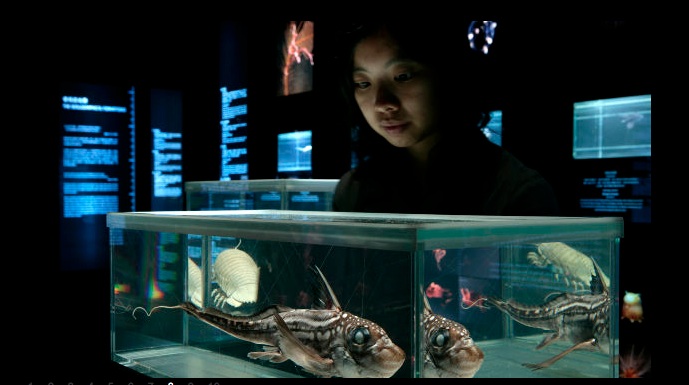

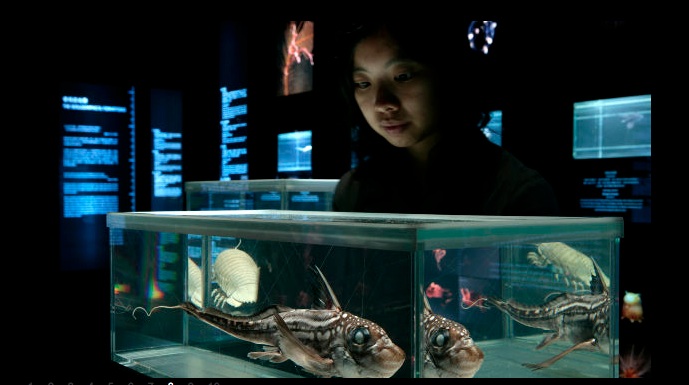
 The Deep, now at The Bloomfield Science Museum in Jerusalem offers a rare glimpse into the biological bounty of the planet’s oceans. Image © Claire Nouvian
A visit to The Deep, an exhibition now appearing at Jerusalem’s Bloomfield Science Museum is an educational foray into the planet’s least known repository of biological resources. Instituted in commemoration of the International Year of Biodiversity, The Deep focuses on the other-worldly forms of life that exist in conditions of “perpetual darkness, bone-chilling cold, crushing pressure and jaw-dropping geology,” and that attests to the “infinite mystery if our planet’s last true frontier.”
Visitors to The Deep are introduced to the realms of oceanography and marine biology – disciplines further from the limelight than those dealing with that better known frontier – outer space. While life elsewhere in the cosmos has yet to be found, the exhibit reveals that “the [ocean] depths make up the greatest reservoir of life on the planet,” with an estimated “10 million species still to be discovered. Despite that “the high seas cover 60% of the Earth’s surface and represent 98% of its volume, they are one of the least protected zones on the planet.”
The Deep begins with a large panel offering a cross-sectional depiction of the ocean. Oceans are divided into zones, each characterized by distinct conditions and ecosystems: the pelagic zone, the midwater, the benthic zone, and the seafloor.
These areas vary from each other in terms of amount of light, temperature, salinity, pressure and oxygen concentration. As a result there are profound differences in the kind of life forms supported at the various layers.
Beneath the Twilight Zone
At what is known as the “twilight of the ocean,” 150 meters beneath the surface (the ocean is 11,000 meters deep at its lowest point, the Mariana Trench in the western Pacific), 99% of all light has been absorbed. Exploration of these depths is a recent phenomenon dating from the 1980s when submersibles and Remotely Operated Vehicles (ROVs) operated by American research institutions discovered largely gelatinous and often gigantic organisms there.
The sea level between 200 and 600 meters is termed the “glass menagerie” where the primary strategy for survival is appearing invisible to predators. The animals at this level are made up of up to 98 percent water. These beings include some of the longest animals on the planet reaching up to 100 meters in length.
In addition to the exhibit’s many photos and videos – some of which are being shown for the first time — The Deep includes a collection of truly incredible organisms exquisitely preserved.
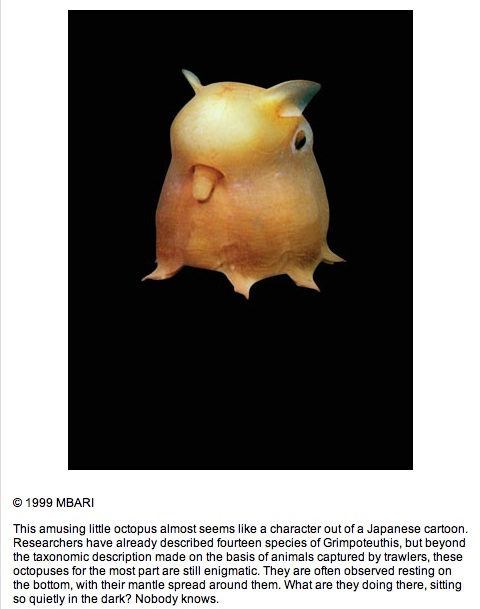
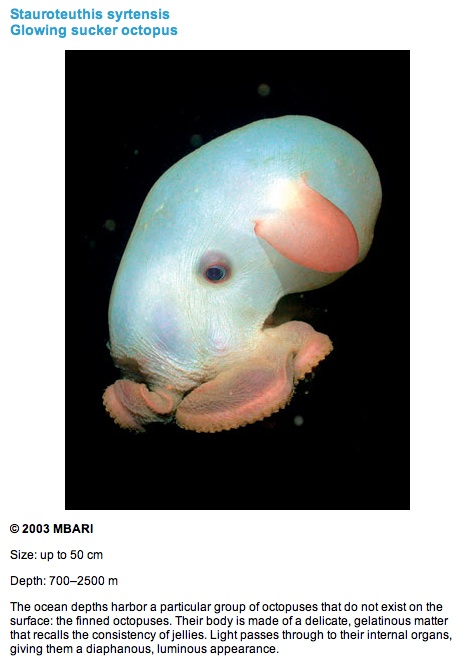
Seeing them one wonders whether they have been created with incredible resolution by Pixar, the digital animation company or if they do really exist. With their lush colors, translucence, exquisite fragility and glowing shapes and forms the primary mission of such creatures is to find food, feed and mate — in total darkness.
Their sensory adaptations to meet these needs and to avoid becoming the prey of predators further along the food chain has resulted in marine life that take the form of spirals, cones and other geometric forms one might believe were computer-generated. The variety of antennae and other sensors they have developed defy belief.
Life in the Oceanic Black
At one thousand meters there is no light whatsoever and the creatures found at these depths engaged little movement and have no skeletons or scales. Given the scarcity of oxygen and food the residents of these depth have developed strategies based on slow metabolism and the evolution of biological features (immense teeth, extensible stomachs) so as not to miss any source of food.
The exhibit documents the relatively brief history of oceanographic expeditions that began in the mid-1800s when the Norwegian and British governments began dispatching scientific expeditions aboard tall-masted ships; one of these, the British HMS Challenger discovered hundreds of new genra and species during its voyages.
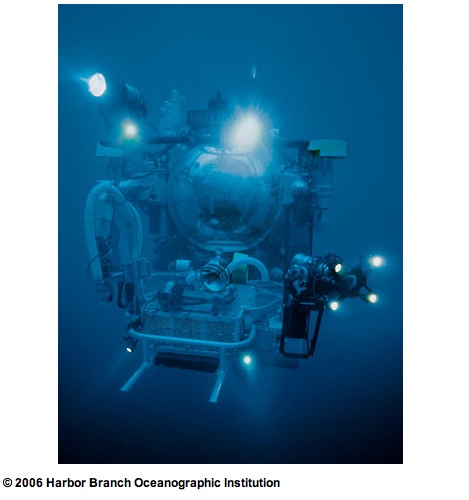
These ships were succeeded by trawlers dragging nets, bathyscaphes (in the 1950s), and later high-tech submersibles (like the Woods Hole Oceanographic Institute’s Alvin) and underwater robots – all of which have made remarkable discoveries. They have not only revealed splendorous living creatures but also land forms and ecosystems that were previously unknown: Hydrothermal vents, methane seeps and whale carcasses surrounded by large amounts of biomass sustained by “chemosynthesis,” the derivation of energy sources from chemical reactions.
The Deep’s curator is Claire Nouvian, a prize-winning journalist and photographer who states that “preserving the deep sea from irreversible destruction is my mission in life.” Among her motives in creating the exhibit was her desire to “share my fascination for The Deep sea with everyone… nothing replaces the contact with reality.”
Her purpose is “to create a bond between the public and the oceans’ depths” since she believes that The Deep is “unjustly punished by its very condition: it is remote from us.”
As a result “these distant environments suffer more than other ecosystems from their exploitation because there is, by nature, no possible witness.”
The Deep, was made in partnership with the organization, BLOOM (an organization founded by Nouvian and devoted to marine conservation), the National History Museum of Paris and TOTAL Foundation for Biodiversity and the Sea.
A visit to The Deep transports the visitor to an awesome planetary environment inhabited by beings that have not – yet — been threatened to the same extent as terrestrial and aquatic flora and fauna. The exhibit is devoted to bringing an incredible array of little-known life forms to the attention of the public and to conserving the habitats where these creatures dwell – among the rarest and most difficult physical conditions imaginable.
The Deep does not explicitly deal with the burning environmental issues of the day – sea level rise due to glacial melting, the degradation of coastal areas and estuaries, over-fishing and the threat to marine species or the destruction of vast expanses of marine systems by human-generated hazards (for example, the ongoing oil spill in the Gulf of Mexico).
These topics await exhibitions of their own. Still the Deep should be visited for the lessons it does offer – a glimpse into a spectacular, but little-known world that is a vital part of our own.
Living in or passing through the Middle East? Visit the Bloomfield Museum to see The Deep.
Fascinated? Read more on protecting our marine environment:
6 Tips to Clean the Sea on World Ocean Day
Iron-Rich Whale Poop Essential for Our Seas
Hunt For Air France Flight Brings Ocean Garbage Problem to the Surface