
The Best Way to Keep Buildings Green is Not to Build New Ones

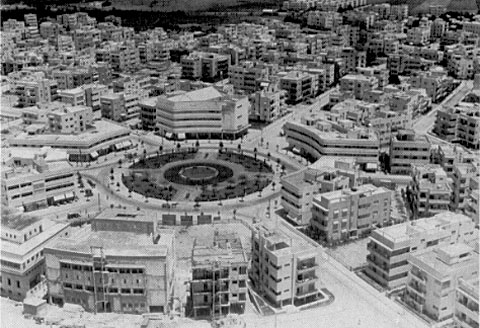
Central Tel Aviv, Cira 1940’s: A Sustainable Idea Then and Now

All over the Middle East, many old and often historical buildings are being torn down in order to “make way” for new, modern ones. This trend is especially true in cities like Cairo, Egypt and Tel Aviv, Israel, where the quaint and classical architecture of the “colonial period” (which also applies to India) is often forced to give way to glass faced skyscrapers which even though are claimed to be safer in the event of earthquakes and other natural disasters are less sustainable in regards to keeping them cool in summer or warm in winter.

This issue was expressed in an article in Treehugger where they reported that older styles of architecture, built before the “thermostat age” we live in now, had to be constructed to enable people to cope with the climate they lived in – particularly in regions where people experienced extreme changes in temperature during various times of the year.Many Middle Eastern countries have buildings constructed in a manner known as Islamic Art and Architecture, which involves using arches, thick walls and small windows to keep out the sun’s heat in summer, and warm the occupants during the colder winter months.

Although Islamic architecture also incorporates earlier Romanesque and Byzantine styles, the main purpose was durability and protection against the elements as well as beauty to the beholder. We’ve talked about countries such as Saudi Arabia are now incorporating the sustainability of Islamic architecture into newer structures such as the recently competed KAUST University in which the buildings themselves have been constructed in order to screen out a good deal of the heat that is generated by the hot Arabian sun; making the internal environment  more sustainable for the students.

But the main idea in preserving older buildings is simply to use them and not tear them down for the purpose of constructing a new, less sustainable one.

An example of efforts being made to preserve older styles of architecture can be seen today in Tel Aviv, Israel, where parts of the inner “core” city are being preserved and designated as historical areas. Tel Aviv is one of the few cities in the world where the architectural ideas of Sir Patrick Geddes are being designed as World Heritage sites by the UN organization UNESCO.

Geddes’ unique “White Building” architectural styling was used in construction of buildings in Tel Aviv during the period from 1930 to 1948, and utilized the principles of large balconies, thick walls with small windows, and white paint to reflect the sun’s heat.

During Tel Aviv’s 100th anniversary celebration last year, a lot of mention was made about the city’s unique “White City Architecture” and efforts being made to preserve it.

Mention was also made, however, of the construction of many new high rise buildings, many of 40 stories or more, that have been built recently, often at the expense of older, perhaps more sustainable buildings.

While the new, glass exterior skyscrapers certainly look nice, they require a lot of energy to heat and cool them that in the long run is counter-productive to the environment. We might all take a lesson from people such as Geddes, and make more efforts to preserve and restore the older buildings, instead of replacing them with news ones. This idea is especially relevant from an environmental point of view. And to quote what was written in the above Treehugger article: The greenest brick is the one that is already in the wall.

::TreeHugger

Articles about sustainable Middle Eastern architecture:

Tel Aviv’s 100th: Sustainability and Beyond

Saudi Arabia’s KAUST University Designed as a Model of Environmental Sustainability

Hassan Fathy: the Middle East Father of Sustainable Architecture

Maurice Picow
Maurice Picowhttps://www.greenprophet.com/
Maurice Picow grew up in Oklahoma City, U.S.A., where he received a B.S. Degree in Business Administration. Following graduation, Maurice embarked on a career as a real estate broker before making the decision to move to Israel. After arriving in Israel, he came involved in the insurance agency business and later in the moving and international relocation fields. Maurice became interested in writing news and commentary articles in the late 1990’s, and now writes feature articles for the The Jerusalem Post as well as being a regular contributor to Green Prophet. He has also written a non-fiction study on Islam, a two volume adventure novel, and is completing a romance novel about a forbidden love affair. Writing topics of particular interest for Green Prophet are those dealing with global warming and climate change, as well as clean technology - particularly electric cars.
2 COMMENTS
  1. I’m not an expert, but wasn’t Patrick Geddes more concerned with the design and planning of the city as a whole, rather than the architecture of the buildings? Doesn’t the distinct White City style owe more to Bauhaus and the International Style? Not finding fault, just really interested…

LEAVE A REPLY

Please enter your comment!
Please enter your name here

TRENDING

Earth building with Dead Sea salt bricks

Researchers develop a brick made largely from recycled Dead Sea salt—offering a potential alternative to carbon-intensive cement.

Farm To Table Israel Connects People To The Land

Farm To Table Israel is transforming the traditional dining experience into a hands-on journey.

Remilk makes cloned milk so cows don’t need to suffer and it’s hormone-free

This week, Israel’s precision-fermentation milk from Remilk is finally appearing on supermarket shelves. Staff members have been posting photos in Hebrew, smiling, tasting, and clearly enjoying the moment — not because it’s science fiction, but because it tastes like the real thing.

Quintin Tarantino walks on a bike lane in Tel Aviv

Quentin Tarantino lives in Israel now, quietly blending into Tel Aviv life (which is pretty loud and late night!) — until Tel Aviv, of course, notices him.

An Army of Healers Wins the 2025 IIE Goldberg Prize for Peace in the Middle East

In a region more accustomed to headlines of loss than of listening, the Institute of International Education (IIE) has chosen to honor something quietly radical: healing. The 2025 Victor J. Goldberg Prize for Peace in the Middle East has been awarded to Nitsan Joy Gordon and Jawdat Lajon Kasab, the co-founders of the Army of Healers, for building spaces where Israelis and Palestinians — Jews, Muslims, Christians, Druze, and Bedouins — can grieve, speak, and rebuild trust together.

Qatar’s climate hypocrisy rides the London Underground

Qatar remains a master of doublethink—burning gas by the megaton while selling “sustainability” to a world desperate for clean air. Wake up from your slumber people.

How Quality of Hire Shapes Modern Recruitment

A 2024 survey by Deloitte found that 76% of talent leaders now consider long-term retention and workforce contribution among their most important hiring success metrics—far surpassing time-to-fill or cost-per-hire. As the expectations for new hires deepen, companies must also confront the inherent challenges in redefining and accurately measuring hiring quality.

8 Team-Building Exercises to Start the Week Off 

Team building to change the world! The best renewable energy companies are ones that function.

Thank you, LinkedIn — and what your Jobs on the Rise report means for sustainable careers

While “green jobs” aren’t always labeled as such, many of the fastest-growing roles are directly enabling the energy transition, climate resilience, and lower-carbon systems: Number one on their list is Artificial Intelligence engineers. But what does that mean? Vibe coding Claude? 

Somali pirates steal oil tankers

The pirates often stage their heists out of Somalia, a lawless country, with a weak central government that is grappling with a violent Islamist insurgency. Using speedboats that swarm the targets, the machine-gun-toting pirates take control of merchant ships and then hold the vessels, crew and cargo for ransom.

Leopoldo Alejandro Betancourt López Turned Ocean Plastic Into Profitable Sunglasses

Few fashion accessories carry the environmental burden of sunglasses. Most frames are constructed from petroleum-based plastics and acrylic polymers that linger in landfills for centuries, shedding microplastics into soil and waterways long after they've been discarded. Leopoldo Alejandro Betancourt López, president of the Spanish eyewear brand Hawkers, saw this problem differently than most industry executives.

Why Dr. Tony Jacob Sees Texas Business Egos as Warning Signs

Everything's bigger in Texas. Except business egos.  Dr. Tony Jacob figured...

Israel and America Sign Renewable Energy Cooperation Deal

Other announcements made at the conference include the Timna Renewable Energy Park, which will be a center for R&D, and the AORA Solar Thermal Module at Kibbutz Samar, the world's first commercial hybrid solar gas-turbine power plant that is already nearing completion. Solel Solar Systems announced it was beginning construction of a 50 MW solar field in Lebrija, Spain, and Brightsource Energy made a pre-conference announcement that it had inked the world's largest solar deal to date with Southern California Edison (SCE).

Related Articles

Popular Categories