

 Moshe Safdie’s Habitat ’67 designed for Montreal World Fair a model of sustainable living. Image via Wikipedia.
Sustainable building is gaining some speed in the Middle East, but at a pace that is powerless against escalating climate damage. The Gutman Visitation Center’s Living Building in Jerusalem and Qatar’s LEED certified convention center offer good examples of what can and should be done, but we can only hope that influential architects and developers will do more to voluntarily adopt better building standards.
Moshe Safdie, born in Haifa in 1938, immigrated to Canada and graduated from McGill University in 1961. His architectural career commenced with “Habitat ’67,” designed for the Montreal World Fair, and has developed steadily since.
Although based in Canada and the United States, Safdie set up an office in Jerusalem in the 1970s and played an integral role in developing the old city and linking it with the new city. He has since participated with Modi’in, Yad Vashem Holocaust Museum, and the Rabin Memorial Center not to mention a score of other projects worldwide. While within the Middle East Safdie’s impressive architectural design has done much to advance peace and honor history, his recent projects abroad are even more impressive given their commitment to promote climate stability.
Peace Building
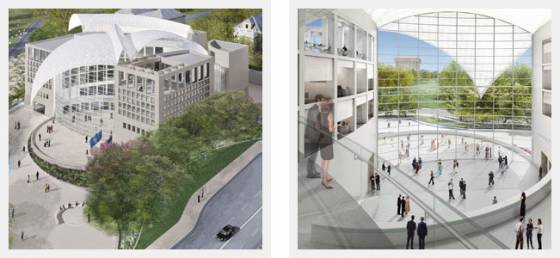
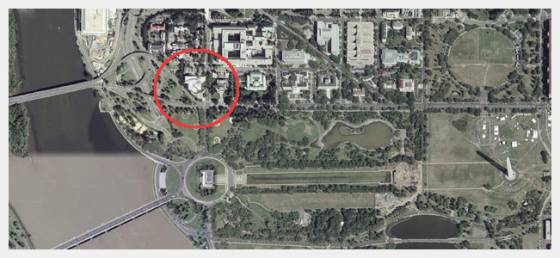
The United States Institute of Peace recently reported that construction of one such project, its headquarters on the Northwest corner of the National Mall in Washington D.C., has been completed. According to the website, the building is expected to be fully operational in 2011 and will nurture efforts to “prevent and resolve international conflicts, promote post-conflict stability and development, and increase conflict management capacity, tools, and intellectual capacity.”
Moshe Safdie and Associates won a competitive bid against 50 other architectural firms to build the “peace building.” The President of the US Institute of Peace says “we are certain, however, that Safdie’s experience, reputation, and creativity working with the project in Washington D.C., and around the globe, will serve this project well.”
Leadership in Energy and Environmental Design
In addition to its peaceful motives, the building is LEED (Leadership in Energy and Environmental Design) Certified. This refers to the United States Green Building Council’s voluntary building standard that can be achieved at four different levels: Certified, Silver, Platinum and Gold.
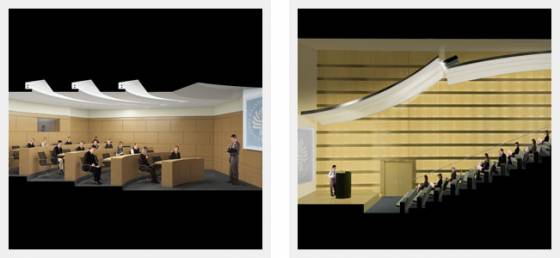
To achieve certified status, the peace building was built on the site of a converted parking lot with a green landscape and shade trees, protects and conserves water, improves energy performance, and will reduce waste and encourage recycling when completed. Though not the most ambitious LEED certification, Safdie’s design takes an important step in the right direction.
Video of Moshe Safdie at TED talk in 2002 (from the archives)
Egypt and the United Arab Emirates both have official Green Building Councils, while other Middle Eastern countries are either emergent or prospective GBC members. Although Israel does not promote LEED, the SI-5281 standard developed in 2005 essentially serves the same purpose.
However, we think that if respected architects like Moshe Safdie insist upon green building materials and methods in the Middle East as well as abroad, lesser known architects and developers will necessarily follow suit.
Read more on green building in the Middle East:
Green Building Takes Off in Turkey
Green housing construction gets underway in Israel, creates jobs in Negev town of Yeruham
Elias Messinas Builds On Green Education From Israel and Practice in Greece



[…] seen many funky buildings on Green Prophet, including Moshe Safdie’s famous Habitat ’67 and beehive shaped architecture in Syria, but the difference between them and Ramot Polin lies in […]
[…] seen many funky buildings on Green Prophet, including Moshe Safdie’s famous Habitat ’67 and beehive shaped architecture in Syria, but the difference between them and Ramot Polin lies in […]
[…] Bring Moshe Safdie’s Green Building to the Middle East […]
[…] throughout the country offer a variety of useful workshops in permaculture, off-grid living, sustainable building, and organic farming. These programs can be as short as one day or as long as an extended […]
[…] Bring Moshe Safdie’s Green Building to the Middle East […]
[…] Bring Moshe Safdie’s Green Building to the Middle East AKPC_IDS += "18583,"; swfobject.embedSWF("http://www.youtube.com/v/XnqhvRLMn5s&rel=0&fs=1&showsearch=0&showinfo=0", "vvq-18583-youtube-1", "425", "344", "9", vvqexpressinstall, vvqflashvars, vvqparams, vvqattributes); Browse topics: architecture, Beirut, Lebanon, urban design, urban planning […]
Isaac: thanks for your input. We will continue to explore these issues as the blogging evolves, and yes! I hope we do maintain the requisite strength and conviction. Stay tuned for more on the Safdie saga.
Sorry about the delay, it took me a few days to get the disqus feed working with my email :)Tafline, you've asked some complicated questions, but lets see where this goes…In terms of how governments in the Middle East are being pressured toward Green Development, I can only speak of one with any degree of expertise. In Israel, there is a growing grassroots movement both locally in cities and nationally on a federal scale that is attempting to push mayors and lawmakers toward more socially just and ecologically sound development. Recently this topic took center stage, when the Netanyahu government proposed a reform that would drastically change Israel's building and planning laws. As most of the land in Israel is owned and protected by federal laws, the sweeping change that Netanyahu and his colleagues wanted to impose frightened and disturbed many people, so much so in fact, that more than 5,000 letters of protest were collected and sent to the government in a period of just a few days last week. On an ongoing basis there are organizations like the Movement for Israeli Urbanism (http://miu.org.il/), Earth's Promise (http://www.earthspromise.org), Bimkom (http://www.bimkom.org/), and others that work on multiple scales to bring issues of sustainable development to the public sphere. The fact that the supreme court put Netanyahu's building and planning reform on hold is a major victory, but there is still a long way to go before comprehensive legislation is passed that will force designers, planners, and builders to work cooperatively to create truly energy saving, smart, and innovative programs. Bottom line – pressure is being exerted, but at the moment, at least in Israel, it is an uphill battle. Do you know what is going on in any of the other Middle Eastern countries?In terms of power that architects, landscape architects, and developers have vis-a-vis persuading the government to enact laws that support green development, I have mixed feelings. On the one hand, I believe that developers can wield a tremendous amount of influence in the halls of power simply through their choice of projects and where they choose to invest their money. If all the developers in Israel (and elsewhere in the Middle East) decided that they would only do projects that met “x” and “y” criteria for sustainability, governments would be forced to listen. Politicians are all capitalists at heart and they have a history of following the money. The flip-side is that designers (i.e. architects and landscape architects) have less power to influence government officials because they are, to a large extent, limited to creating designs/programs that meet the needs of their clients (i.e. the developers). Of course there are superstar architects and landscape architects (like Safdie, Corner, The Olin Group, Gehry, and others) that can do just about anything they want, so there is hope in the design camp as well.All in all, I think the design and development professions hold great potential to positively impact our built and un-built environments. I would like to see more non-governmental organizations that link developers, designers, and citizens in collaborative ways that generate new programs and ideas for development. These hybrid organizations could lead the way in showing what development could be, if it took in to account social, environmental, and economic factors. In Charlottesville, Virginia the Charlottesville Community Design Center has used this formula to influence their municipality to enact laws that support green development (http://www.cvilledesign.org/). In closing, I want to stress that I don't believe there is one way to achieve sustainable development goals. I think that everyone – regular citizens, designers, developers, activists, etc that is interested in a healthy future needs to continue to innovate and think outside the box in order to find new modes of information sharing and collaboration. When we can all sit at a table and discuss these complex issues with common language and understanding we will be at the doorstep of real change. May we all have the strength and conviction to keep moving forward in this ongoing battle for our future!
He was, well at least his work that was commissioned was responsible. It was called the Safdie Plan but I wonder how much, if he at all, was pushing for the ring around Jerusalem to happen. I think architects,build what their clients expect them to. I am not saying it's right.
But, wasn’t he also responsible for the disastrous Safdie plan that would have devastated national forests to the west of Jerusalem, while failing to provide housing close to the centre of the city?
Hi Bayou. I think there are… stay tuned and we'll find them for you.
Hi Isaac:Thanks so much for your response, and for setting the record straight. Do you think that sufficient pressure is being put on governments in the Middle East to develop legislation that encourages green development? Also, in your view, what kind of power do architects and developers have to persuade government if any?
Hi Tafline,Thanks for sharing your knowledge. Whereas I agree with the great majority of your post and applaud designers who utilize energy saving strategies and environmentally-friendly materials, I am not convinced that it will cause “lesser known architects and developers to necessarily follow suit”. The majority of green design these days stems from the economic incentives architects/landscape architects can show their customers. If governments in the Middle East (and elsewhere around the world), do not take the initiative to prepare legislation that encourages green development, I think mainstream designers will have a hard time convincing their developer counterparts of the benefits of eco-development. That said, the more examples there are of successful green development, the more “hard data” there will be for other designers to utilize in their proposals and programs. At the end of the day environmentally-friendly development is no different than any other environmental debate – complicated and intimately tied to our economic, political, and social systems. Any comprehensive solution will need to account for each one of the above mentioned systems and its relationship to the whole.
I read with interest the articles on Mr. Fathy and Mr. Safdie. Both of these men appear(ed) to be ahead of their times. I wonder if there are any current architects committed to the same philosophy and values as these eminence grise.