


Hassan Fathy, an Egyptian architect saw the value of natural building long before it became a fad in the west.
Green Prophet has railed against projects like Dubai Burj Tower. We have pounded our chests at the audacity of Masdar City’s “zero” footprint claim, and we have decried the potential consequences of unsustainable approaches to building and planning: $22 billion USD for a building project and “sustainable” simply don’t belong in the same sentence.
What we really need is a compassionate and sensible voice, a voice that calls for affordable and authentic building practices. Hassan Fathy was that voice.

Egyptian architect Hassan Fathy died in 1989 but left behind a legacy of 160 building projects ranging from small projects to large-scale communities complete with mosques and schools. His impact can still be felt from Egypt to Greece and even New Mexico, where in 1981 he designed the Dar Ar-Salam community. Fathy received several awards for his work, including the Aga Khan Award for Architecture in 1980, and founded The International Institute for Appropriate Technology in 1977.
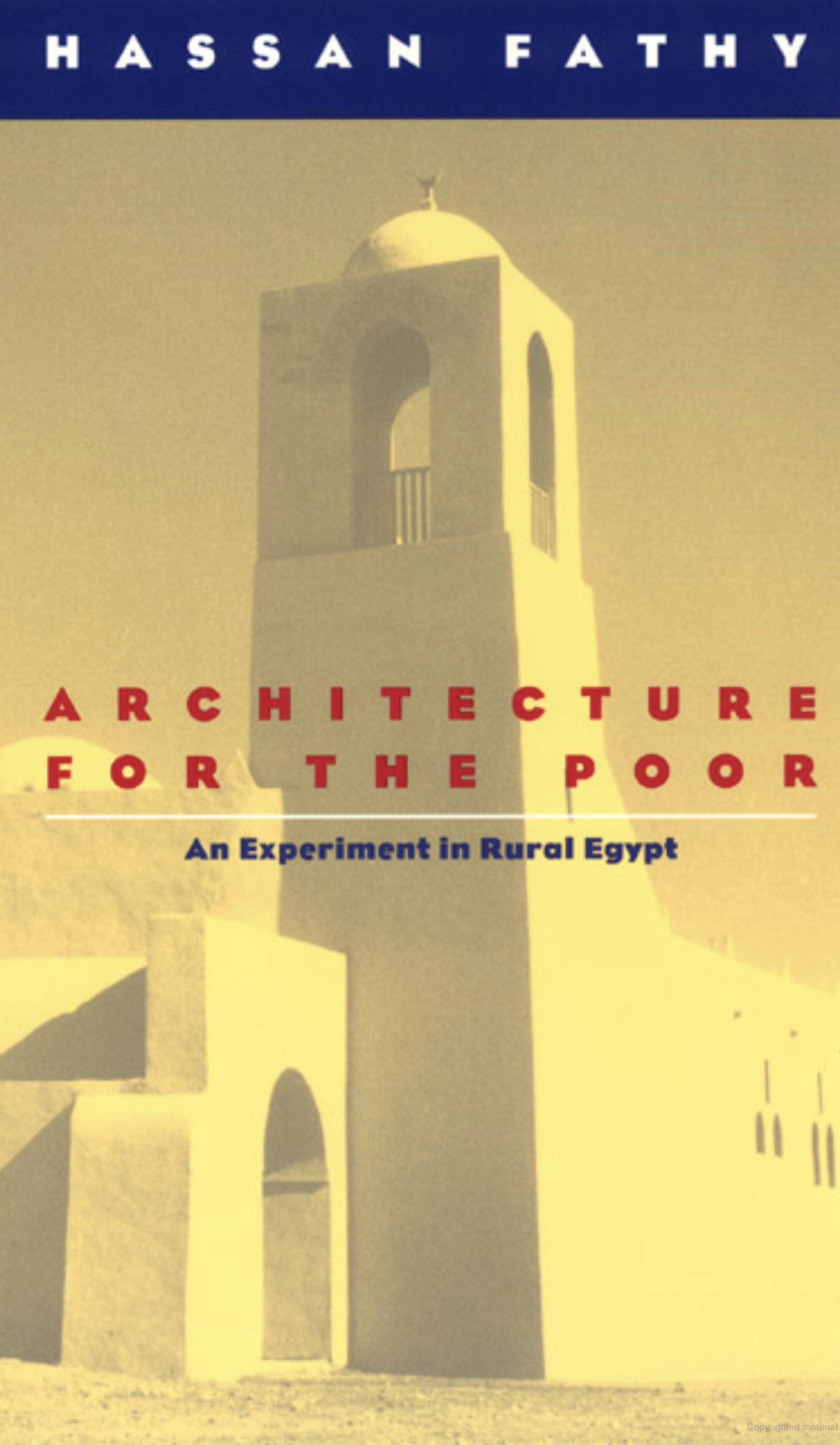
Hassan Fathy and Architecture for the Poor
One of his first assignments after graduating in 1926 from what is now the University of Cairo was to build a school at Talkha, a small town along the Nile in Northern Egypt. The absolute squalor of the place “haunted” Fathy: the streets were littered with rotten food and filthy water, the buildings were dilapidated, and the peasants who lived there had accepted their depressing lot. This experience inspired him to improve the lives of those who were powerless to do so without help.

Fathy wrote in his book Architecture for the Poor (links to PDF): “They needed decent houses, but houses are expensive. In large towns capitalists are attracted by the returns from investment in housing, and public bArchitecture for the Poor (odies…frequently provide extensive accommodation for the citizens, but neither capitalists nor the state seem willing to undertake the provision of peasant houses…”
Traditional design using mud
While other architects were seeking fame and fortune, Hassan Fathy saw the genius of incorporating traditional design and building materials. He wrote “here, for years, for centuries, the peasant had been wisely and quietly exploiting the obvious building material, while we, with our modern school-learned ideas, never dreamed of using such a ludicrous substance as mud for so serious a creation as a house.”
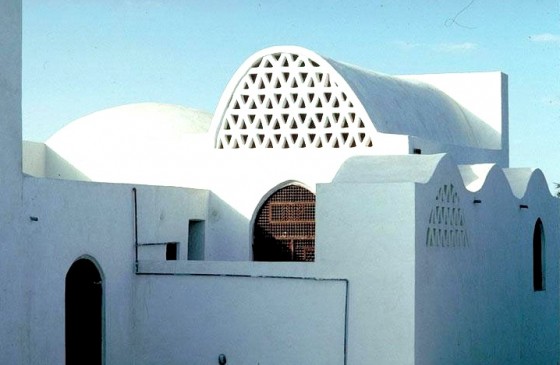
Fathy cared more about improving the standard of living for the people he served than he did about fancy western materials and technology.
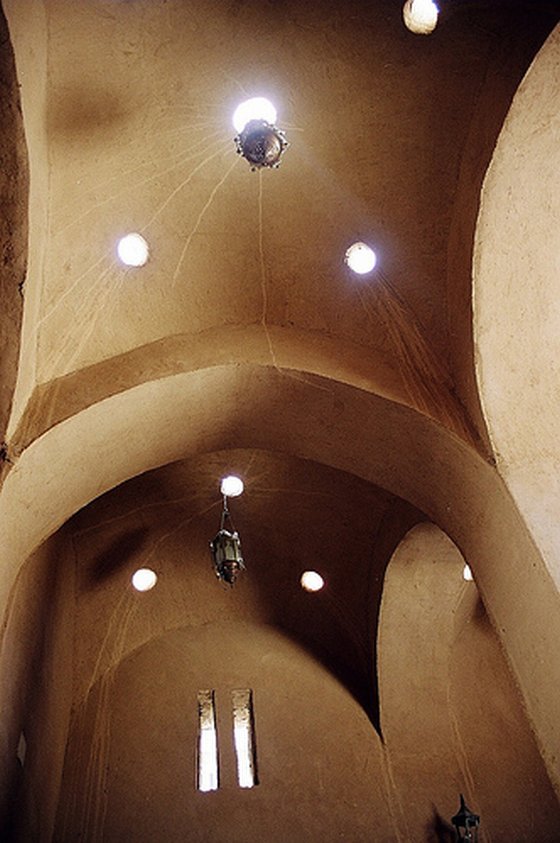
In 1946 he was commissioned by Egypt’s Antiquities Department to build New Gourna Village for 3,000 families who were raiding the ruins at Luxor. The villagers weren’t so excited about being displaced, but Fathy committed to smoothing their transition.

He built thick brick walls and traditional courtyards, which both supported cultural values and created passive cooling (see design above), and enlisted the villagers as builders of their own homes. This not only reduced labor costs and created jobs, but also helped the villagers to connect with what Fathy considered a sacred space. Home for him was a place to seek solace and comfort from the outside world.
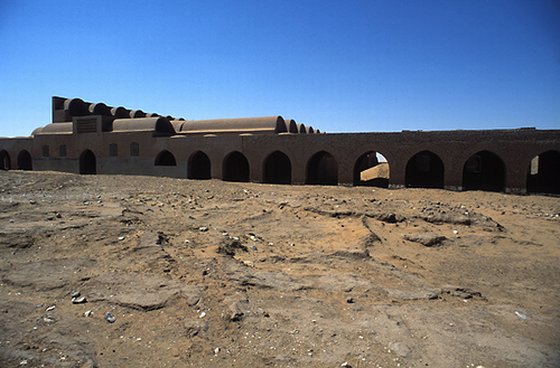
Finally, Hassan Fathy respected that nature should take precedence in the design of new structures. “Architectural form should consider the forces in nature of wind, rain, even how an earthquake shaking it would make it fall in a pattern that follows the geological formation of a mountain,” he once wrote.
No doubt Dubai’s artificial World Islands would have seemed preposterous to him.
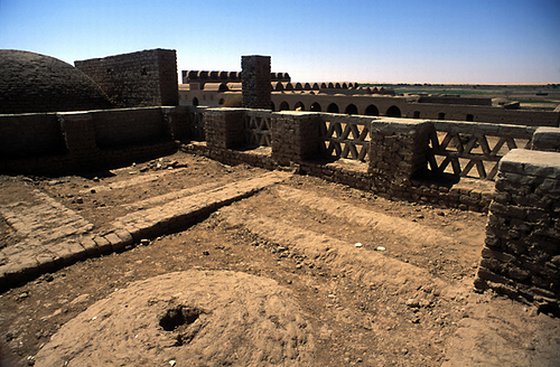
In short, Fathy’s designs were affordable, congruent with nature, elevated the human condition, and they were sustainable. We think this is a model that would better serve the Middle East than other lavish projects taking place.
More on Architecture, Middle East:
Recent Jerusalem Seminar in Architecture Focused on Green Design
Can An Ecological Peace Park Catalyze Peace Between Syria and Israel?
AECOM Teams Up with Ellerbe Beckett to Create More Sustainable Building In The Middle East



[…] Hassan Fathy is The Middle East’s Father of Sustainable Architecture – Home for him was a place to seek solace and comfort from the outside world. Finally, Hassan Fathy respected that nature should take precedence in the design of new structures. “Architectural form should consider the forces in nature of wind, rain … […]
[…] Hassan Fathy Is The Middle East’s Father Of Sustainable … – Hassan Fathy, an Egyptian architect saw the value of natural building long before it became a fad in the west. Green Prophet has railed against projects like Dubai … […]
[…] Hassan Fathy is The Middle East’s Father of Sustainable Architecture – Hassan Fathy … Salam community. Fathy received several awards for his work, including the Aga Khan Award for Architecture in 1980, and founded The International Institute for Appropriate Technology in 1977. Architecture for the poor One of his first … […]
[…] “They needed decent houses, but houses are expensive. In large towns capitalists are attracted by the returns from investment in housing, and public bodies…frequently provide extensive accommodation for the citizens, but neither capitalists nor the state seem willing to undertake the provision of peasant houses…” – See more at: http://www.greenprophet.com/2010/02/hassn-fathy-sustainable-architecture/#sthash.FbyWvgNK.dpuf […]
[…] If Hassan Fathy is the father of sustainable architecture, then Nader Khalili must be his close cousin. The Egyptian and Iranian architects respectively grew up with an interest in housing poor populations and refugees with earth architecture and both made enormous contributions to the modern application of ancient building techniques. But Khalili, who spent much of his career in the United States and received awards from the Aga Khan Foundation, NASA, and the United Nations, veered down a particularly unconventional path. […]
[…] Fathy is the Middle East’s father of sustainable architecture. Before it was fashionable or even fathomable, he was championing earth architecture in the hopes […]
[…] ancient building techniques can work just as well. Designed by Abed el-Rahman Yasin, a student of Hassan Fathy, the green building which is located in Sakhnin features 20 different energy saving features […]
[…] an eco-village and Buddhist retreat takes its form and inspiration from Egyptian architect (and the Middle East’s father of sustainable building) Hassan […]
[…] an eco-village and Buddhist retreat takes its form and inspiration from Egyptian architect (and the Middle East’s father of sustainable building) Hassan […]
[…] Hassan Fathy was an Egyptian architect who wanted to build a different world using the cheapest material the earth provides – mud. When in 1946 he was commissioned to build a new village in Luxor, he did something which many architects at the time wouldn’t even contemplate. He asked the community what they wanted and integrated the best of their traditional earthen construction techniques with his architectural expertise. What emerged was ‘New Gourna’, a stunning earthen village with natural ventilation, large bright rooms, beautiful domes — and all at low cost too. […]
[…] Hassan Fathy was an Egyptian architect who wanted to build a different world using the cheapest material the earth provides – mud. When in 1946 he was commissioned to build a new village in Luxor, he did something which many architects at the time wouldn’t even contemplate. He asked the community what they wanted and integrated the best of their traditional earthen construction techniques with his architectural expertise. What emerged was ‘New Gourna’, a stunning earthen village with natural ventilation, large bright rooms, beautiful domes – and all at low cost too. […]
[…] more than Damluji. She has fought what she calls architectural recolonisation in Egypt alongside Hassan Fathy who championed mud architecture practiced by the falaheen (rural peasants) in the 197os. And she’s also worked in Yemen […]
[…] For thirty years she has fought what she calls architectural recolonisation in Egypt alongside Hassan Fathy who championed mud architecture practiced by the falaheen (rural peasants). She has also worked in Yemen restoring and renovating […]
[…] to favor earth architecture, like Nader Khalili’s wonderful earth bag homes fit for space, or Hassan Fathy’s mud structures in Egypt, Peksen caters to modern urbanites who seek contemporary design solutions to dwindling material and […]
[…] to favor earth architecture, like Nader Khalili’s wonderful earth bag homes fit for space, or Hassan Fathy’s mud structures in Egypt, Peksen caters to modern urbanites who seek contemporary design solutions to dwindling material and […]
[…] lauded the benefits of ancient building techniques many times before. Both Hassan Fathy’s incredible mud structures in Egypt and ancient Syrian beehives are a model for sustainable design because neither require an […]
[…] the verge of quitting. By complete chance she stumbled across Hassan Fathy’s book about his earth-inspired architecture work at Gourna. “I suddenly discovered that I had been studying the wrong type of architecture,” she […]
[…] the verge of quitting. By complete chance she stumbled across Hassan Fathy’s book about his earth-inspired architecture work at Gourna. “I suddenly discovered that I had been studying the wrong type of architecture,” she […]
[…] Hassan Fathy is the Middle East’s Father of Sustainable Architecture AKPC_IDS += "71884,"; __spr_config = { pid: '4ef1a3d5396cef53f100007b', title: 'Earth-Friendly Vernacular Date Palm Leaf Architecture Revisited in London', ckw: 'date palm,desert,eco-building,green design,Gulf,vernacular architecture', chan: 'architecture-urban', no_slide: '', slide_logo: false, pub: '2012-04-26 10:32:33', url: 'http%3A%2F%2Fwww.greenprophet.com%2F2012%2F04%2Fearth-friendly-vernacular-date-palm-leaf-architecture-revisited-in-london%2F', header: 'RECOMMENDED FOR YOU' }; var content = document.getElementById('simplereach-slide-tag').parentNode, loc; if (content.className){ loc = '.' + content.className; } if (content.id){ loc = '#' + content.id; } __spr_config.loc = loc || content; (function(){ var s = document.createElement('script'); s.async = true; s.type = 'text/javascript'; s.src = document.location.protocol + '//d8rk54i4mohrb.cloudfront.net/js/slide.js'; __spr_config.css = 'document.location.protocol + '//d8rk54i4mohrb.cloudfront.net/css/p/4ef1a3d5396cef53f100007b.css'; var tg = document.getElementsByTagName('head')[0]; if (!tg) {tg = document.getElementsByTagName('body')[0];} if (tg) {tg.appendChild(s);} })(); […]
[…] what do the Brothers exactly envisage? Himdan told me that the Muslimbrothers’ example is Hassan Fathy; “because he had the perfect cycle in terms of material use, in terms of ownership of the people […]
[…] Hassan Fathy is the Father of Sustainable Architecture […]
[…] Hassan Fathy is the Middle East’s Father of Sustainable Architecture […]
Read: ‘Hassan Fathy & Continuity in Islamic art & architecture: The Birth of a new Modern’ American university Cairo press.
Thanks Ahmad, I’ll try to find it the next time I’m in Cairo!
I have written an article on New Gourna as well, which shall soon be published on a website for non-commercial purposes. May I have permission to use your images? If they aren’t yours, would you please be able to guide me to the source/s?
Thanks!
[…] Hassan Fathy is the Middle East’s Father of Sustainable Architecture AKPC_IDS += "65436,"; __spr_config = { pid: '4ef1a3d5396cef53f100007b', title: 'Piping Sunlight with Solotubes, Plastic Bottles and Islamic Architecture', ckw: 'daylighting,green design,Islamic Architecture,Middle East,Solotubes,sustainable design', chan: 'architecture-urban', no_slide: '', slide_logo: false, pub: '2012-02-10 07:09:12', url: 'http%3A%2F%2Fwww.greenprophet.com%2F2012%2F02%2Fsolotubes-plastic-bottles-islamic-architecture%2F', header: 'RECOMMENDED FOR YOU' }; var content = document.getElementById('simplereach-slide-tag').parentNode, loc; if (content.className){ loc = '.' + content.className; } if (content.id){ loc = '#' + content.id; } __spr_config.loc = loc || content; (function(){ var s = document.createElement('script'); s.async = true; s.type = 'text/javascript'; s.src = document.location.protocol + '//d8rk54i4mohrb.cloudfront.net/js/slide.js'; __spr_config.css = 'document.location.protocol + '//d8rk54i4mohrb.cloudfront.net/css/p/4ef1a3d5396cef53f100007b.css'; var tg = document.getElementsByTagName('head')[0]; if (!tg) {tg = document.getElementsByTagName('body')[0];} if (tg) {tg.appendChild(s);} })(); swfobject.embedSWF("http://www.youtube.com/v/buMyJPQLS9U&rel=0&fs=1&showsearch=0&showinfo=0", "vvq-65436-youtube-1", "560", "453", "10", vvqexpressinstall, vvqflashvars, vvqparams, vvqattributes); […]
[…] : 1 ، 2 ، 3 ، 4 ، 5 ، 6 حسن فتحي – آن للبناء أن يكتمل الجزء […]
[…] Hassan Fathy is the Middle East’s Father of Sustainable Architecture AKPC_IDS += "63305,"; __spr_config = { pid: '4ef1a3d5396cef53f100007b', title: '13 Green Building Tips From Nader Khalili Student ', ckw: 'earth architecture,eco-building,green building,green design,Hassan Fathy,Middle East,nader khalili,space architecture,Sustainable Architecture,sustainable building', chan: 'architecture-urban', no_slide: '', slide_logo: false, pub: '2012-01-12 20:23:50', url: 'http%3A%2F%2Fwww.greenprophet.com%2F2012%2F01%2F13-green-building-tips-nader-khalili%2F', header: 'RECOMMENDED FOR YOU' }; var content = document.getElementById('simplereach-slide-tag').parentNode, loc; if (content.className){ loc = '.' + content.className; } if (content.id){ loc = '#' + content.id; } __spr_config.loc = loc || content; (function(){ var s = document.createElement('script'); s.async = true; s.type = 'text/javascript'; s.src = document.location.protocol + '//d8rk54i4mohrb.cloudfront.net/js/slide.js'; __spr_config.css = 'document.location.protocol + '//d8rk54i4mohrb.cloudfront.net/css/p/4ef1a3d5396cef53f100007b.css'; var tg = document.getElementsByTagName('head')[0]; if (!tg) {tg = document.getElementsByTagName('body')[0];} if (tg) {tg.appendChild(s);} })(); […]
[…] Hassan Fathy is the father of sustainable architecture, then Nader Khalili must be his close cousin. The Egyptian and Iranian architects respectively grew […]
[…] have on one end simple earth architecture such as Hassan Fathy’s famous works in Egypt, which requires very little imported materials and have virtually no environmental impact, and then […]
[…] are many excellent examples of earth architecture in the Middle East, including Hassan Fathy’s work, the Beehives of Syria, and Yemen’s gorgeous clay castles. But SIREWALL has perfected a rammed […]
[…] are many excellent examples of earth architecture in the Middle East, including Hassan Fathy’s work, the Beehives of Syria, and Yemen’s gorgeous clay castles. But SIREWALL has perfected a […]
[…] the proposals – in many senses of the word. Consisting of a series of domed buildings reminiscent of Islamic architecture, the entire center huddles around a large leafy courtyard with water features that keep the area […]
[…] make the country more stable in the face of climate change and diminishing resources. Not since Hassan Fathy, the Father of Sustainable Architecture, has a real pioneer in green building stepped out of the shadows. Until […]
[…] lauded the benefits of ancient building techniques many times before. Both Hassan Fathy’s incredible mud structures in Egypt and ancient Syrian beehives are a model for sustainable design because neither require an […]
[…] Hassan Fathy is the Middle East’s Father of Sustainable Architecture […]
[…] Hassan Fathy is the Middle East’s Father of Sustainable Architecture […]
[…] majestic pyramids and self-aggrandizing Pharoanic temples and tombs belonging to a bygone era, few Egyptian architects have distinguished […]
[…] Hassan Fathy is the Middle East’s Father of Sustainable Architecture […]
[…] traveler looks for: friendly faces who will welcome you with a glass of delicious hibiscus juice, sustainably-built accommodations modeled after an ancient village, fresh food, and resplendent views of the nearby limestone […]
[…] Hassan Fathy is the Middle East’s Father of Sustainable Architecture […]
[…] Egyptian architect Hassan Fathy, who devoted his career to promoting ancient building materials and techniques, would be proud. […]
[…] Hassan Fathy is the Middle East’s Father of Sustainable Architecture […]
[…] It’s hard not to compare Dubai and Cairo – two cities that occupy many of our worried green thoughts. Although different on so many levels, one thing stands out: despite being relatively young and stroppy, Dubai is definitely the cleaner city. Sure, there is litter along the beaches and in other more isolated areas, but when compared to Egypt, the Emirate comes out squeaky clean. Even so, French Architect Dominique Gauzin-Müller told Almasry Alyoum that she can envision a sustainable urban future for Egypt, particularly if the country embraces wisdom advocated by their very own father of sustainable architecture – Hassan Fathy. […]
[…] Hassan Fathy is the Middle East’s Father of Sustainable Development […]
[…] an important issue that you think we need to know about, or if you are working in cleantech or sustainable architecture and design, please drop me a line at [email protected]. I’m dying to meet […]
[…] decidedly impractical glass towers that shimmer along the Gulf (the resort looks a lot like these Hassan Fathy buildings, […]
[…] ecological kibbutzes and individual families are building rammed-earth homes in the spirit of Hassan Fathy, homes that have a wider […]
[…] Hassan Fathy Is the Middle East’s Father of Sustainable Architecture […]
[…] Hassan Fathy is the Middle East’s father of sustainable architecture, then Mohamed Kassas is the prophet […]
[…] Hassan Fathy is the Middle East’s Father of Sustainable Architecture AKPC_IDS += "45465,"; […]
[…] in the Middle East. Although they are visually spectacular, we often wonder at the true sustainability of buildings that cost millions of dollars to construct. But the first of three Moroccan projects commissioned […]
[…] and Boaz Khan made these lovely ecoolers that mimic ancient Arabic detail and ecological awareness, Hassan Fathy built sustainable structures that cherished the genius simplicity of old, and even Foster & […]
بسم الله الرحمن الرحيم
شكرا على هذا الموضوع و بالله عليكم اذا كان يوجد شئ اخر عنكم عنهذا الموضوع بالذات ان ترسلوه لي باسرع وقت ممكن فانا في امس حاجة له
و لكم جزيل الشكر
[…] Hassan Fathy is The Middle East’s Father of Sustainable Architecture AKPC_IDS += "19490,";Browse topics: architecture, sustainable housing […]
[…] Hassan Fathy is The Middle East’s Father of Sustainable Architecture […]
[…] Mais sobre Hassan Fathy aqui. […]
[…] Hassan Fathy: the Middle East Father of Sustainable Architecture […]
The Arts' Center at Kibbutz Neot Smadar in Israel's Arava, is an impressive ecologically sound structure that incorporates natural materials and a natural cooling system based on water and wind.
That sounds about right. People in the Middle East use unglazed ceramics to cool liquids in jars. More design specs of Fathy's can be found here:http://www.unu.edu/unupress/unupbooks/80a01e/80…
What's good about Fathy is that he used his common sense! It seems like he saw an injustice and did what he could to make it better for everyone. He didn't just build a building that suited him. I don't know why this kind of compassion disappeared for a while, but I'm glad it's making a comeback with this green movement!
[…] **Published with permission of Green Prophet […]
Very interesting design for natural cooling,Has anyone got an idea what the apparatus is on the right side,it looks like an earthen pot with maybe water to cool the warm air,any ideas?