
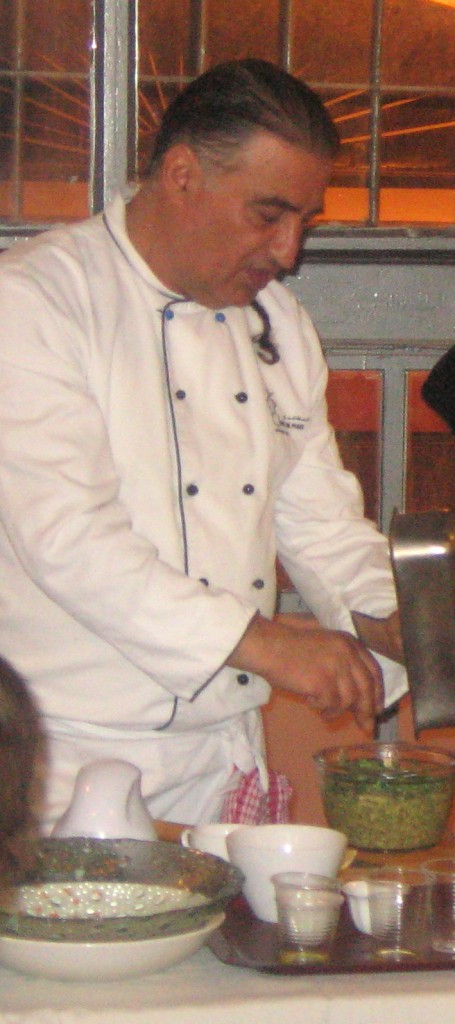
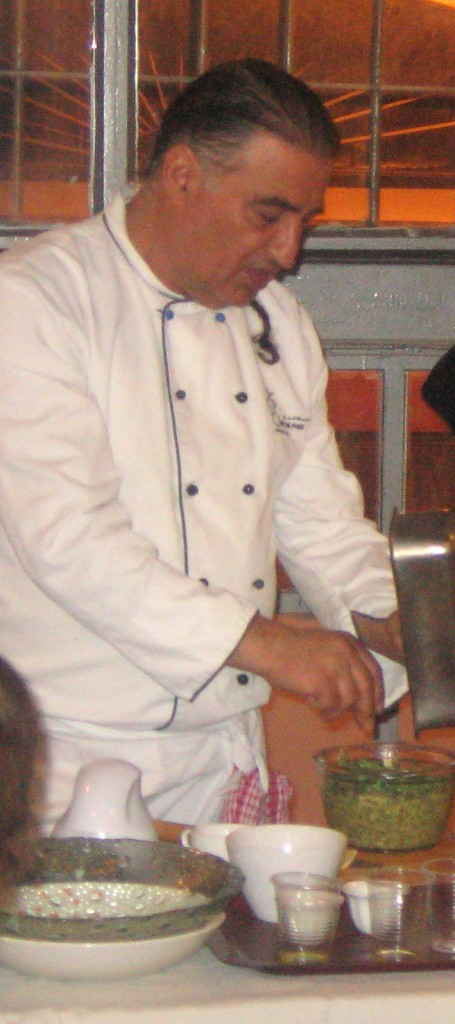
 Chef Basson makes za’atar pesto
Moshe Basson’s culinary roots stretch back through time from 200 CE, when the collection of Jewish oral law known as the Mishnah began to take shape – to the Jewish presence in Iraq, where his family lived till the 1950s – to the present time in Jerusalem.
He takes his deep knowledge of foods mentioned in the Bible and other Jewish sources, adds kitchen wisdom garnered from grandmothers of all ethnic streams, and distills the essence of Biblical cooking in his Jerusalem restaurant, Eucalyptus, every day.
Basson’s passion for the land and its native edibles began when he was a small boy roaming the hillsides and abandoned gardens between Jerusalem and Bethlehem. Arab women taught him to forage wild herbs; his father taught him the names and uses of culinary and medicinal plants growing in the home garden.
His fascination with the authentic, historic foods of Israel eventually led him to establish a restaurant and to become a founding member of Chefs for Peace. His involvement with the Slow Food movement brought him the Slow Food Award in Bologna, the “Nobel Prize for chefs,” and honorary citizenship to that city. Today, he’s a respected food historian and his restaurant, Eucalyptus, is rightly famous.
You’d think Basson would be too important or too busy to catch for an interview, but Green Prophet found him accessible and down-to-earth.
Who were your first culinary influences?
My mother, a great cook. My father, who owned a bakery and grew herbs and vegetables in our family garden. Then, old ladies. Arab, Druze, Iraqi, Syrian – whatever their background, women are the ones who cook native seasonal foods and serve them to their families.They keep the tradition alive.
Can you tell us a little about native herbs and how you cook them?
Let’s take chicory – olesh in Arabic. It’s related to endive, and like endive is slightly bitter. It’s in season in late winter till early spring and was used as maror, the bitter herb eaten at the Passover Seder. I pre-boil chicory leaves for a few minutes to take the bitterness away, then cook them with olive oil, garlic, and lemon.
Most people don’t know that the common cyclamen also has edible leaves. They are slightly toxic, but pre-boiling and then rinsing them makes them safe to eat. In Iraq, they are served stuffed with minced lamb and rice. Never eat a cyclamen root! Only the leaves can be made edible.
Do you know of medicinal uses for wild herbs?
Oh, Yes. One of my workers wasn’t feeling well today, so I clipped some twigs off an olive tree growing near the restaurant and simmered the leaves for 10 minutes. Olive leaves lower blood pressure and blood sugar, as well as being antiseptic, antiviral, and antibiotic. My worker drank several cups of this tea over the day and felt better by the time we closed than when she first came to work.
How do you know so much about food in Jewish historical sources?
I’ve studied Tanach (Bible) and the Mishnah all my life. Keeping my eyes and ears open, I draw logical conclusions. For example, the Arabs maintain a tradition of smoking green wheat (frika). It’s an historical ingredient with common roots in Jewish law; the Mishnah mentions it with regard to Passover and Shavuot. The wheat is green, but ready to be harvested exactly at Lag B’omer time (33 days after Passover).
Before then, farmers worry over the safety of their harvest because late rains could ruin it. They harvest and smoke it over bonfires before it’s entirely ripe, while the grain is still green and “milky. I think the Lag B’Omer fires traditional in Israel have to do with a memory of this procedure, which has been kept intact by the Arab population.
The smoking kills mice, insects, and insect eggs in the wheat. I believe that our forefather Yosef (Joseph) used this method to store the abundance of seven year’s wheat harvest against the seven-year famine he foresaw.
It’s like a puzzle, an endlessly fascinating way of putting together a picture of how our ancestors lived and ate. I love to fit the pieces together, then cook what I know. At some point, the search and the knowledge became a part of me. It’s something I need to do.”
We see that you’ve spent a considerable amount of time traveling in Europe and the Far East. How do you manage to communicate when you’re abroad?
Apart from Hebrew, I speak Arabic, English, a little French, Italian, and Spanish – and a smattering of Yiddish. No, really, Yiddish. I learned it from my late father, who owned a bakery and learned to bake Israeli breads with Ashkenazi bakers. When it comes to cooking, I can give a recipe over in any of those languages, spontaneously, even if I’m not fluent in it.
What do you consider your finest achievement?
I’m proud of having returned Israeli cuisine to its roots, and of having made this authentic style of cooking known to the outside world. To be authentic, by the way, it has to be kosher. Even Christian tourists insist on that.
We took a quick tour of the spic-and-span kitchen at Eucalyptus restaurant. Basson uncovered a pot – the most appetizing aroma of potatoes cooking in the pan juices from roast lamb wafted up. Three vividly-colored soups in espresso cups stood on a tray: just enough for a taste of each. (We know from experience how delicious those soups are, the Jerusalem artichoke soup especially.)
A young worker rolled out dough for pitta bread to cover the chicken stew – it bakes on top of the ceramic stew pot, sealing the food inside. And we saw no waste in Basson’s kitchen (“Leftovers go to the chickens or to the compost.”). The entire place spoke of the chef’s fine palate and respect for the food.
Food historian and Jerusalem restauranteur, this is Chef Moshe Basson.
Continue reading:



i came up with a theory that involves the book of genesis (fig leaves) buddha (sitting under the bodhi fig tree) jesus (many sayings about figs) ross hornes’ book (new health revolution) and science (figs are the msot important source of food for fruit eating rainforest animals). i then experimented on the figs by eating mainly dried figs (same brand) for over 10 years now and found cycles which i related to the numbers in psgs 11/12 of the book fo revelations. this theory has gone everywhere. so far i have had eliminations at days 504, 840, 1176, 1512, 1848, 2184, 2520, 2856, 3192 and 3528. today is day 3747. i have definitely found something. i am not lying. what i have discovered has gone around the world and many songs have been written about it……the foo fighters’ last 4 albums……..coldplays’ last 4 albums……..”vertigo” by U2 (my first name is phil). an elimination is a day when you experience strong flu-like symptoms and feel terrible. bad stuff is washed out of your body.
[…] alert to ward off the cloud of locusts heading north. Foodies, on the other hand, recalled that chef Moshe Basson served locust several years ago at Eucalyptus, his high-end Jerusalem restaurant, as part of a […]
[…] lovers know that tahini has a sweet face too. We recently enjoyed a light dessert created by chef Moshe Basson of Jerusalem, who squirted alternating threads of tahini and silan date honey onto a plate to form a pretty […]
[…] is that when the author tastes something she likes, she tracks the recipe down, collecting the food traditions of the people who cook it along the […]
I can only echo what Karin said: call the restaurant and interview Basson yourself to ascertain how much he cares and what he knows. His fund of knowledge from Jewish and Israeli sources is the result of almost 60 year's ongoing study.
This is a great story about the Eucalyptus tree planted by Basson in his childhood. But in reply to Ms. Kloosterman response – my judgment still stays: Mr. Basson did not care too much about being incongruous or possibly when he chose the name he didn't even know that Eucalyptus tree is not a native tree to Israel. For an Israeli like me, it stills a disappointing fact. But nevertheless I'd love to check his food.
I can only echo what Karin said: call the restaurant and interview Basson yourself to ascertain how much he cares and what he knows. His fund of knowledge from Jewish and Israeli sources is the result of almost 60 year's ongoing study.
This is a great story about the Eucalyptus tree planted by Basson in his childhood. But in reply to Ms. Kloosterman response – my judgment still stays: Mr. Basson did not care too much about being incongruous or possibly when he chose the name he didn't even know that Eucalyptus tree is not a native tree to Israel. For an Israeli like me, it stills a disappointing fact. But nevertheless I'd love to check his food.
The first Eucalyptus restaurant was built around an enormous eucalyptus tree that Basson had planted himself in his childhood. That was in Jerusalem's Talpiot neighborhood. I used to pass by the restaurant on the way to work. I'd love to peek through the door and marvel at this cool Middle-Eastern eatery with a tree smack in the middle of it, shooting up through a space in the roof. Basson carried the name from one location to the other, as his restaurant moved to more accessible areas.
Ben, maybe there is a clever reason there? Perhaps he built the restaurant in front of a large Eucalyptus tree? Maybe it's a spiritual thing? I suggest you call the restaurant and ask before making judgement calls.
What amazes me the most about Moshe Basson is the gross disconnects that are either simple ignorance or lack of sensitivity to the incongruity of his message. This article emphasis the importance of native ingredients and the connection to biblical cooking and yet the name of his restaurant is Eucalyptus which is a tree brought to Israel from Australia. This tree is neither biblical, nor native to the region. What exactly his message? Couldn't he find a more suitable name to his restaurant that will portray him message?
Yes, I've heard the same from a very different source. I was told that old-fashioned Jerusalem mothers give their boys za'atar at breakfast on days that they're expecting a test at school.
Just put the recipe up, James. But if you're talking about dried za'atar spice, then it's different. Mix it with enough olive oil to make a paste; add 1 small crushed clove of garlic, a squirt of lemon juice and salt to taste. Sumac – a dusting of it, if you have some. Enjoy!
RT @GreenProphet Chef Moshe Basson Revives Food Traditions In Israel | Green Prophet http://bit.ly/aHm3W0
Enlightening interview Miriam. We are all waiting for the zatar pesto post. Sounds tangy and perfect brain food. A Bedouin herb collector once told me zatar is excellent for studying and improving cognitive functioning.
We love chef Moshe Basson. So does @greenprophet – http://bit.ly/bom6cU
great post Miriam, thank you. Moshe Basson is a true inspiration. can you post here or send me his recipe for zaatar pesto – I brought some zaatar with me to the UK & would love to use it more…cheers,Jamesjames “at” greenprophet.com
Chef Moshe Basson Revives Food Traditions In Israel | Green Prophet http://bit.ly/biDO55
Chef Moshe Basson Revives Food Traditions In Israel | Green Prophet http://bit.ly/biDO55
Chef Moshe Basson Revives Food Traditions In Israel | Green Prophet: Apart from Hebrew, I speak Arabic, English, a… http://bit.ly/bHfw9r
Chef Moshe Basson Revives Food Traditions In Israel | Green Prophet: Chef Basson makes za'atar pesto Moshe Basson'… http://bit.ly/bjpxOF
Chef Moshe Basson Revives Food Traditions In Israel | Green Prophet: My worker drank several cups of this tea over… http://bit.ly/bjpxOF
Chef Moshe Basson Revives Food Traditions In Israel | Green Prophet: My worker drank several cups of this tea over… http://bit.ly/bjpxOF
Chef Moshe Basson Revives Food Traditions In Israel | Green Prophet: My worker drank several cups of this tea over… http://bit.ly/bjpxOF
RT @kloostermania Israel's slow food pioneer Moshe Basson – an interview http://bit.ly/aHm3W0