
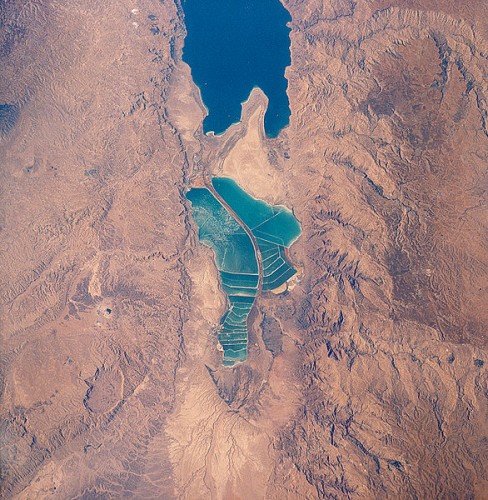

 A recent article in Israel’s Globes financial newspaper, explores how Israel’s valuable exports of Dead Sea mined potash to India will be reduced this year due to the weakest monsoon season in India in five years.
The article Weak Monsoon Dries up Israel Chemicals Ltd (ICL) Potash Exports may result in a reduction of Israeli potash exports to India by nearly 12% as compared to the amount shipped in 2008. And it could save the depleting face of the Dead Sea, heavily mined for this resource used in the fertilizer business.
At an amount of 2.42 million tons of the salt and potassium based chemicals, at a price of $460 US per ton, the prices that Israel and Jordan are seeing is a 26% drop from 2008.
China, another big potash producer, has also seen a reduction in its exports of the chemicals, and plans to reduce its prices to between $400 – 450 US per ton.
What does all this have to do with the environment; especially in regards to a product that comes from one of the driest spots on earth? Really a lot, since both Israel and Jordan rely on their potash exports as a perennial source of income. The potash is obtained from large evaporation pools located at the southern portion of the Dead Sea, and produced at Israel’s Dead Sea Works and Jordan’s Arab Potash Company. The industry is heavily contested by Israeli environmentalists.
Jordan, which had seen a steady rise in its potash exports, reported a 1.2% drop in volume in the 1st quarter of 2009. Total potash exports by Jordan have dropped further in 2009, by as much as 53%.
Potash, otherwise known as potassium carbonate is used in the production of soap, glass, and baking soda, and is a major ingredient for fertilizers, which are very important for growing crops on the Indian subcontinent.
With much less monsoon rains falling in India’s major crop growing areas, there is less need for fertilizers, resulting in a decreased demand for potash. This all amounts to a virtual chain of events in which global warming and climate change is causing a change in weather patterns that is resulting in mass flooding and increased rainfall in some areas, and drought–like conditions in others.
India is thus experiencing this phenomenon in which areas on India’s western coast have been battered by torrential rains, causing disastrous flooding, while large areas of central India, the country’s “breadbasket” are experiencing a big reduction in rainfall, resulting in drought.
So less monsoon rainfall is resulting in smaller potash imports into India, and lower potash exports by countries like Israel and Jordan; giving a good example of how global warming and changing weather patterns in one part of the world can have an economic affect on another part. Since less depletion of the resources will be happening in the Dead Sea, the upside is that global warming might be nature’s way of restoring balance.
For more about the Dead Sea’s human caused imbalance see this video from the BBC.




Give back to your environment by sharing journey with others.
http://travelshareindia.blogspot.com/
[…] has resulted in severe drought in many agricultural regions in India. As a result, this has caused a drop in potash orders for both Israel and Jordan which resulted in companies like Dead Sea Works to have a problem with their potash contracts to […]
Global Warming Effects in India Hit Jordan and Israel’s Dead Sea Potash http://bit.ly/M8hnA #Israel #India #DeadSea
This is a very interesting article, I had no idea that the dead sea yielded potash. I have two uncles who would like to read this, one of them works in the concrete industry and I recently learned that they use potash and the other used to buy and sell dead sea minerals for beauty products, although I understand this has now been stopped? I will forward this on to them!
Thanks for the info.
P.S. We write a green blog and would love to be added to your links page or perhaps submit a guest post. You can check our site here;
Our Everyday Earth – Green Blog
Global Warming Effects in India Hit Jordan and Israel’s Dead Sea … http://bit.ly/PWXYN
Global Warming Effects in India Hit Jordan and Israel’s Dead Sea Potash http://ow.ly/15KUqR
New blog post: Global Warming Effects in India Hit Jordan and Israel’s Dead Sea Potash http://bit.ly/k2CXy