

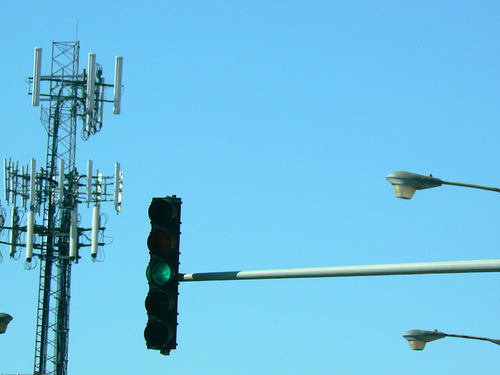
Hurricane Katrina: Phone home –– If you have a cell phone tower planted somewhere near your home or your kid’s daycare, you’ll probably think they are evil, but new research finds that cell phone towers can give precious information to help us understand climate change patterns, and floods.
Though New Orleans residents were told to evacuate days before the arrival of Hurricane Katrina, no one could have predicted the real extent of the devastation.
Researchers from Tel Aviv University say they have found a novel and reliable way to help predict the intensity of the next big flood, using common cell phone towers. Their model, which analyzes cell phone signals, adds a critical component to weather forecasting never before available.
“By monitoring the specific and fluctuating atmospheric moisture around cell phone towers throughout America, we can cheaply, effectively and reliably provide a more accurate ‘critical moisture distribution’ level for fine-tuning model predictions of big floods,” says Prof. Pinhas Alpert, a geophysicist and head of Tel Aviv University‘s Porter School for Environmental Education.
Prof. Alpert and his co-researchers Prof. Hagit Messer Yaron and doctoral fellow Noam David reported on their research in the April 2009 Atmospheric Chemistry and Physics.
Information the weather girl can use
Cell phone towers emit radio waves that are diminished by moisture in the air, a factor that can be used to improve model warnings on flood levels. In addition, the researchers measured the rainfall distributions and were able to accurately estimate the size of impending floods before they struck. This was demonstrated in post-analysis of two case-studies of floods in the Judean Desert in Israel, where cell phone towers – and flash floods – are abundant.
Using real data measurements collected from the towers, the researchers demonstrated how microwave links in a cellular network correlated with surface station humidity measurements. The data provided by cell phone towers is the missing link weather forecasters need to improve the accuracy of flood forecasting. The microwave data used in this study was supplied by two cellular providers Cellcom and Pelephone in Israel.
Can texting save lives?
“Our method provides reliable measurement of moisture fields near the flood zone for the first time,” notes Prof. Alpert, who also works with NASA on developing models to study global warming weather patterns. This new tool, he says, can add to the bigger picture of understanding climate change patterns in general.
“Accurate predictions of flooding were difficult before because there haven’t been enough reliable measurements of moisture fields in remote locations,” Prof. Alpert adds. Using the signals collected from cell phone towers as they communicate with base stations and our handsets, weather forecasters will now have a crucial missing piece of information for flood prediction that they never had before. It will permit forecasters and residents alike to more accurately gauge the danger they face from an impending flood.
Because hundreds of thousands of cell phone towers are already in place, the Tel Aviv University invention can be adopted quickly. And cell phone companies are already collecting the data anyway, as Americans continue to ramp up their minutes of call time every month.
[image via benimoto]


[…] Professors Pinhas Alpert and Colin Price, lecturers at the Porter School of Environmental Studies’ International MA Program at Tel Aviv University, have predicted that increased flooding will result from global climate change. Alpert helped to pioneer the use of cellular phone networks for monitoring the amount and intensity of precipitation and water vapor – measurements which are virtually free of charge and can be used for studying global climate systems. […]