
Red-Dead Canal Announcement Stirs Controversy

Dead Sea

The global contest for the Seven New Wonders of the World is not the only reason the Dead Sea is making news this week.

Last Saturday, Israeli Vice Premier Silvan Shalom announced that the World Bank  agreed to finance a $1.25 billion feasibility study on the Red-Dead Canal plan.  The plan, a joint venture supported by Israeli, Jordanian, and Palestinian officials, proposes a 180 kilometer (110 mile) pipeline between the Red Sea and the Dead Sea.  The pipeline will transfer 200 billion cubic meters of water to the Dead Sea, half of which will be pumped to the rapidly receding body and half of which will be used in desalination projects to provide drinking water to the drought-stricken region.

The World Bank launched a Study Program in 2008, based on terms of reference the three parties introduced (but did not agree on fully), to investigate the environmental, social, and technical costs of the canal.  Although the World Bank confirmed that Mr. Shalom did meet with its president, Robert Zoellick, during an official visit to Washington DC last week, it has not made an official commitment to finance the study.

Jordan was also quick to deny the Israeli official’s claim.  Fayez Batayneh, Jordan’s director for the canal project, told the Jordan Times he hopes the report is true, but did not receive any official correspondence from the World Bank confirming its agreement to fund the study.

Meanwhile, Friends of the Earth Middle East (FoEME), who strongly oppose the canal, issued a statement claiming that these news reports show “politicians are using the Red Dead Canal project for their own political image and not out of concern for the Dead Sea.” (Both Mr. Shalom and Prime Minister Binyamin Netanyahu have indicated this project is important for the advancement of the region’s “financial peace” as part of the broader regional peace agenda.)

FoEME also emphasized the fact that, although the Israeli, Jordanian, and Palestinian parties, as well as the World Bank, agreed to undertake a study of alternatives to the canal as a means of saving the Dead Sea, they have failed to launch this study or to appoint a panel of experts to oversee the integrity of the entire research project.  They called on the parties to establish an Independent Alternative Study, or for the World Bank to withdraw from the project.

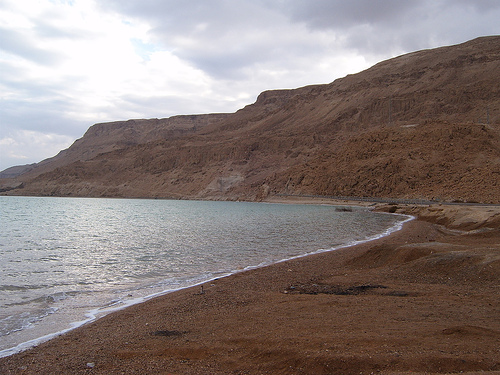
The Dead Sea is shrinking one meter every year, largely due to diversion of the Jordan River water for agriculture and industry.  Estimates predict that if business continues as usual, it will be gone completely by 2050.

:: Ynetnews, World Bank, AFP, Jordan Times, FoEME
Image Credit: heatkernel

More on the Red-Dead Canal:
Jordan To Launch Red-Dead Canal Without Israel
Drought in Jordan Calls People to Pray for Rain and the Controversial Dead-Red Peace Canal
Strategic Solution’s Floating Gas Pipes Could Avert Red-Dead Environmental Catastrophe


Rachel Bergstein
Rachel Bergsteinhttps://www.greenprophet.com/
When her vegan summer camp counselor explained to a fifteen-year-old Rachel how the dairy industry pollutes the groundwater in poor rural communities and causes global warming, there was no turning back. Her green fire lit, Rachel became increasingly passionate about the relationship between human societies and the natural environment, particularly about the systemic injustices associated with environmental degradation. After snagging a B.A. in Peace and Justice Studies at the University of Maryland, where she wrote an undergraduate thesis on water injustice in Israel/Palestine and South Africa, Rachel was awarded the New Israel Fund/Shatil’s Rabbi Richard J. Israel Social Justice Fellowship to come and spread the green gospel in Israel for the 2009-2010 academic year. She currently interns for Friends of the Earth Middle East in their Tel Aviv office. When Rachel is not having anxiety about her ecological footprint, carbon and otherwise, she can be found in hot pursuit of the best vegetarian food Tel Aviv has to offer. She also blogs about her experience as an NIF fellow and environmentalist in Israel at organichummus.wordpress.com. Rachel can be reached at rachelbergstein (at) gmail (dot) com.
1 COMMENT
  1. I think it’s also important to mention the other side of the story, which may have sparked the Israeli side to react: if we recall about 6 weeks ago, Jordanian bankrollers said they would go ahead with their own canal project.

    http://greenprophet.com/2009/05/19/9077/jordan-red-sea-dead-sea-canal/

    Here Silvan Shalom refutes the report that the world bank had not given the green light:

    http://www.jpost.com/servlet/Satellite?cid=1246296540471&pagename=JPost%2FJPArticle%2FShowFull

    Of course politicians have been using the Dead Sea for their political motives. That’s been the whole story all along, no? I do believe these politicians think it can create better relations between Jordan and Israel.

Comments are closed.

TRENDING

Eco organization offices destroyed by Iran missile

Tel Aviv's eco organization, the Heschel Center, was impacted by an Iranian missile.

What are AWG air-water generators, and why they aren’t a golden-bullet solution (yet)

Atmospheric water generators (AWGs) sound like magic: machines that can pull drinking water out of air. The idea is mentioned in the Bible, where the elders would pray for water collected as dew on plants and the catch on turning this into a machine is in the physics. To turn invisible vapor into liquid, you must remove heat, especially the latent heat of condensation.

Jordan’s $6 Billion Aqaba–Amman Desalination Project from the Red Sea Moves Forward

In 2025, the Jordanian government signed agreements with a consortium led by Meridiam and SUEZ, alongside VINCI Construction and Orascom Construction. Under a 30-year concession agreement, the consortium will design, build, finance, operate, and maintain the system before transferring it back to the Jordanian government. The total investment is estimated at approximately $6 billion USD.

The Saudi Startup Turning Desalination’s Toxic Waste Into Its Own Disinfectant

For millennia, the Middle East's water crisis seemed an immutable fact of geography — a region defined as much by what it lacked as by what lay beneath its sands. Today, a convergence of plummeting solar costs, advancing membrane technology, and hard-won engineering expertise is rewriting that story.

Earth building with Dead Sea salt bricks

Researchers develop a brick made largely from recycled Dead Sea salt—offering a potential alternative to carbon-intensive cement.

Should You Invest in the Private Market?

startustartup Unlike public stock exchanges, which offer daily trading, strict...

How to build a 100-year-company

Kongō Gumi is a Japanese construction company, purportedly founded in 578 A.D., making it the world's oldest documented company. What can we learn about building sustainable businesses from them?

From Pilot Plant to Global Stage: How Aduro Clean Technologies’ 2026 Expansion Signals a Turning Point for Chemical Recycling Investors Like Yazan Al Homsi

The company's Next Generation Process (NGP) Pilot Plant in London, Ontario, has officially moved into initial operating campaigns, generating the kind of structured, repeatable data that separates laboratory promise from commercial viability.

How AI Helps SaaS Companies Reduce Repetitive Customer Support Work

SaaS products are designed for large numbers of users with different levels of experience, and also in renewable energy.

Pulling Water from the Air

Faced with water shortage in Amman, Laurie digs up...

Turning Your Energy Consultancy into an LLC: 4 Legal Steps for Founders in Texas

If you are starting a renewable energy business in Texas, learn how to start an LLC by the books.

Tracking the Impacts of a Hydroelectric Dam Along the Tigris River

For the next two months, I'll be taking a break from my usual Green Prophet posts to report on a transnational environmental issue: the Ilısu Dam currently under construction in Turkey, and the ways it will transform life along the Tigris River.

6 Payment Processors With the Fastest Onboarding for SMBs

Get your SMB up and running fast with these 6 payment processors. Compare the quickest onboarding options to start accepting customer payments without delay.

Related Articles

Popular Categories