


With many types of solar technology in development, it can be challenging to determine which is most effective.
The efficiently in which a solar cell can convert sunlight into usable energy is certainly crucial, but cost is also of great importance in today’s solar industry.
Technology like dye-sensitized solar cells offer a new, more affordable direction that is off to a good start thanks to companies like Israel’s 3GSolar.
Dye-sensitized technology has several advantages. First, it does not use silicone, which reduces its production and consumption costs by half and makes it more environmentally friendly.
Instead of silicone, dye technology consists of thin solar cells in which photoelectrons are provided from the heating of a photosensitive dye.
Companies like Israel’s 3GSolar are aiming to achieve around 7% efficiency in their cells, which is less than most Photovoltaic cells, but they have a significantly better efficiency to price ratios.
The reduced price for solar energy is certainly better for low-income areas, the developing world, and increasing the sheer number of solar structures in society as a whole.
3GSolar has been the main Israeli company focusing on dye-sensitized technology, and a large part of their target market is the developing world, and areas where there is currently no energy at all.
Powering African villages, at least with enough energy to use lights at night, is one of the goals. As areas of the developing world will start using more energy, it makes environmental (and now economic) sense to start them off with new solar systems rather than fossil fuel derived energy.
Dye-sensitized solar cells have come a long way since their creation in 1991, and today they seem as though they could become a solid alternative energy option for bringing solar panels into society on a larger scale, and particularly in the developing world.
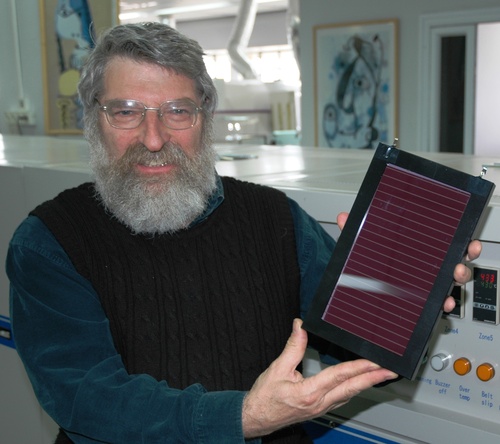
See video of 3GSolar (formerly Orion) and their work in Senegal, here. Above picture of 3GSolar founder Dr. Jonathan Goldstein.
More on dye and solar powering Africa:
3GSolar Goes Public In Canada
A Jewish Heart for Africa Shines in Solar
3GSolar Creates Dye-Based Solar Electricity
::3GSolar



[…] of the main problems with the dye solar cell technology is that it achieves only around 7% efficiency in their cells, which is lower than standard […]
Dye-ing To Power Solar Cells in Africa http://tinyurl.com/oxsxh7 #renewable
Dye-ing To Power Solar Cells in Africa | Green Prophet: With many types of solar technology in development, it c.. http://bit.ly/RCSbE
Dye-ing To Power Solar Cells in Africa | Green Prophet: With many types of solar technology in development, it c.. http://bit.ly/IpT7D
RT @LabellaGreen: Dye-ing To Power Solar Cells in Africa | Green Prophet http://bit.ly/1WRTVr
Dye-ing To Power Solar Cells in Africa | Green Prophet http://bit.ly/1WRTVr
‘Dye-sensitized technology has several advantages. First, it does not use silicone, which reduces its production and consumption costs by half and makes it more environmentally friendly.’
The author has confused silicone (silicon based organic polymer) with silicon (inorganic crystalline semiconductor).
Dye-ing To Power Solar Cells in Africa | Green Prophet http://bit.ly/NAjm4
Dye-ing To Power Solar Cells in Africa http://ow.ly/b6dP