

 Each week Orthodox Jews read one segment of the Five Books of Moses so that they can complete the entire Five Books within the course of a year. In this week’s Eco-Rabbi post I discuss a Jewish approach to meat.
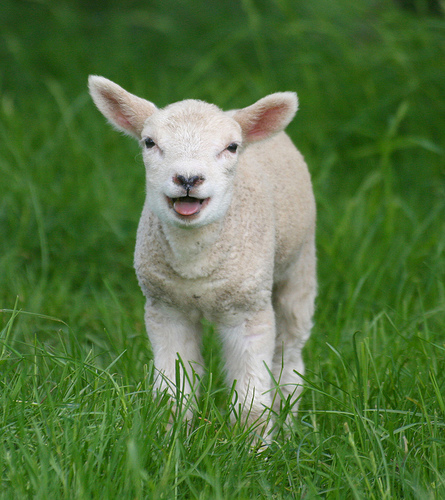
I’m a vegatarian… sympathizer. (Seriously, could you really eat lamb after looking at that picture?) Yeah, I couldn’t go without eating meat. But I understand the importance of respecting the animal that gave up its life to be eaten.
Down the block from where I live there are regular hafganot, demonstrations, against the slaughter of innocent animals so that us evil meat eaters can have an unhealthily full stomach.
Personally, I think that they’d do a lot more for the well-being of animals if they would protest the mistreating of animals, and not the eating of them. Sure, the mistreating is addressed at the demonstrations, but I think the message is lost in the presentation. I would certainly sign a petition to that extent, instead of what happens now, where I just get hungry for a burger when I see them there…
Coming from this perspective, the idea of sacrificing is not an easy one to wrap my head around. The way the sacrifices are presented in the bible it sounds like needless slaughter.
A friend of mine is a vegetarian, and a Cohen, priestly descent. He was talking with a friend of his who does eat meat and that friend asked if he would fulfill the priestly obligations of sacrificing and eating if the temple were to be built in his lifetime. When my friend answered that he would his friend asked how he could be a vegetarian but be willing to sacrifice animals?
In response my friend asked how his friend was willing to sacrifice an animal’s life for his own pleasure but not in honor of the One who created him, and the animal for that matter…
Interestingly, the bulk of sacrifices during the time of the temple were eaten. People could not afford to eat meat on a regular basis. But a few times a year people were commanded to bring a sacrifice. Most of the meat went to them and their family. A portion went to the priest who sacrificed it. And a small portion went to God.
A person ate their sacrifice with friends and family because the law is that you had to finish it before the end of the day – a good thing in pre-refrigeration days. And it was probably the most meat that they would have eaten all that year.
In days when buying a cow was the equivalent to buying a car today (see our post on Whole Animal Cooking for a modern version of this), it’s hard for me to imagine that people were as wasteful with meat as they are today. The few sacrifices that were totally burnt were done so so that the person bringing the sacrifice would feel as if it was supposed to be them in the animal’s place. A sacrifice to God. And when you raise the animal and bring it on foot across the country I can imagine that you truly felt it.
Consequently, the laws sound so gruesome because they cover every detail of how to sacrifice the animal, so that nothing goes to waste.
I wish that today people would think twice before they cook, eat and dispose of their meat. As I said, I could not give up meat. But I think that there is something special about dedicating the meat that you eat to God, the creator of it all.
More on vegetarianism and meat-eating debate:
Vegewarianism and Vegaware Dinner
Barcode Your Organic Beef With Bactochem DNA Database
Whole Animal Cooking



[…] Animals Feel Pain? One of the major reasons for vegetarianism from the eco-Rabbi and arguments heard from animal rights campaigners is the view that animals feel pain, and as […]
@EMD thank you for your comments. This post was meant to present aspects and ideas to think about. It was not meant to be an all-inclusive article about the Judaic-religious issues surrounding vegetarianism.
That IS a good idea, and I will consider tackling it. However, it may need a book contract to do so properly. I will still try and cover some of the issues in future installments.
Meanwhile, I appreciate your filling in our readers on some of the other issues to be considered.
When considering your points about instant gratification I would respond that i think that the reality is that when things are difficult, people are much less likely to do them. But sometimes that is only a symptom.
It depends greatly on the person’s dedication to the idea behind the issue. If a person is truly committed to kashrut it will not matter how much they like pig, and if a person is truly committed to recycling it wont matter where the closest bin is.
But that is not the ONLY reason why someone might not hold to their convictions.
If a person is conflicted, than that can affect their decisions as well. A person can feel very strongly about recycling but also feel that the process currently is as bad for the environment as simply throwing out the bottles. This person might want to recycle anyways with the faith that the process will become more and more environmentally friendly in time. Meanwhile they might not always feel dedicated enough to shlepp out to the nearest recycling bin. They are “recycling friendly.”
Similarly with kashrut, or vegetarianism…
So it’s not the instant gratification that decided their actions, I would argue, rather levels much deeper.
Very well said, EMD.
Dear Rabbi,
Usually I very much enjoy your posts in Torah Tidbits. I thought that this week’s post, however, was very disappointing. First, you say that although you are vegetarian-friendly, “I couldn’t go without eating meat.” Putting instant gratification above principles seems to go against everything that Judaism is really about (I am Kosher-friendly, but pork is just so tasty). Torah law is pretty clear that meat is only to be eaten for the purpose of consecrating animals and elevating them, and NOT because one “can’t go without them” or simply likes the taste.
The instant gratification rationale can easily be used as an excuse for not following ALL green practices.
Example 1: I am “recycling-friendly,” but the place where I need to take my bottles is really far from my house…
Example 2: I am “anti-litter-friendly,” but it takes a lot of discipline to keep the garbage in my car until I can find a can, rather than just throwing it out the window…
Another thing that bothered me about the post: you ONLY addressed the suffering of animals as a reason to be vegetarian. There are MANY other reasons, most of them very relevant to/compatible with Judaism. For instance, many scientists believe that eating meat is not eco-friendly, because the tremendous amount of grain (etc.) needed to feed cattle could easily feed all of the starving people in the world.
It is becoming more and more clear that red meat is NOT healthy, especially not in abundance. Is this an issue of Pikuach Nefesh?
You didn’t address the facts that: Rav Kook was extremely pro-vegetarian; that all of humanity was vegetarian until after the flood, and this was when humanity lived at a higher level; that some believe that when Mosiach comes we will return to being vegetarians, etc.
In short, I think you owe the readers of this blog, and of Torah Tidbits, a more in-depth look at the issues involved instead of such a one-dimensional look at religious vegetarians. I will be happy to write such a post, if you are interested…