
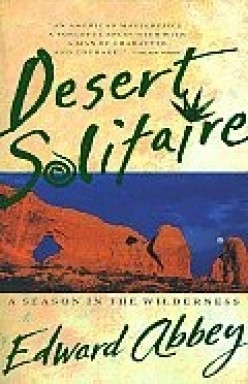
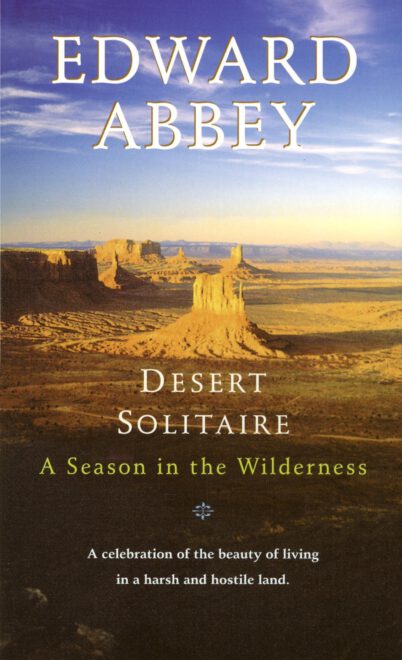
Special guest desert dwelling activist and academic Lucy Michaels, gets to the heart of the matter with a classic eco text: “The burnt cliffs and lonely skies … all that which lies beyond the end of roads:” From Desert Solitaire and why Israel’s deserts need their own Edward Abbey.
In the late 1950’s, a young ranger and sometime philosopher, Edward Abbey, spent three seasons as a ranger at Arches National Monument, a national park in southeast Utah in the USA. Desert Solitaire, his classic memoir of life in the desert wilderness chronicles both his adventures and his quest to experience nature in the raw.


Abbey’s book, however, transcends specific locations and speaks directly to the desert experience. His world is the slickrock desert with views open and perfect in all directions. A world of natural arches like jug handles or flying buttresses, tilted or warped by pressures from below or eroded by water or wind.
His garden is the pinyon pine and the juniper; the cactus and the cliffrose. His neighbours: the kangaroo rats, tiger lizards and beetles. His world turns from off-white to buff, pink, brown and red, tones which change with the time of day and the moods of light, weather and the sky. Out here, 20 miles from civilisation, his ticking watch is meaningless, ridiculous.

Against this vast canvas, Abbey’s stories are small yet riveting. His communion with the snakes that visit his trailer; the survey crew who lay the flags for a new paved road through the national park, which he carefully removes later that night; the fates of the local cowboys, Indians and prospectors; the moon-eyed horse gone feral in Salt Creek; the dead man at Grandview Point.
 The centrepiece his dreamlike adventure paddling down Glen Canyon to witness “a portion of earth’s original paradise” that would soon be drowned forever by the damming of the Colorado River. All the while time passes and seasons change as he sits out on his porch surveying his 33,000 acre view.
More than nature writing
Abbey’s book is, however, more than just nature writing at its finest (a definition he personally hated); it is an urgent call to defend the canyon lands from encroaching development.
For Abbey “Desert Solitaire” is both a memorial to “places already gone or going under fast” and “a tombstone or a bloody rock” to be hurled defiantly at “something big and glassy” such as the windows of a corporate headquarters.
It is not surprising, therefore, that Abbey is widely acknowledged as an inspiration to the American wilderness defence movement.
Abbey reserves special venom for tourists who drive in national parks, but not through other sacred places, such as cathedrals or museums. Besides “you can’t see anything from a car; you’ve got to get out of the goddamned contraption and walk, better yet, crawl, on hands and knees over the sandstone; through the thornbush and cactus. When traces of blood begin to mark your trail you’ll see something, maybe. Probably not.” The desert lands move too slowly for those of us hurtling about in our everyday lives.
Abbey’s great gift to us in “Desert Solitaire” is in noticing and revelling in the imperceptible things that simply don’t exist from a passing car window.
Wit as sharp as desert cliffs
What makes this book so engaging is that Abbey’s wit is as sharp as the jagged cliffs he describes. At times sanctimonious and overly dramatised, for the most part he is startlingly sincere.
Whist his tone is definitely his own, his message draws deeply on Thoreau and Emerson in perceiving wilderness as humankind’s sacred ancestral home and sole source of hope. For Abbey, the wilderness is essential as a place of freedom and escape to complement and complete civilization. “It is not a luxury, but a necessity as vital to our lives as water and good bread. A civilisation which destroys what little left remains of the wild cuts itself off from its origins. Industrial man…will make himself an exile from the earth and will know, at last, the pain and agony of final loss.”
Since the days of Abraham, and very probably long before, Israel’s mythical deserts have been sacred: a place of spirit, of revelation and renewal. Yet prominent Zionist leaders, notably Israel’s first prime minister, David Ben Gurion, came to see the desert in a very different light: it needed to be subdued and “made to bloom” to meet the needs of the young state. While this vision may have improved our material understanding of deserts, it has also engendered the destruction of exquisite places causing untold environmental damage for the sake of haphazardly placed factories, waste dumps, greenhouses, plantations and mines.
It has also resulted in the vilification of the Bedouin and their traditional desert lifestyles.
Book illuminates new environmental threats
And Israel’s deserts are still threatened by Ben Gurion’s dictum: from sand mining in Israel’s last intact sand dune to build hotels in Eilat and the re-introduction of copper mining in Timna.
From the plans to build a hotel for 4X4 drivers in the peaceful Sasgon valley, to the Valley of Peace – a proposal to transform the Arava into a Las Vegas of the East by billionaire Itzhak Tshuva, clearly a megalomaniac of Nebuchadnezzan proportions. Besides, much of Israel’s spectacular open spaces are located in military zones, tantalisingly out of reach, whilst other places are deeply scarred by tanks, bulldozers and off-road vehicles, whose tracks remain decades after they are gone.
Desert Solitaire demands another understanding. It is for those who have rambled through Israel’s desert lands following a tempting track down a wadi or tracking the ibex across the cliffs. It is for those who yearn for the shadows cast by the setting sun on the Edom Mountains, have charted the movements of the stars across the vast night skies or made coffee on an open fire under the shade of an acacia tree.
It is for those who have drawn inspiration from the eroded paths and changing colours of the day. It is for those for whom the desert simply is; and not for those for whom the desert waits to be something else. As a desert dweller myself, it was overwhelming to find such an articulate voice for the inexpressible sentiments that I feel for the land around me.
A call to defend the desert
While these deserts have had their literary champions in the past, from Dhu al-Rumma to TE Lawrence, Gertrude Bell and Pierre Loti, Israel’s deserts of today cry out for defenders. Defenders who understand what is at stake when we despoil our deserts and ride roughshod over their ancient wisdom for the sake of short term profits. Defenders who support mindful and sustainable development where necessary, and not simply development that claims to be “green” or “eco” when it is nothing of the sort. Defenders to encourage Israeli school kids to read old “Cactus” Ed as they memorise Ben Gurion. This would leave them with no excuse for perceiving the Negev and the Arava as blank canvases for exploitation and development.
The Negev does have some powerful literary voices, among them both Daniel Hillel and Haim Watzman. The Negev and Arava also have many unsung heroes who have also resisted sprawl and unnecessary development in recent years, but there are too few of us.
Put this book in your rucksack next time you go for a tiyul (trip). Find a shady spot on a craggy hilltop with a huge view, and read. You may well return home transformed.
About Lucy Michaels
 Lucy grew up in North London, a long way from her current desert home, but has always followed the call of the wild. At university she discovered Earth First! and has been active in radical environmental and anti-globalisation movements ever since. This included a five year stint as a director/researcher at Corporate Watch in Oxford.
From the first moment she arrived at Kibbutz Lotan in the Arava valley in Spring 2005 she knew she had come home. After a year working in Jerusalem, she found her way back down: first, to study and then work at the Arava Institute for Environmental Studies and now as a doctoral student of Professor Alon Tal at Ben Gurion University’s Desert Studies Institute in Sde Boqer where she is researching what Israelis think about climate change. She’s happiest when out hiking in the desert or involved in some crazy permaculture project.
Lucy currently lives with husband Uri Gordon somewhere on the route 40 between Kibbutz Lotan and Sde Boqer.


What Israel needs is for all of the invaders to leave. The Europeans that came to “make the desert bloom” did so by both subduing nature and killing the indigenous population. It is a nation built on the sorrow of another and the shame of a state sponsored apartheid.
It is a nation in which greedy Europeans smack their fat lips on finger sandwiches and hummus from the comfort of a lawn chair while cheering Israeli helicopter gunships dropping phosphorous bombs on women and children in Gaza.
The deserts in Palestine belong to the Palestinians. They do not need “voices” from greedy invaders, nor do they need help from those who desecrate them with their mere presence.
[…] A twelve hour bus ride south of Cairo (travel overnight if you like), the lodge is great for artists or yogi masters seeking refuge from the noise and pollution further north, couples in love, or the single adventurer with a decent budget. Despite its remote location, the lodge offers a smorgasbord of activities that will keep restless children occupied all day, leaving parents free to bask in the desert’s rustic warmth. […]