

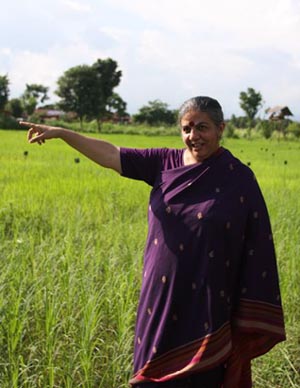
 Vandana Shiva isn’t a writer to pull punches. By the twelfth page of ‘Stolen Harvest’ (2000), she announces a damning verdict on Western food production:
“Industrial agriculture has not produced more food. It has destroyed diverse sources of food, and it has stolen food from other species to bring larger quantities of specific commodities to the market using huge quantities of fossil fuels and water and toxic chemicals in the process.”
In Israel, two percent of the population works as farmers, mostly in hi-tech, irrigated, chemically treated and globally traded agriculture, worlds away from the 70 percent of the world’s people who farm for a living.
Shiva, an Indian physicist turned food activist, is certainly not the first writer to tackle the ethics of the sprawling, mechanized, global food economy. However, as a voice from the Third World, she paints an unusually intimate portrait of the traditional wisdom and customs that stand to be swept away by the forces of genetic engineering, trawler fishing and commoditization.
‘Stolen Harvest‘ focuses on three major changes in food production: The Green Revolution, which used industrial methods to get more human food out of crops on land; the Blue Revolution, which used aquaculture to raise fish catches fourfold in the last 40 years, and the White Revolution, the feedlot approach to dairy and meat farming which has raised milk and meat yields. To Shiva, each “revolution” has come at tremendous cost.
One result of the Green Revolution in India has been replacing locally grown mustard oil with imported soybean oil, or with soybean oil produced domestically but from seeds sold by agricultural giant Monsanto. Shiva explains what used to be the norm of mustard oil production before “Soy Imperialism:”
“Indigenous oilseeds, being high in oil content, are easy to process at small-scale, decentralized levels with eco-friendly and health-friendly technologies … The bulk of oilseed processing is done by over 1 million ghanis (expellers) and 20,000 small and tiny crushers that account for 68 percent of edible oils processed … Women in the bastis, or slums, usually buy small quantities of mustard oil extracted on their local ghani in front of their eyes…Yet these community-based systems of food and health safety were quickly dismantled in the name of food safety in 1998, when local processing of mustard oil was banned and free imports of soybean oil were installed in response to a mysterious contamination of Delhi’s edible-oil supply.”
She further mentions that Indian children don’t eat soy oil, and that the soybean, which has a lower oil content than mustard seed, is poorly suited to the national needs.
The next area Shiva turns to is the ocean, where on the Indian coast large shrimp trawlers have arrived to supply the appetites of Western elites who fancy prawns. As they scrape the ocean floor with dragnets, the ships annually kill off as many as 150,000 turtles living on the seabed. They also pull up loads of fish not suitable for sale, which are dumped back into the sea either dead or dying as “bycatch” that can be as much as a third of the weight of the total sellable catch.
Where shrimp are not caught wild, they are bred in saline aquaculture pools that leach into the underground aquifers locals rely on for drinking water, and the coastal farms destroy acres and acres of mangrove trees that usually safeguard the seaside villages from heavy winds.
“The environmental destruction caused by intensive shrimp farming is one of the major factors for its spread in Third World countries, even though the main consumers of shrimp live in affluent countries. In country after country where commercial shrimp fishing has been tried, it has proven unsustainable. For this reason, this industry is known as a ‘rape and run’ industry.”
Shiva is not against all aquaculture or fishing. However, she points out the vast difference between the modern, industrial approach and the traditional methods of fish farming, in which fishermen used hand-crafted nets and woven mats, or combined a rice paddy with prawn cultivation. Whereas the traditional methods have lasted for 500 years, industrial fish catching for export has made life unlivable for many of India’s coastal villages.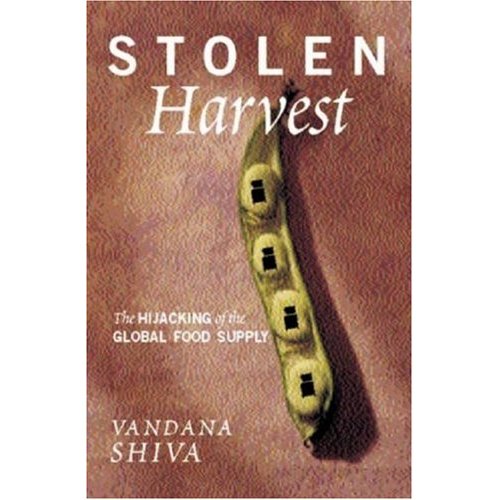
Finally, Shiva looks at the livestock industry in India, which has moved toward industrially raised and slaughtered cows for export. She first grounds the readers in the significance of the traditional Indian cow, which eats crop waste and pastures on uncultivated land:
“Indigenous cattle do not compete with humans for food; rather, they provide organic fertilizer for fields and thus enhance food productivity. Within the sacredness of the cow lie this ecological rationale and conservation imperative. The cow is a source of cow-dung energy, nutrition, and leather, and its contribution is linked to the work of women in feeding and milking cows, collecting cow dung, and nurturing sick cows to health.”
And yet, seeing the cow as a milk machine or a meat factory apart from the bigger agricultural picture, as Western cattle raisers do, moves away from the Indian culture of the sacred cow, and generates the industrialized “mad cow.” Remarking on the Indian Al-Kabeer slaughterhouse, which kills 184,200 buffalo a year, Shiva writes that those same animals could have provided for the fuel needs of 900,000 average Indian families of five.
“Al-Kabeer has provided just 300 jobs,” Shiva writes. “In contrast, small-scale slaughtering for local consumption creates livelihoods and allows all parts of an animal to be used. …In large-scale industrial slaughterhouses, all these byproducts are treated as waste and become a source of pollution.”
Some of Shiva’s revelations were new to me, such as the far-reaching consequences of mass-producing shrimp. I also was shocked at how in world trade negotiations, India’s request to limit environmental damage through new regulation banning export of raw animal hides and fur was struck down as illegally limiting free movement of goods.
Finally, it was particularly sobering to read about the future of Indian wheat processing, which at press time was comprised of 3.5 million family run wheat shops providing 40 million tons of wheat flour a year. According to Shiva, less than 1 percent of flour consumed in India comes in packaged brands, because Indians prefer local and fresh ingredients. However, American-based food giants Cargill and Archer Daniels Midland seek to capitalize the industry through mechanization and branded packaging, which Shiva says will eliminate the livelihoods of at least 100 million Indians in the wheat industry.
A weak point in Shiva’s book is that despite her firm belief in traditional food raising techniques, she does not relate to the high birthrate in many of the poorer countries whose agriculture she seeks to defend. I do not know if a country such as India, or Egypt, or Israel for that matter, could feed its populace which has grown thanks to artificially abundant food, as well as medical advances that have reduced infant mortality and extended life expectancy. Whatever Shiva may make of the world’s outsize human population, she does not deal with the consequent increased demands on the resources of food.
Yet the book is a valuable look at how Western corporate agribusiness, which strips away animal and crop diversity by growing monocultures of soy, wheat, shrimp and cows, is also reducing the human diversity of the world by making traditional food raising costly or impossible. As consumers of rice, non-labeled genetically engineered soybean oil, and frozen shrimp, in Israel we certainly enjoy the fruits of industrialization in India and around the world. Stolen Harvest shows that this has come at great cost.
This book review is by Daniella Cheslow, and is posted by James.


, she announces a damning verdict on Western food production:)