


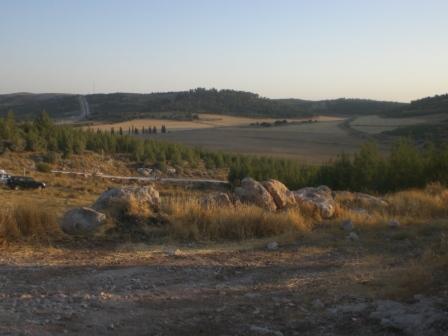
The Elah Valley. Beautiful rolling hills, a patchwork of gold, green and brown with fields, orchards and pasture steeped in biblical tales: Who wouldn’t want to live here?
Thanks to developer Jake Leibowitz, hundreds of new immigrants, mostly from North America, will soon be able to move into the luxury Eden Hills development after 18 years of delays and setbacks. The developers describe the community as a “celebration for ecology and Zionism”, succeeding in settling Jewish olim as well as incorporating green innovations including solar power, geothermal technology and water purification.
But the congenial mezuzah-fixing ceremony attended by Minister of Housing Zeev Boim recently glossed-over the bitter quarrel between the developers and environmentalists who sought to stop the new 1,000 dunam town dead in its tracks. The Society for the Protection of Nature in Israel’s (SPNI) Michelle Levine describes the development as an “environmental catastrophe” and told Green Prophet that it “is in essence a bigger disaster to the environment than their gray water and solar power schemes could ever hope to rectify”.
Why? Because it’s being built close to Israel’s primary wildlife corridor, a natural migratory path for flora and fauna (although planning authorities eventually ordered the size of settlement to be reduced to safeguard the corridor).
Regardless of its size, Levine believes that Eden Hills, just south of Beit Shemesh, should never have been given the go-ahead in the first place, following the Israel 2020 master plan which recommends that existing urban centres should strengthened instead of building new yishuvim [settlements] in order to preserve open spaces in the tiny country. “No new community period can call itself an ‘environmental’ community,” says Levine.
We have gone past the point where we can build more communities. There’s only so much green space we can take up in Israel.
It’s a positive sign of the times that Israeli property developers are investing in ecologically-sound buildings (like REAL Housing in the Negev), but perhaps they should give more thought to where they put them…
Related Prophecies: REAL(ly) Affordable and Sustainable Housing Hits the Negev and Green Building or Greenwashing in Kfar Saba?
Photo: Michael Green.



[…] religions including Islam and Judaism, the first man and woman are believed to have resided in a garden of lush greenery and ample fruits. In contemporary urbanised societies, we long for that simpler, stuff-free […]
So you guys all have good thoughts. But it would be a lot better if you can just decide what the fruit was that Eve ate! Im sure it would help many people. Such as my daughter who is trying to do a report about the Forbidden Fruit, but no website has one answer. Please take that into concideration.
Michael, well said. I agree that the posters above who claim Eden Hills is some kind of environmentally friendly “eco-community” likely bought property there, with a vague understanding of environmental principles, but probably solid and good intentions. Unfortunately, Eden Hills is slated to be built directly on top of an important wildlife corridor and will do unfathomable damage, no matter how well their toilets compost or their light bulbs save on electricity. In short, Eden Hills is the worst kind of example possible – akin, very much, as you say, to burning down the rainforest to plant organic bananas. I would be happy to forward the extensive findings of the Environmental Impact Report to anyone interested, though they are in Hebrew; the report was conducted over a two-year period by the Nature & Parks Authority, the JNF, the SPNI and ALL the relevant environmental organizations in Israel. When you have an overview of the environmental situation in the area, you begin to understand exactly why Eden Hills is such a disaster, from a scientific point of view.
Below is SPNI’s press release from 2006, following the Regional Planning Council’s last ditch effort to reign in the developer, who refused to compromise on any environmental issue without being forced into it by government agencies!
In light of the irresponsible and irreversible approval granted Eden Hills by the National Planning Council, the Regional Planning Council’s new parameters constitute a victory for the many species of local endangered plant and animal life – and for a sustainable Israel. Dismissing developers’ revised Eden Hills’ plans as minor architectural changes that do not solve the ecological problem whatsoever, the Regional Planning Council has established permanent guidelines for any development in the area:
200 meter wildlife corridor from Israel’s separation fence that can never be developed in any way; this cannot even be fenced off – leaving the corridor intact means dropping 50 or 60 houses from the original plan
Minimum 400 meter bridge for the road leading in to Eden Hills must include a viaduct (opening as large as possible to provide safe passage for animals); the opening must be as wide as possible, which could be up to 150 meters
Limit the collecting or transferring of trees and protected plants; the construction will have to be supervised by the Nature and Parks Authority
Limit further spread of development in the direction of the recognized, yet unexcavated archaeological site (lowest layers date from Second Temple times, settled again during Byzantine times), which must be protected with a right of way for public access
No house may occupy two dunams (2 dunams = 1/2 acre); Israeli building code stipulates that the maximum area one residence may occupy is one dunam or 1/4 acre
Eden Hills Timeline of Events
1/31/06 Regional Planning Council concludes the revised plans do not solve the ecological problem and sets permanent guidelines for the area’s development, accepting most of SPNI and opposing parties’ position
1/10/06 Eden Hills developer submits revised plans
11/24/05 Regional Planning Council agreed in principle with the ecological problem of building Eden Hills in the wildlife corridor and ordered the developer to submit a revised plan, reducing building and preserving the wildlife corridor
7/05 Council for Agricultural Land and Open Spaces canceled Eden Hills’ plans for a 12 acre Industrial Park, accepting in part SPNI’s opposing stand
2004 Environmental Impact Report, sponsored by Israel Land Authority, Nature and Parks Authority, JNF, and the Ministries of Interior and Environment, concluded the proposed area serves as a critical wildlife corridor and should be protected nature reserve
2002 National Planning Council approves Eden Hills and attached Industrial Park
1998 Initial approval of Eden Hills stipulates all development would be held up until completion of Environmental Impact Report
SPNI is pleased that the Regional Planning Council has taken the conclusions of the extensive environmental research seriously; they accepted all of SPNI’s concerns as valid and addressed them. However, no believer in Israel 2020 could be truly satisfied unless the community is built within an existing infrastructure, for example at Moshav Roglit.
Dear Mr Friedman, Eden Hills is about as ‘ecological’ as cutting down Amazon rainforest to establish an organic banana plantation.
Perhaps the renewable energy and grey water eases your conscience, but it’s greenwashing in any other language. There are plenty of places to build within the infrastructure of existing communities. And it wasn’t the SPNI that published the Israel 2020 plan, it was the government…
“Its underlying planning principles include: concentrated and dense development, urban renewal, prevention of new settlements and increased density of existing ones, improved public transportation, and emphasis on green buffers, open spaces and the preservation of heritage and nature values.”
Foreseeing a green, environmentally-sound future for Israel is both praiswothy and imprtant.However please remind Israel’s (SPNI) Michelle Levine and friends that their goal should be to support projects that will exemplify eco-consruction and not persistantly castigate any and every new project or road design .
The country’s developement is esential and cannot be halted. I would like to see SPNI’s positive impact on Israel in the media and not merely their snide objections.At this point they should imbrace such a project and help guide it’s green aspects and not cost it and Israel in general ,sensless waste of time and millions of shekel. Their positive impact on our envirement would have been many fold by now
Developing on open land is not environmentally-friendly. The only development Israel can sustain is in its cities. Simon– your comment sounds like it was taken from Eden Hill’s brouchure…
Eden Hills appears to be the most environmentally friendly development ever dreamt of in Israel and it is on a site where Jews lived two thousand years ago. If city planners are wise they will learn from it and those who objected to it in the past for various reasons should now use its example to lobby for similar technology to be used in developments elsewhere.
Thank you for the article point well made. We have enough moshavim in the Elah expanding their is really no need for a new project like this. From my view on the hill just above this proposed project. They seem to have managed to squeeze in a gigantic home on the far side of the hill just out of view.. Sadly, I think this may be the begining. I had attended a ground breaking some three years ago. I had long hoped the project would be stopped in the courts. I have been meaning to bike out to the house for some time. I will let you know if their is anything interesting to report..
Amazing post Michael and I think this message should be sent loud and clear to people who are coming to “settle” the land of Israel… better for them to buy homes in Jerusalam or Tel Aviv and mix with the “locals”… this eco project sounds more like a middle america housing project to keep the riffraff out and the “quality” people in…