
Biodegradable Transistors from Blood, Milk and Mucus Protein

biodegradable transistors, nano technology, Tel Aviv UniversityResearchers at Tel Aviv University (TAU) pave the pay for a new era in nano-technology. Say hello to transistors made of blood, milk and mucus.

Blood, milk and mucus proteins could soon replace silicon to produce transistors, which amplify electrical signals and are at the basis of most modern technology. One of the most important benefits of this discovery is that these transistors will be biodegradable.

A team of researchers including students Elad Mentovich and Netta Hendler of TAU’s Department of Chemistry and The Center for Nanoscience and Nanotechnology, with supervisor Shachar Richter and in collaboration with Prof. Michael Gozin and his  student Bogdan Belgorodsky, have brought together biology and chemistry to create self- assembling protein-based transistors.

Each organic protein has unique properties and when mixed together can create a complete circuit with electronic and optical capabilities with great flexibility in terms of conductivity, memory storage, and fluorescence.

Blood proteins can absorb oxygen allowing researchers to add different chemicals to adjust the properties of the semiconductor in order to create specific technological properties. Milk proteins, which say strong and stable in different environments, form the fibers which become the building blocks of the transistors. Finally, mucosal proteins have the ability to keep red, green and, blue fluorescent dyes separate, together creating the white light emission that is necessary for advanced optics.

If this can be scaled up, there will be an important revolution in nano- sized technology. First there will be a shift from a silicon era to a carbon era, and these products will be biodegradable, notes Mentovich.

Apple, Nokia and all the big electronic companies could finally help address the growing problem of electronic waste, which is overflowing landfills worldwide.

Second, transistors built from blood, milk and mucus proteins will be ideal for producing smaller, flexible devices. Current technology which uses silicon is 18 nanometers high, but in the case of blood protein, for example, the film is approximately four nanometers high.

This breakthrough in biological electronics could lead to a new range of flexible technologies, screens, cell phones, tablets, biosensors, and microprocessor chips. The hope is that this can lead to a more flexible and eco-friendly technology.

The team at Tel Aviv says they are already working on a biodegradable display, with other electronic devices to follow.

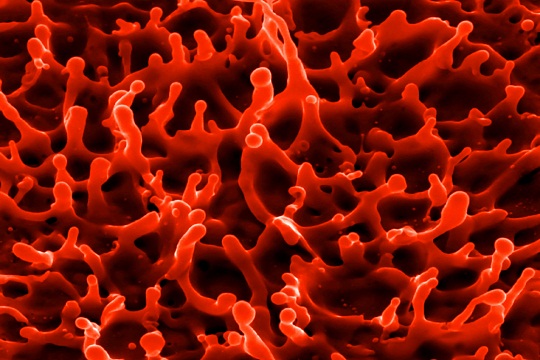
Image of gold nanospikes from Shutterstock

Linda Pappagallo
Linda Pappagallohttps://www.greenprophet.com/
Linda's love for nature started when at the age of eight she discovered, with her dog, a magical river in the valley of a mountainous region in Lebanon. For four years Linda and her dog explored along the river, until one day she saw construction scrapers pushing rock boulders down the valley to make way for new construction sites. The rubble came crashing into the river destroying her little paradise, and her pathetic reaction was to shout at the mechanic monsters. Of course that was not enough to stop the destructive processes. As she continued to observe severe environmental degradation across the different places she lived in the Middle East and Africa, these terrible images remained impressed in her mind. However, environmental issues where not her first love. Her initial academic and career choices veered towards sustainable economic development, with particular interest in savings led microfinance schemes. Nevertheless, through experience, she soon realized a seemingly obvious but undervalued concept. While humans can somewhat defend themselves from the greed of other humans, nature cannot. Also nature, the environment, is the main “system” that humans depend on, not economics. These conclusions changed her path and she is now studying a Masters in International Affairs with a concentration in Energy and the Environment in New York. Her interests lie on ecosystems management: that is how to preserve the integrity of an Ecosystem while allowing for sustainable economic development, in particular in the Middle East and Africa.

TRENDING

Eco organization offices destroyed by Iran missile

Tel Aviv's eco organization, the Heschel Center, was impacted by an Iranian missile.

What are AWG air-water generators, and why they aren’t a golden-bullet solution (yet)

Atmospheric water generators (AWGs) sound like magic: machines that can pull drinking water out of air. The idea is mentioned in the Bible, where the elders would pray for water collected as dew on plants and the catch on turning this into a machine is in the physics. To turn invisible vapor into liquid, you must remove heat, especially the latent heat of condensation.

Jordan’s $6 Billion Aqaba–Amman Desalination Project from the Red Sea Moves Forward

In 2025, the Jordanian government signed agreements with a consortium led by Meridiam and SUEZ, alongside VINCI Construction and Orascom Construction. Under a 30-year concession agreement, the consortium will design, build, finance, operate, and maintain the system before transferring it back to the Jordanian government. The total investment is estimated at approximately $6 billion USD.

The Saudi Startup Turning Desalination’s Toxic Waste Into Its Own Disinfectant

For millennia, the Middle East's water crisis seemed an immutable fact of geography — a region defined as much by what it lacked as by what lay beneath its sands. Today, a convergence of plummeting solar costs, advancing membrane technology, and hard-won engineering expertise is rewriting that story.

Earth building with Dead Sea salt bricks

Researchers develop a brick made largely from recycled Dead Sea salt—offering a potential alternative to carbon-intensive cement.

How AI Helps SaaS Companies Reduce Repetitive Customer Support Work

SaaS products are designed for large numbers of users with different levels of experience, and also in renewable energy.

Pulling Water from the Air

Faced with water shortage in Amman, Laurie digs up...

Turning Your Energy Consultancy into an LLC: 4 Legal Steps for Founders in Texas

If you are starting a renewable energy business in Texas, learn how to start an LLC by the books.

Tracking the Impacts of a Hydroelectric Dam Along the Tigris River

For the next two months, I'll be taking a break from my usual Green Prophet posts to report on a transnational environmental issue: the Ilısu Dam currently under construction in Turkey, and the ways it will transform life along the Tigris River.

6 Payment Processors With the Fastest Onboarding for SMBs

Get your SMB up and running fast with these 6 payment processors. Compare the quickest onboarding options to start accepting customer payments without delay.

Qatar’s climate hypocrisy rides the London Underground

Qatar remains a master of doublethink—burning gas by the megaton while selling “sustainability” to a world desperate for clean air. Wake up from your slumber people.

How Quality of Hire Shapes Modern Recruitment

A 2024 survey by Deloitte found that 76% of talent leaders now consider long-term retention and workforce contribution among their most important hiring success metrics—far surpassing time-to-fill or cost-per-hire. As the expectations for new hires deepen, companies must also confront the inherent challenges in redefining and accurately measuring hiring quality.

8 Team-Building Exercises to Start the Week Off 

Team building to change the world! The best renewable energy companies are ones that function.

Related Articles

Popular Categories