Home Blog Page 752

A Recipe for Pea Pod Soup

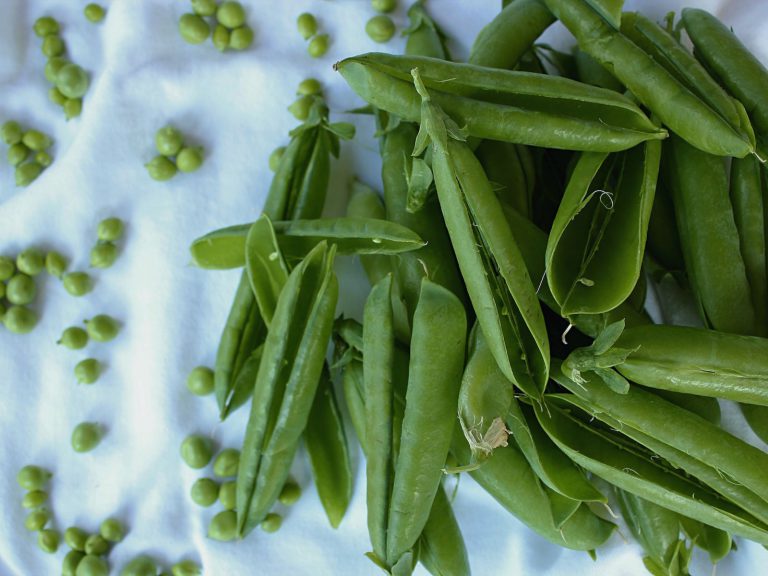
Pea Pod Soup. Use the whole pea and its pod!

Fresh peas are delightful. They are bursts of green, garden-tasting goodness, immensely better the moment they are picked than even a day or two later. Peas can be snacked on raw out of the pod, simmered in cream, tossed with lemon zest and pasta, puréed with olive oil and ricotta and spooned on crostini. These are all excellent treats, and highly recommended.

But here’s the thing about fresh peas: once you’ve shelled them, your pile of pods will inevitably be an order of magnitude larger than your pile of peas. The process of shelling, on good days, is meditative and relaxing. On days that are even the slightest bit busy, it is finicky, tiresome, and given how small the pile of peas you end up with, likely to strike you as not worth the trouble.

Unless, that is, you get to turn the pods into something yummy as well.

Make Delicious Pea Pod Wine

Pea pods are very fibrous and tough, and can’t just be cooked and eaten. They can, however, get diverted from your compost heap, and turned into soup. Not a cream soup – nothing so heavy seems seasonal – but a smooth, thin, refreshing soup, perfect for summertime. It’s a subtle, mossy green way to make the the most of your hard pea-shelling work.

Pea Pod Soup Recipe

  • 2 tbsp olive oil
  • 1 medium onion, roughly chopped
  • 2 cloves garlic, minced
  • 1 large mixing-bowl’s worth of pea pods (about 2 quarts)
  • 1 L light veggie or chicken stock (I diluted some regular stock with water)
  • 1 handful of fresh thyme
  • 1 lemon, zest thereof
  • salt and pepper to taste
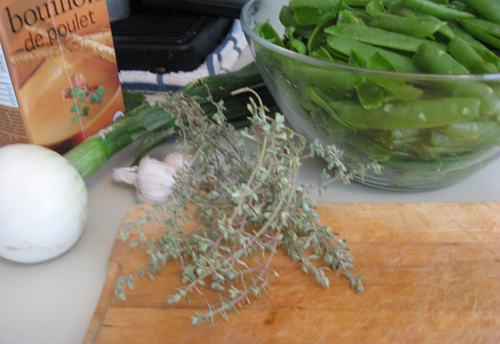
pea pod soup recipe ingredients
Getting ready for pea pod soup

Method for making pea pod soup

1. Place a large soup pot over medium heat. Pour in a glug of oil, and leave to warm through. Add in onion; sauté until softened and beginning to turn translucent, about 5 minutes. Stir in garlic and sauté another couple of minutes.

2. Add pea pods to the pot and pour in the stock, which should just barely cover the pods. (Add a bit of water if the stock seems scanty.) Throw in the thyme, stems and all, cover and bring to a gentle simmer.

3. Uncover pot and allow soup to simmer until pea pods are very tender, about 45 minutes. Remove soup from heat and let cool for a few minutes. Pick out the thyme stems.

4. Transfer the soup to a blender and process for a few seconds (you’ll need to do this in batches). You’re not trying to purée the soup – the pods won’t ever break down that far – but rather to chop the pods up and release all their juices and soft flesh.

5. Strain the soup through a fine-mesh sieve, pressing on all the solids with the back of a spoon to extract as much liquid as possible. Return soup to the pot, and discard the solids.

6. Stir lemon zest into the soup, and taste. Add as much salt and pepper as you like. Ladle into bowls, or (our preference) refrigerate and have the soup chilled.

pea pod soup recipe bowl
Simple pea pod soup, ready to garnish

7. Serve soup with thick slices of toast and a salad for a light, easy-going hot weather lunch or supper.
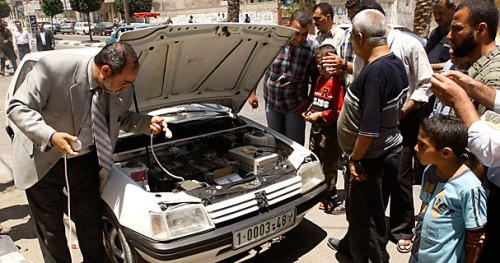
 

Electric Cars in Gaza: Necessity is the Mother of Invention!

electric car gaza picture
The Gaza Strip seems like the last place in the world where we would hear good news on the environmental – or any – front. Since Hamas took control of the Gaza Strip last summer, Israel has imposed a nearly total blockade, resulting in shortages of everything from fuel to water to food and medical supplies.

In the context of this crisis, two innovators from Gaza, Waseem Khazendar and Fayaz Anan, decided to respond to the dire conditions of their community, and in doing so made this corner of the globe a little greener.

Khazendar and Anan created the first Palestinian electric car!

"The Compost Guy" on a Composter’s Delight and Dilemma in Tel Aviv

compost tel aviv composting bin image

Due to not having a yard and feeling an overwhelming sense of guilt every time I throw away my food scraps in a conventional garbage, I spent my first few months in Tel Aviv trying to figure out some plausible composting options in the city. This was harder than expected because so many Israelis have never even heard the word compost, which is the same in Hebrew as it is in English.

Still, the search for a compost in Tel Aviv was an incredibly insightful experience that has brought me closer to the environmental scene here.

Back in December I found myself on the Heschel Center roof (center for all things environmental) with a bucket of compost, deciding whether it was the right place for me and my scraps. It wasn’t. It didn’t feel quite right, and maybe that had to do with the plastic green compost bin instead of a pile or a heap. On the roof, though, I met fellow gardeners and environmentalists who I’ve later seen at other environmental gatherings where they dubbed me “the compost guy.”

BYOM… (Bring Your Own Mug)

0

Instead of relying on the paper and styrofoam cups that are provided at work, bring your own mug. Some coffee shops will make your beverage straight in a mug brought from home. The less disposable you use, the less that ends up in the landfill. Check out other landfill solutions.

Sizzle, A Global Warming Comedy, Is Not So Hot

My partner and I watched this movie with increasing incredulity and frustration. She is a former science journalist, and she won’t mind me telling you, gave up on ‘Sizzle’ after 15 minutes.

I sat through it all, and felt deflated after 85 minutes of this eco-baloney – filmmaker Randy Olson sets out to pick up on Al Gore and his ‘An Inconvenient Truth’ movie with its one-sided view; thats fair enough – present both sides of the argument, but why fill this so-called ‘mockumentary’ with half-assed scenarios about pseudo producers and skeptic techies who have sudden breakthroughs and become converts to the global warming (& human responsibility for such) cause as well?

Wine Cubes for keeping bits of old wine

0

eco friendly date

I love cooking with wine… and sometimes I add some to my cooking too. Cooking with alcohol, especially wine, can release elements in food that would otherwise not come out, specifically tomatoes and meats.

If you have a little bit of wine left over in a bottle but cannot finish it, instead of letting it spoil on your counter, you can pour it into an ice cube tray and freeze it.

This way you are not wasting that last drop and you are keeping the wine fresh for future cooking. Or have a hand at making some ancient wine? Try making mead.

Israel's Water Levels Go From Red to Black

7

kinneret red lineEvery Israeli knows what the Sea of Galilee’s (a main source of Israel’s drinking water) red line means. It’s bad. It means Israel is running out of water and we’re all in trouble. So when the Israel Water Authority came out with a campaign about two weeks ago saying that Israel’s water levels were deteriorating from the red line to the black line, that was even scarier.

To make matters worse, last week the Director of the Water Authority announced that Israel is currently facing the worst water supply crisis in 80 years, ever since they started keeping records. And that unless our water consumption patterns (which have increased in disproportionate levels to our population increase) and water purification methods change… it’s bad news all around.

So what do the red and black lines actually mean?

Israeli Researchers Listen to Plants to Find Water Contamination

0

In the Middle East, water is never far from our minds. As Israel’s water shortage takes effect, the quality of our water is in brisk decline. Hot on the heels of this crisis, a team of researchers in Bar-Ilan University has developed an effective method for locating and measuring water contamination.

The new method, developed by Professor Zvy Dubinsky and Dr. Yulia Pinchasov, is based on the concept that contamination disrupts plant growth–therefore analyzing plant growth can serve to detect whether or not there is contamination.
The researchers analyze the rate of photosynthesis (the process of converting sunlight into energy) of plants growing in the water, to examine whether the plant is realizing its full photosynthesis potential. If it isn’t, this could indicate that there is a disruption in the water, i.e., a contaminant.

How does it work? Well, it starts with a green laser beam. Also, did you know that plants can sing?

Controversial Red-Dead Sea Canal on Hold – But why?

6

Last month Green Prophet wrote about the controversy over the so-called “Peace Canal” or “Peace Valley” lauded by French President Nicolas Sarkozy in his recent trip to Israel. A huge man-made canal carrying water north from the Red Sea was envisaged as the centrepiece of the joint Israeli-Jordanian initiative, backed by claims of breathing life into the ailing Dead Sea, developing tourism projects on both sides of the Israel-Jordan border, as well as plenty of well-worn rhetoric about “making the desert bloom”.

Environmental groups who vigorously opposed the plans, such as Friends of the Earth Middle East, may be breathing a sign of relief this week following reports that the canal has been put on hold – albeit for the wrong reasons.

Is Israel's Bottled Water Polluted?

1

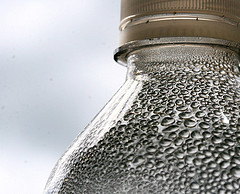
As a thirsty greenie living in Israel, I try to avoid buying bottled water, and instead have recently purchased a very cool stainless steel water bottle – made in the US by Klean Kanteen. But sometimes it’s difficult to avoid buying some water in plastic bottles – although after reading this story, I will think twice.

This report was spotted in this weekend’s Haaretz newspaper (11th July 08):

“‘Mineral Water with a Taste of Gas’: Gasoline fumes penetrate the plastic mineral water bottles sold at gas stations, according to Technion professor Joseph Miltz of the Faculty of Biotechnology and Food Engineering.”

Eco Tourism in the Middle East: Syria

7

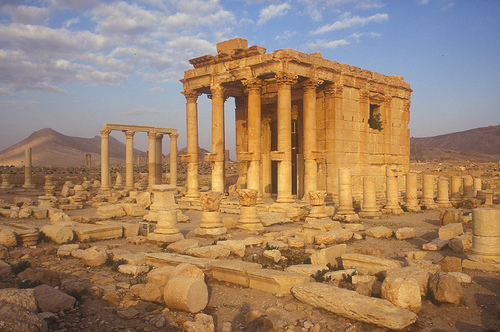
Now that we’ve toured Lebanon, Jordan, and even Iran, let’s make an online eco-visit to Syria. Since Syria has not yet experienced a wave of mass tourism, its sites are still well preserved and relatively undisturbed. That, combined with the fact that Syria has a wide variety of landscapes ranging from forests to beaches to mountains, makes Syria a perfect spot for eco-tourism.

Like other Arab countries in the region, eco-tourism in Syria mainly consists of environmentally friendly tour operators offering a range of wildlife-focused trips.

Here are some of Syria’s top green tourism companies:

Is Wind Energy a Danger to Migrating Birds?

7

We’ve explored the heady possibilities of wave energy…But what about wind? Wind turbines, those modern day versions of Don Quixote’s windmills, may have some environmental drawbacks, according to research being carried out by the Israel Ornithological Center, a branch of the Society for the Protection of Nature in Israel. The study appears to center around a growing concern by ornithologists (bird watchers) that large revolving turbine blades could be deadly to the thousands of migrating birds who pass through Israel annually on their journey to and from summer homes in Russia and Eastern Europe.

One World, Many Beads: A Journey in Bedouin Jewelry

In The Beginning

There came a moment when I realised that I had to make a business with the jewellery that I kept buying for myself in Sinai. Everytime I returned to Tel Aviv with a new bracelet, a fancy anklet or a ‘jada’ for the hand, a stranger on the beach, in the market, even on a bus would say to me “Ooh where did you get that from?” and sometimes I would end up selling the jewellery I was wearing at the insistence of the admirer.

Close the Fridge

0

When I was a child growing up I was indecisive. It would take me whole minutes of peering into the fridge to decide what to eat. My grandmother used to chide this practice saying: “Don’t pray in front of the open refrigerator!” Orthodox Jews can take up to twenty minutes in their silent prayer on a weekday. While one is praying he, or she, is not supposed to move their feet, but instead, stand upright, unmoving…

Avoid leaving fridge doors open. Each minute the door is open takes three minutes of energy to cool down again.

Tel Aviv Puts Jaffa Skyscraper Plans on Hold

2

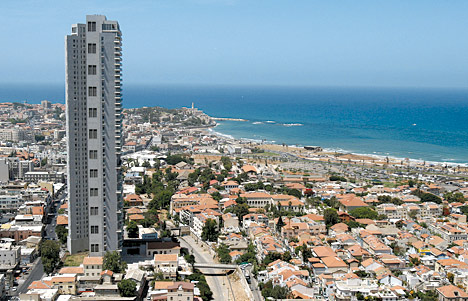
Photo by Dan Keinan, Haaretz.

A modernist skyscraper was built with no connection to the existing urban context, and plans for a row of similar towers threatened to destroy the character of the historical city center. This so outraged the residents of the area that they managed to bring about a complete ban on skyscraper construction in the historical city center.

The city was Paris, and the year was 1977. (The skyscraper was the Montparnasse Tower, which in 2005 turned out to be loaded with asbestos…) However, a similar process may be underway in Tel Aviv of 2008.

On Wednesday, the Local Planning and Construction Committee (an organ of the Tel Aviv Municipality) decided, unanimously, to freeze a plan for a 30 story residential building at the corner of Nahalat Binyamin and Derech Yaffo Streets.