In the modern nutrition universe, that level of commitment deserves an applause. But for those who don’t live in a Nordic fishing village, the nutrition company Zinzino has built its omega-3 research and formulations around these principles, combining biomarker testing, antioxidant protection and traceable sourcing across both sustainably harvested small-fish oils and a vegan marine-microalgae alternative.
Dubai Municipality has set up 12 AI-powered "Ehsan Stations" to safely and officially feed strays. The city also officially supports Trap-Neuter-Return (TNR) programs.
A new project in Spain shows how digital twins, which are virtual replicas of real environments, are becoming powerful tools for protecting ecosystems.
In the modern nutrition universe, that level of commitment deserves an applause. But for those who don’t live in a Nordic fishing village, the nutrition company Zinzino has built its omega-3 research and formulations around these principles, combining biomarker testing, antioxidant protection and traceable sourcing across both sustainably harvested small-fish oils and a vegan marine-microalgae alternative.
Dubai Municipality has set up 12 AI-powered "Ehsan Stations" to safely and officially feed strays. The city also officially supports Trap-Neuter-Return (TNR) programs.
A new project in Spain shows how digital twins, which are virtual replicas of real environments, are becoming powerful tools for protecting ecosystems.
In the modern nutrition universe, that level of commitment deserves an applause. But for those who don’t live in a Nordic fishing village, the nutrition company Zinzino has built its omega-3 research and formulations around these principles, combining biomarker testing, antioxidant protection and traceable sourcing across both sustainably harvested small-fish oils and a vegan marine-microalgae alternative.
Dubai Municipality has set up 12 AI-powered "Ehsan Stations" to safely and officially feed strays. The city also officially supports Trap-Neuter-Return (TNR) programs.
A new project in Spain shows how digital twins, which are virtual replicas of real environments, are becoming powerful tools for protecting ecosystems.
In the modern nutrition universe, that level of commitment deserves an applause. But for those who don’t live in a Nordic fishing village, the nutrition company Zinzino has built its omega-3 research and formulations around these principles, combining biomarker testing, antioxidant protection and traceable sourcing across both sustainably harvested small-fish oils and a vegan marine-microalgae alternative.
Dubai Municipality has set up 12 AI-powered "Ehsan Stations" to safely and officially feed strays. The city also officially supports Trap-Neuter-Return (TNR) programs.
A new project in Spain shows how digital twins, which are virtual replicas of real environments, are becoming powerful tools for protecting ecosystems.
In the modern nutrition universe, that level of commitment deserves an applause. But for those who don’t live in a Nordic fishing village, the nutrition company Zinzino has built its omega-3 research and formulations around these principles, combining biomarker testing, antioxidant protection and traceable sourcing across both sustainably harvested small-fish oils and a vegan marine-microalgae alternative.
Dubai Municipality has set up 12 AI-powered "Ehsan Stations" to safely and officially feed strays. The city also officially supports Trap-Neuter-Return (TNR) programs.
A new project in Spain shows how digital twins, which are virtual replicas of real environments, are becoming powerful tools for protecting ecosystems.
In the modern nutrition universe, that level of commitment deserves an applause. But for those who don’t live in a Nordic fishing village, the nutrition company Zinzino has built its omega-3 research and formulations around these principles, combining biomarker testing, antioxidant protection and traceable sourcing across both sustainably harvested small-fish oils and a vegan marine-microalgae alternative.
Dubai Municipality has set up 12 AI-powered "Ehsan Stations" to safely and officially feed strays. The city also officially supports Trap-Neuter-Return (TNR) programs.
A new project in Spain shows how digital twins, which are virtual replicas of real environments, are becoming powerful tools for protecting ecosystems.
In the modern nutrition universe, that level of commitment deserves an applause. But for those who don’t live in a Nordic fishing village, the nutrition company Zinzino has built its omega-3 research and formulations around these principles, combining biomarker testing, antioxidant protection and traceable sourcing across both sustainably harvested small-fish oils and a vegan marine-microalgae alternative.
Dubai Municipality has set up 12 AI-powered "Ehsan Stations" to safely and officially feed strays. The city also officially supports Trap-Neuter-Return (TNR) programs.
A new project in Spain shows how digital twins, which are virtual replicas of real environments, are becoming powerful tools for protecting ecosystems.
In the modern nutrition universe, that level of commitment deserves an applause. But for those who don’t live in a Nordic fishing village, the nutrition company Zinzino has built its omega-3 research and formulations around these principles, combining biomarker testing, antioxidant protection and traceable sourcing across both sustainably harvested small-fish oils and a vegan marine-microalgae alternative.
Dubai Municipality has set up 12 AI-powered "Ehsan Stations" to safely and officially feed strays. The city also officially supports Trap-Neuter-Return (TNR) programs.
A new project in Spain shows how digital twins, which are virtual replicas of real environments, are becoming powerful tools for protecting ecosystems.
Far be it for this Green Prophet to disavow her love of the city of Tel Aviv. Tel Aviv has almost everything – the beach, museums, great food, interesting architecture, a happening nightlife… But also, of course, traffic congestion, waste, pollution, an overdose of concrete, and the improper collection of rainwater, to name a few. Tel Aviv – or any city – can be a lot to take and many urbanites find themselves searching for greener pastures eventually.
In Israel, these greener pastures will soon come in the form of an intentionally eco-friendly town in the northern Israeli region of Gilboa called Nurit. And lots of Israeli urbanites (mostly from Tel Aviv, Jerusalem, and Haifa) are getting on board.
Currently in the works with the first 100 homes ready by next year (and 400 families living in Nurit by 2012), this new green town is the product of intense consultation with global environmental experts. Nurit will not only encourage, but actively enforce environmentally responsible behavior via its infrastructure and services. And here’s how:
Ricotta is a summer cheese. And as the weather warms up, Jewish people start to think about the Hebrew holiday of Shavuot – the holiday that features dairy so prominently. In part it’s a question of ecology: meat is a high-impact food, and if we can all cut down a bit, the planet be much better off.
In part it’s a question of health: with all of the heavy holiday meals we’ve been having, a bit of a break seems in order. And in part it’s a question of celebration: just as the harvest enjoins us to pay closer attention to what we grow in the soil, making cheese rather than simply buying it in the store helps in the appreciation department.
Plus, it’s a bit of a chemistry experiment, and just plain fun.
There are some foodstuffs that we buy in their original, unvarnished form: fruits and vegetables, eggs, milk, meat. And then there are some foodstuffs that we buy already processed: bread, jam, pickles, and so on. These are all things that we could make at home, but for the sake of convenience and efficiency we tend to leave to others.
Once in a while, though, it can be incredibly enlightening to take one of these on and make it yourself. When you see the amount of raw fruit, labour and time you need to produce a small half-pint of jam, the seemingly high cost of the jar in the store makes more sense, and the need for properly paying farmers and food producers does, too.
We guarantee that you’ll never waste that last little bit in the bottom of the jar once you’ve made a batch yourself. In short, the more you have a hand in producing your own food the more you will appreciate it, and the more you will start to care about its origins, effects on the land, and sustainability.
Start cheesemaking with ricotta
In that spirit, we thought we’d take a first foray into the wonderful world of cheese-making. A very preliminary foray, mind you: there are no caves, specially injected moulds, or aging processes here. Just two ingredients, fifteen minutes, and minimal technique.
On with the chemistry!
Milk contains two basic kinds of proteins: casein or milk protein (about 80% of the protein in milk is casein), and whey protein. To make cheese, a small amount of an edible acid (in the form of vinegar, lemon juice, or enzymes) is added to milk, causing it to curdle.
The curdling essentially separates out the two kinds of protein: the curds are casein, and the whey is, well – whey.
The curds, which contain the bulk of the protein in the milk, are the material from which all cheese is made. Various flavouring agents, ageing times and processing methods all conspire to produce the huge assortment of cheeses that we know and love.
Ricotta is the simplest kind of cheese to make because it is just fresh, unprocessed curds – no further treatment is required. In commercial production, ricotta is made from the whey which is the by-product of the manufacture of other kinds of cheese, like mozzarella. That whey can usually go through a second process of acidification and curdling, yielding up more casein and thus more curds. Since whey is fairly hard to find at the local supermarket, this recipe calls for making ricotta directly from milk.
Homemade Ricotta Cheese Recipe
To yield about 3/4 cup of cheese:
1 litre whole milk
3 tbsp lemon juice
Pour the milk into a medium saucepan and set it over low heat. You want to bring the temperature of the milk up very gradually. Once you see little bubbles start to appear around the edge of the pan, you’re ready for step 2.
Pour the lemon juice into the milk, stir once just to make sure it’s distributed, remove the pan from the heat, and leave it alone for 15 minutes. Almost immediately you will see curds start to form. This will look somewhat gross. That’s okay – it’s what’s supposed to happen.
Set a fine-mesh sieve over a large bowl and gently pour the contents of the saucepan into the sieve. Leave the curds to drain for about an hour. Stir a couple of times to make sure all the liquid (the whey) has a chance to filter out.
Congratulations! You’ve made ricotta. Scrape the cheese out of the sieve to use immediately, or press into a cake, wrap in plastic and refrigerate if you’re setting it aside for later.
One of the most shocking things about making ricotta is seeing just how little cheese you end up with relative to the amount of milk with which you started. This is one of those aha moments: the cheese shop won’t seem to be overcharging outrageously once you see the quantity of milk cheese-making requires.
Ricotta cheese with tomatoes
So, what to do with all that lovely ricotta? All manner of things, from pasta to dessert. We tossed ours with some roasted vegetables (more harvest celebrating) for a substantial autumn salad.
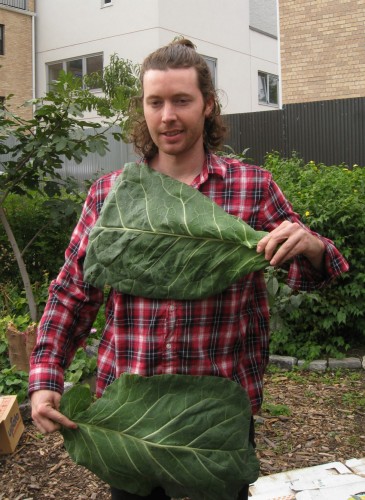
It’s always exciting to get farm-fresh organic produce delivered to your door through a Community Supported Agriculture (CSA) scheme, which have proliferated wildly around Tel Aviv and Jerusalem. But when I tagged along with a friend to her Brooklyn CSA last weekend, I saw how nice it can be when farmers deliver their vegetables and fruits to a community garden and the members gather to pick up their weekly payload.
The vegetables are from Hearty Roots, a farm written up by the New York Times in March. The farmers are city people who were drawn to the soil, and farm hand Danny Percich drives two and a half hours each Saturday from upstate New York to three dropoff locations in Brooklyn from May to November.
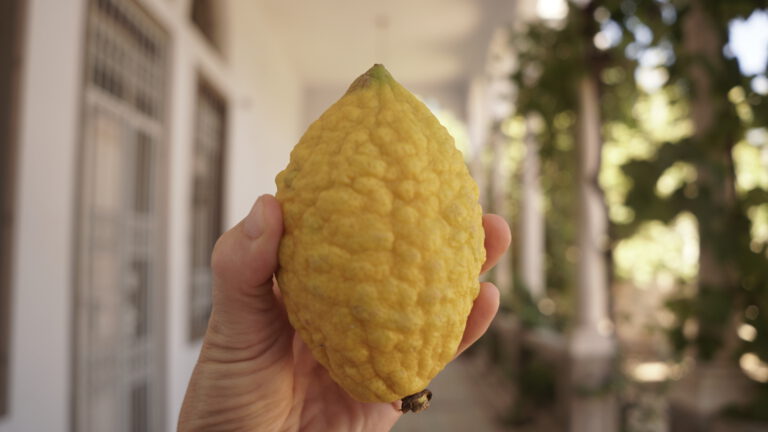
Just after the Hebrew holiday of Sukkot Jewish people start planning what to do with the ritual fruit called an etrog. It is one of the four species used in the holiday. It is a wonderful smelling fruit that can be put to use in marvellous and creative ways.
Brew the rind into beer
A local craft beer in Tel Aviv called Dancing Camel brewery makes a Sukkot beer using etrog rinds. Why not make your own? Or start simpler with a tej mead beer from Ethiopia.
Make etrog perfume
Perfumers distill essences of fruits and plants into oils that they deliver in a perfume. We know of an Israeli that makes an etrog perfume but why not try it yourself? Start simpler and make Ethiopian beer Tej, flavored with a bit o’ etrog rind.
Freshen up your closet
Keep it in your clothes closet. As it slowly dries out it releases a wonderful smell and will make everything smell nice.
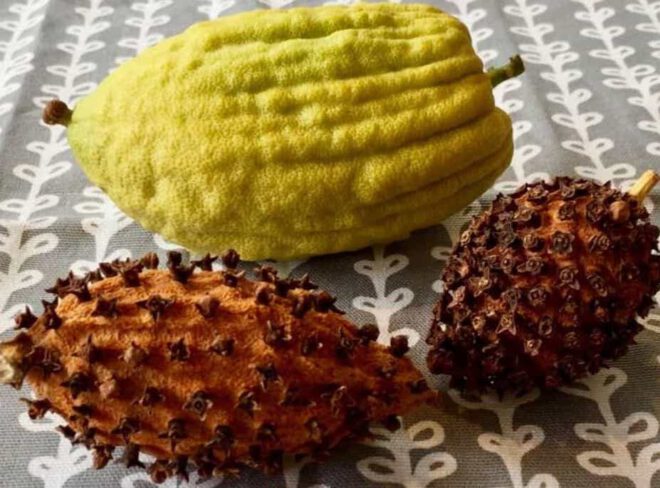
Some people take an afternoon and push cloves into the etrog, covering the entire etrog. They then use the finished product for havdala, a Jewish ceremony performed after the end of the Sabbath, Saturday after nightfall. If you opt to do this, make sure you do so in one sitting since the etrog will dry out very quickly and you will not be able to continue later.
Make etrog-flavored vodka
Well you are not going to make the vodka. You will buy a good quality vodka and drop what rinds you have, minus the pulpy white bits, and let it sit for a month to release the smell of the etrog and to turn it into a flavor.
Make etrog jam
Like marmalade, but better
There are elaborate dishes such as etrog meringue pie, etrog cake or etrog risotto that people have historically made when they knew there were no pesticides on the rind of the fruit. If you find organic, or have a bounty of summer fruit to preserve like strawberries it is worth to make long-shelf life preserves and marmalade. But you will only have one or two etrogs. So follow this recipe to make etrog jam you will eat within a week or two.
You probably wouldn’t have oil-rich emirate, Abu Dhabi, pegged for environmental awareness. The United Arab Emirates are notorious for their abundance of fossil fuels and thus, sadly, do their fair share to contribute to carbon dioxide emissions.
This week, though, the state-owned Abu Dhabi Media Company announced that it would collaborate with National Geographic on between 10 to 15 films over the next five years addressing people’s relationships to the earth, their own particular environments, and each other. The companies will jointly contribute $100 million to developing, producing, financing, and acquiring films for the project. Each individual film will be budgeted between $5 million and $60 million.
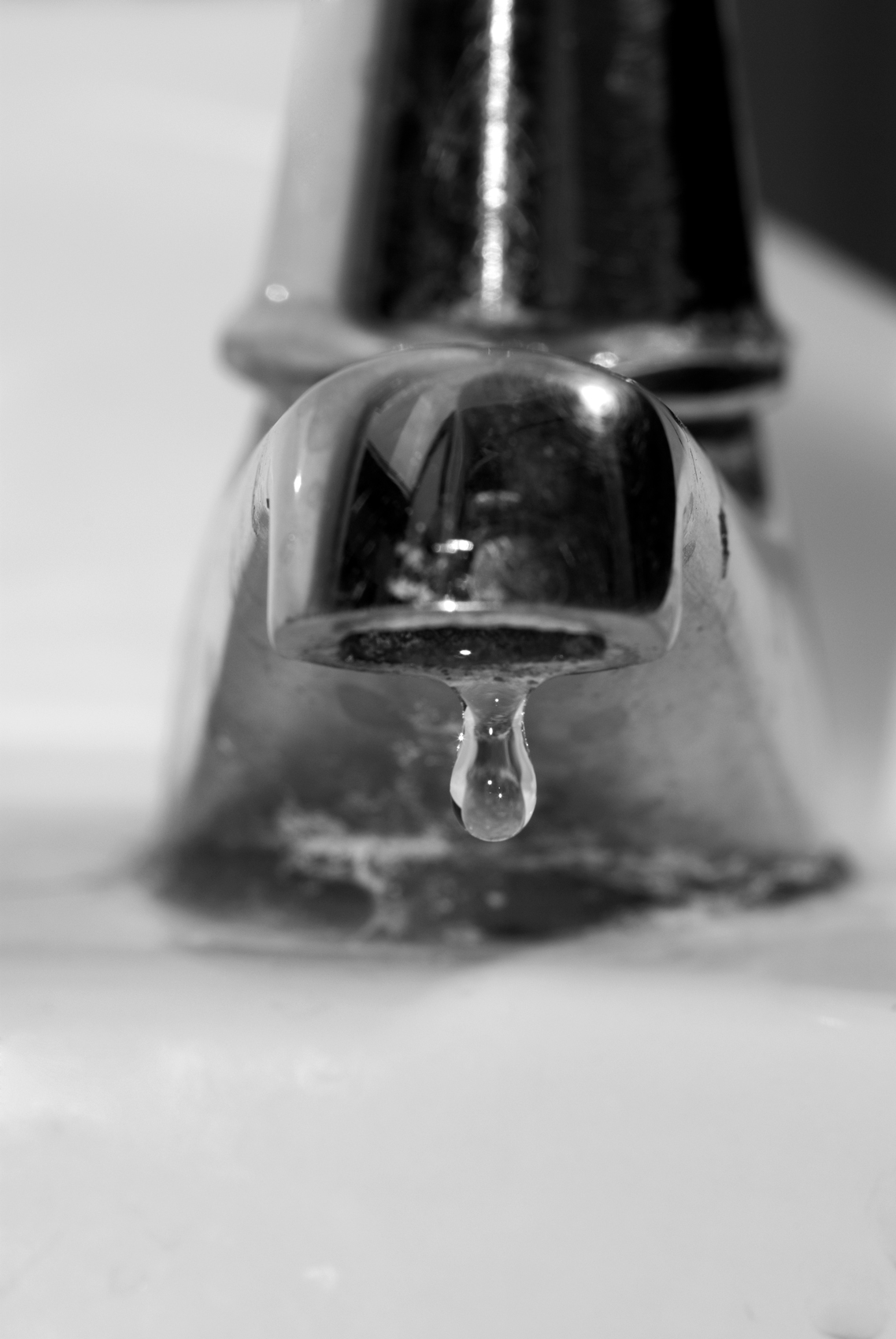
A friend of mine recently asked me with great concern about the water supply from his tap – is it going to disappear tomorrow? Next week?
We hear reports about all of the contamination of our water supplies, and we see the public service announcements in which the lovely model’s skin turns to bark before our eyes, because the water is RUNNING OUT!!
On top of all this, the marketing divisions of some bottled-water companies and water filtration systems are working full time to convince us that the tap water is bad-tasting, harmful, infectious, hazardous, poisonous, and otherwise a tool of the devil.
So does this all mean that we might wake up one morning/afternoon, open the faucet and discover that there is no water??
Freelance writer James Glave has successfully turned the planning and construction of a shed on his property in British Columbia into a thriving trade.
His book, “Almost Green,” his own blog site devoted to the book and his promotional activities selling it, coupled with the Facebook group and the website devoted to renting out the shed as a holiday home, all seem lucrative spin-offs from his long, rambling and sometimes very dull tale of building the shed.
I was very excited when this book arrived, as we are planning to build a shed ourselves, at home in Jerusalem; but this book is about as far from a ‘how to’ guide as you could hope to find.
At times Glave’s prose is funny – his ongoing green feuding with his inlaws made me laugh out loud, and most readers would identify in some way with his anguished efforts to tell his father-in-law some of his gifts aren’t appropriate.
Glave writes with a passion about the difficulties of sourcing truly green materials, in particular his trying to find and agonisingly afford recycled wood (page 144 onwards), and the ongoing efforts to ditch a gas guzzling SUV (bought for him by the father-in-law…) and buy a more environmentally-friendly family size car instead.
If you were going to use one word to describe Israel, the word “construction” would be a definite possibility. Visitors who come to Israel within intervals of only a few years are often shocked at the rapid development in the country. At only 60 years old Israel is constantly building and developing, and sometimes it feels as though a crane should be right up there on the Israeli flag next to the star of David. While great for the economy, however, this construction often takes its toll on the environment.
Especially on trees. Trees that get in the way of construction.
In the rush towards making room for infrastructure or housing, cutting down urban trees usually isn’t given a second thought. According to a resident of Petach Tikva, 20 cypresses over 60 years old were cut down in the city two months ago in order to make an underground parking lot. They literally paved paradise and put up a parking lot. There are many more examples of urban trees – even those with history or which are of a unique species – being treated as second or even third rate elements of the urban landscape.
Luckily the Knesset Internal Affairs and Environmental Committee took notice of the problem recently, and a month ago the panel decided to advance a bill that would require real estate developers to present plans that give priority to leaving trees in place.
Last week, Green Prophet Daniella Cheslow got her teeth into The End of Food, a book which critiques, and predicts the decline of, the modern global food system. This prompted the question: what could be next to face a sticky end? According to a documentary by the same name, The End of Suburbia is also nigh:
“Suburbia has very poor prospects for the future… There’s going to be and end to it and when it happens were going to be in real trouble.”
A couple of years ago I read a book called Carfree Cities, which put forward a very convincing case for reducing the use of private cars in the city, and set out a whole series of design alternatives which, according to author J.H. Crawford, would obviate the need for automobiles in urban areas.
Around the same time, I read another book – James Kunstler’s The Geography of Nowhere – which bemoaned the loss of place and the banal commercialization of the American built landscape. The central villain in Kunstler’s narrative was (surprise, surprise) the automobile.
These days, everyone knows that the automobile is a problem, and the race is on to reduce the negative side effects of our dependence on our cars: pollution, noise, fatal traffic accidents, etc. However, as we race to build a better car, be it electric plug-in, hybrid, hydrogen fuel cell or even liquid natural gas, we may be missing the bigger picture.
Israelis are notorious for their love of gadgets. Well, at least Israeli men are. And Israeli kids. It’s a pretty true stereotype that Israeli elementary schoolers had their own cell phones way before cellphones were widespread in the US. Hand an Israeli kid pretty much any electronic gadget and they’ll figure it out in less than an hour.
This gadget obsession and the continuous development of new electronic equipment (which renders equipment made just the year before quasi-obsolete) definitely takes its toll on the environment, though. Tons of outdated electronic equipment are dumped in landfills every year – leaving the metal parts of electronics to disintegrate and eventually pollute our water and the plastic parts to outlive our children, their children, their children’s children… you get the idea.
The Israeli love of gadgets must have profoundly effected entrepreuner Israel Ganot who, together with his business partner, Rousseau Aurelian, founded Gazelle – an online service that helps you sell and recycle your unwanted electronic junk.
Ernst & Young has announced Clean Tech investment is at record levels as a new investment fund is looking to focus on Israel’s clean tech.
International accounting firm Ernst & Young estimates fully 11% of global venture capital funding will go to clean technology in 2008, up from just 1.6% of VC investments five years ago.
The US is home to the majority of companies funded according to the study, but Europe, China and Israel are all significant players as well. The biofuel and solar sectors are the hottest, of which Israel is thus far most involved in the solar sector.
Beyond almost $9 billion in venture capital money invested in clean tech, Ernst & Young estimates that institutional investors put $23 billion into clean-tech equities and private equity investors put another $50 billion into the clean technology investments in 2007.
Although there are Israelis who hop between Eilat and Tel Aviv on a plane rather than brave the four-and-a-half hour Egged bus ride, for the most part Israel’s postage stamp size makes the country easy to tackle without taking to the skies.
Not so for the USA.
I decided last week that I will visit my alma mater, Northwestern University, located in Chicago. The trip from New Jersey is 800 miles and the family car is out of the question. So I began checking out the options.
Amtrak, the national railroad company, made headlines earlier in the week when New Jersey Senator Frank Lautenberg pushed a $1.5 billion funding increase through Congress. Although this bill still requires authorization to release money, it’s the first time the trains have gotten a raise since 1997. Apparently high gas prices and higher train ridership are providing strong grounds for supporting the trains even though George W. Bush (and John McCain) would rather not subsidize them.
Karnit Goldwasser is most commonly known as the widow of IDF soldier Ehud Goldwasser, who was abducted by Lebanon’s Hezbollah movement during the Second Lebanon-Israel War. Before that tragedy took place, however, she was busy doing things other than lobby for the release of her husband and his fellow soldiers. She was busy getting a Master of Science (MSc) degree in civil and environmental engineering from Israel’s renowned Technion Institute of Technology.
Her interest in the environment was placed on the back burner two years ago, in light of what happened to her husband Ehud, of course. But in dealing with the tragedy of Ehud’s abduction and publicly lobbying for his release, something happened. Karnit became a well known figure who had earned the respect and admiration of the Israeli public.
Now, after Ehud’s body was returned to Israel on July 16th, Karnit has decided to return to her environmental interests and use her celebrity status for the greater good. She will be hosting a television segment about environmental issues on an educational program.
It will take dedicated visionaries to help stop America’s addiction to foreign oil. And that’s what Doron Levi, the COO of alternative energy company Galten Global Alternative Energy has his heart set on doing. The telephone line was shaky and his Internet connection unreliable, yet Levi spoke with me from far away in Ghana where he’s overseeing a project that’s squeezing fuel from the seeds of an African perennial – the jatropha plant. This could be the next big thing for biofuel.
The jatropha is rich in oil and the “weed” doesn’t compete with food crops – making it an ideal specimen for biofuel. It has a duel function of being an ideal perimeter protector as grazing animals do not like to eat it.
Over in Ghana, Levi is working with about thirty locals to grow and cultivate a 250-acre site that may give rise to some of the world’s most important biofuel reserves ever.
Galten is based in Israel, but the company founders chose to plant in Ghana, where the jatropha (Jatropha curcas) already grows.
“We are working according to plan growing the jatropha plants. We’ve built a nursery, but it’s not easy in Africa,” Levi says, noting that the indigenous bush snakes can be particularly dangerous.

 Far be it for this Green Prophet to disavow her love of the city of Tel Aviv. Tel Aviv has almost everything – the beach, museums, great food, interesting architecture, a happening nightlife… But also, of course, traffic congestion, waste, pollution, an overdose of concrete, and the improper collection of rainwater, to name a few. Tel Aviv – or any city – can be a lot to take and many urbanites find themselves searching for greener pastures eventually.











 You probably wouldn’t have oil-rich emirate, Abu Dhabi, pegged for environmental awareness. The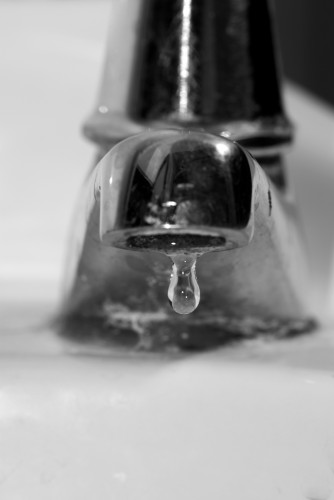


 If you were going to use one word to describe Israel, the word “construction” would be a definite possibility. Visitors who come to Israel within intervals of only a few years are often shocked at the rapid development in the country. At only 60 years old Israel is constantly building and developing, and sometimes it feels as though a crane should be right up there on the Israeli flag next to the star of David. While great for the economy, however, this construction often takes its toll on the environment.

 Israelis are notorious for their love of gadgets. Well, at least Israeli men are. And Israeli kids. It’s a pretty true stereotype that Israeli elementary schoolers had their own cell phones way before cellphones were widespread in the US. Hand an Israeli kid pretty much any electronic gadget and they’ll figure it out in less than an hour.


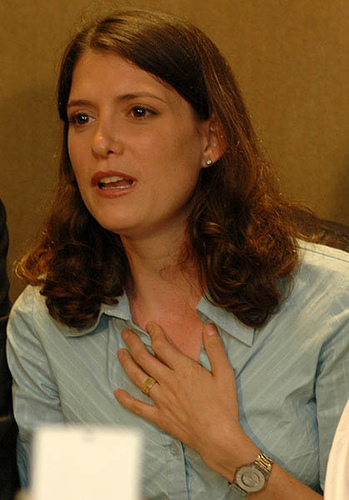
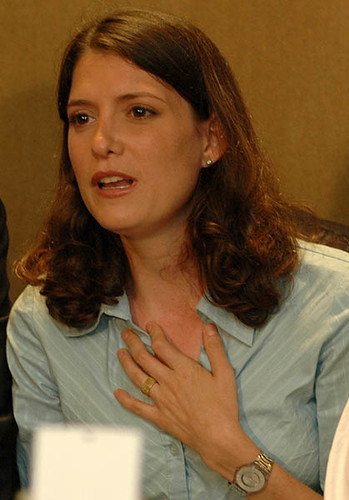 Karnit Goldwasser is most commonly known as the widow of IDF soldier Ehud Goldwasser, who was abducted by Lebanon’s Hezbollah movement during the Second Lebanon-Israel War. Before that tragedy took place, however, she was busy doing things other than lobby for the release of her husband and his fellow soldiers. She was busy getting a Master of Science (MSc) degree in civil and environmental engineering from Israel’s renowned Technion Institute of Technology.