Each week Orthodox Jews read one segment of the Five Books of Moses so that they can complete the entire Five Books within the course of a year. In last week’s Eco-Rabbi post we discussed the Jews slavery in Egypt along with Moses’ first prophecy via a burning bush. This week continues Moses’ fight for his people’s freedom.
After Pharaoh rejects Moses’ first request for his people’s freedom God steps up the attack and gives Moses the tools to send plagues onto the Egyptians in order to leverage the Jew’s freedom from slavery.
This week’s segment describes the plagues of blood, frogs, lice, wild animals, pestilence, boils, hail and locusts. Each of these plagues, in their own right, would cripple a society in those days.
The interesting thing is that God told Moses from the start that Pharaoh would reject Moses’ request until the end. Why would anyone in their right mind do such a thing? Moses is telling Pharaoh that all his troubles will go away if he only lets the Jewish people leave Egypt.
But Moses’ pleas falls on deaf ears.
But there is an explanation, God tells Moses: “I will harden his heart.” And sure enough he does. Moses pleas with Pharaoh to let his people go, and each time Pharaoh denies Moses’ request.
Why perilous? Well, my grandmother and grandfather couldn’t, between the two of them, agree on the best way to make charoset. Trying to come up with a recipe everyone can get behind? Totally hopeless.
But, as we said then, everybody needs to start somewhere, and it’s far better to get in the cooking game than to watch from the sidelines. Trying, as our grade two teacher told told us, is half the battle.
And with that, we plunge fearlessly into the wonderful world of… baba ganoush!
Windows are one of the most significant costs in building projects or home renovations. Next to that are the bills homeowners have to pay for heating and air conditioning. Solving two problems under one roof — literally — is an Israeli company Alubin that has developed all-season reversible windows. The solution is also good for the environment.
Based on the research of Professors Evyatar Erell and Yair Etzion from the Department of Man in the Desert at Ben Gurion University, Alubin is set to commercialize a unique two-sided window that promises to absorb and keep in the heat during the winter, while reflecting the sun for a cool indoors when the hot summer months strike.
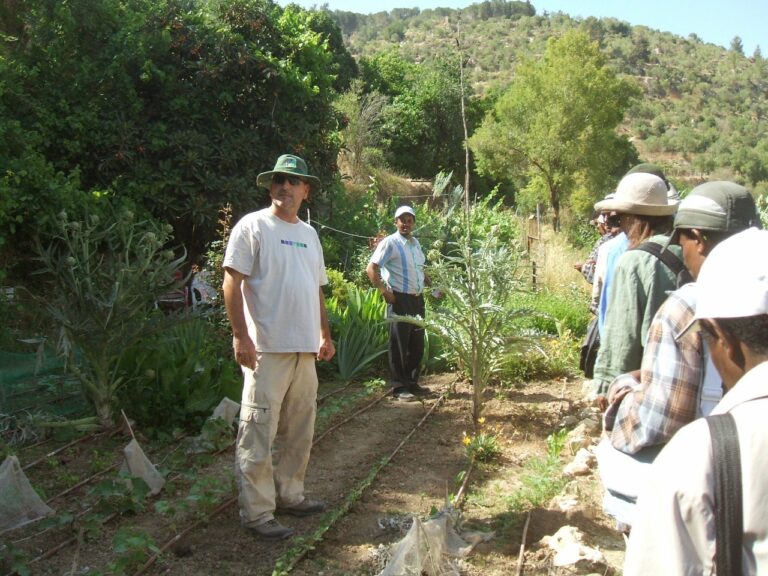
With everything going on over the past month, many of our thoughts have been turned towards the southern area of Israel and the Negev. At more than 60% of the country’s land mass, however, the Negev desert should really be part of the Israeli consciousness more often.
Community based NGO Shvuat ha-Adamah/Earth’s Promise, based in Beer Sheva (the capital of the Negev), encourages people to not only think of the Negev as a crucial part of the country, but to think of it in a sustainable way.
Shvuat ha-Adamah’s mission is: “to improve and safeguard the quality of Israel’s environment by creating replicable grassroots models of sustainable urban development.” The organization works closely with the community in order to create lasting initiatives, such as community gardens and recycling programs.
The historic discovery of a large deposit of natural gas off of the Israel coast has the potential to restructure the Israeli energy market, with effects reaching into other countries in the region as well. The “Tamar 1” deposit, located 90 km west of Haifa, is projected to begin delivery in 2015, and contains at least 88 billion cubic meters of gas. The projections are that Israel will use 220 billion cubic meters by 2030 to generate electricity, so that this deposit will provide about a third of the demand over the next 20 years – certainly a substantial contribution to Israel’s energy budget.
Israelis come from a variety of countries and their diets tend toward the eclectic. My own culinary heritage is staunchly eastern European. But while my mother rendered chicken fat from time to time, she preferred adapting traditional foods to make them lighter.
Alternet‘s Terence McNally interviewed Michael Pollan, ecological food expert and best-selling author of In Defense of Food, who expressed concern about the loss of food’s cultural connotations. Marketers and researchers devalue our intuition, leading us to suspect the foods we were raised on:
Michael Pollan (MP): I remember my mother dutifully giving us all margarine instead of butter. She would say, “Some day they’re going to figure out that butter is actually better for you than margarine,” and we thought she was nuts. In fact, it turned out that margarine was lethal and butter is fine.
Terence McNally (TMN): She was still feeding it to you suspecting that would happen…?
MP: The authority of mothers was essentially destroyed by the food industry.The $32 billion a year in marketing muscle out there has undercut culture’s role in determining what we eat, and culture is a fancy word for your mom.
TMN: Just to emphasize that number, that’s not the food industry, that’s the food marketing industry.
Of course many eastern European staples are healthy. Think of soups rich with legumes and vegetables, stuffed cabbage and chopped liver that “stretch” meat (even if the cabbage is overcooked), and lots of fresh vegetables straight from the garden.
I have rejected my own mother’s copious use of Crisco, a tasteless, pareve (meaning meat nor dairy, thus neutral for a kosher kitchen) shortening heavily marketed by corporate giant Procter and Gamble. Instead I bake with whole wheat flour and canola oil, and serve humus and eggplant salad along with potato kugel and matzah balls.
How have you adjusted your culinary traditions to eat more healthily?
Amidst all its struggles to develop clean and cleaner technologies (and a war with Gaza), it seem that Israelis got a huge gift this week: Israelis were celebrating this week over the discovery of a massive 3 trillion cubic feet natural gas pocket found buried 1.5 km below the sea floor, some 90 km off the coastal city Haifa.
I’d spoke yesterday with a rep from one of the major stakeholders, Shaya Segal from Delek Drilling, who confirms the find, but who, like the local analysts were saying, says that it will take about 2.5 weeks to know what the discovery can mean.
I’ve read reports that taking the natural gas stock from the pocket called Tamar, after the granddaughter of a geologist working at the site, will cost somewhere around $1 billion. But that the value of it amounts to about $15 billion.
If Israelis can pull the gas from the seafloor, with the help of a major Houston-based stockholder Noble Energy, then they could, say reports, be close to energy independent for 15 years. That means buying less fuel resources from Egypt, and other less than friendly neighbors.
But natural gas, a fossil fuel, is not exactly a clean fuel.
The find does question however, the direction of Israel’s future and the development of clean technologies. I imagine the discovery is exciting for Shay Agassi at Better Place, who I’ve personally criticized. His plan to use electric cars in Israel was a good idea on paper, but up until now, it looked as though Israel’s power plants would continue to be fueled by very polluting coal sources.
Meanwhile, according to the Jerusalem Post, just when Israelis and Gazans were hoping for quiet, after a ceasefire earlier in the week, we learn that Lebanon is claiming that part of the Tamar natural gas reserve is in Lebanese territorial waters:
“The Lebanese government might warn Noble Energy Inc., a US corporation which is part of the consortium that discovered the Tamar 1 gas reserve off the shores of Haifa, that the reserve may be in part in Lebanese territorial waters, according to Al Liwaa, a Lebanese paper.
“In a meeting of the Energy, Infrastructure and Public Works Committee in the Lebanese Parliament, Chairman Muhammad Kabbani said Israeli media reports on the recently discovered natural gas reserve raise the possibility that the reserve extends to Lebanon’s territorial waters. “We should take every legal measure possible in order to preserve Lebanon’s right,” the paper quoted Kabbani as saying.”
What’s certain, is that it’s never boring over in these parts of the world.
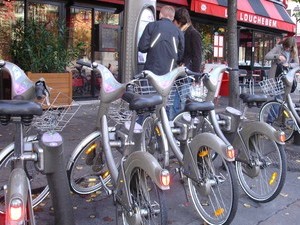
Bicycles have long been recognized as one of the most efficient means of transportation within a city, definitely more efficient than a car. Not only can you move faster within a city on a bike, but it is also much better for the environment since it does not rely on fossil fuels. That’s why big European cities such as Paris have mass bike rental systems that are initiated by the municipality. These programs are usually a great success.
But anyone who knows Israel and who is familiar with the laid back attitude prevalent in Tel Aviv knows that things move a little slower here. The day that the Tel Aviv municipality takes it upon itself to set up a city-wide bike rental system won’t be anytime soon.
Which is why Rafael Aharoni, a Tel Aviv cafe owner, took matters into his own hands.
Aharoni recently invested in placing rental bikes outside of 3 Tel Aviv cafes, which are made available to cafe customers.
Last night, my roommates and I hosted a dinner party for twelve. Out of the eight dishes, only the stuffed peppers had meat; the others were majadara (rice and lentils), garlic-mint carrots, and goat-cheese stuffed eggplants simmered in Hamutal’s amazing pepper sauce muhamarra.
This morning I considered the carbon footprint of the meal. Although the dinner wasn’t vegetarian, it was pretty close and very friendly to the guests who don’t eat meat.
A term coined by fellow Northwestern University alum Alex Hartzler, vegawarianism means “you are ‘aware’ that eating animals contributes more towards global warming than eating plants.
So, maybe, sometimes, you will choose the vegetarian option instead of the meat option.”
Vegawarianism (updated to 2020 – it’s not flexiwarian) is the outlet for guilty omnivores who cannot imagine cutting meat out of their lives completely. One vegawarian is New York Times food writer Mark Bittman, who publishes recipes for preparing duck breast along with articles about the problem of American meat overconsumption.
Is vegawarianism a form of green-washing harmful eating practices, or a legitimate, moderate approach to getting more people talking about our meat habits? Comments welcome.
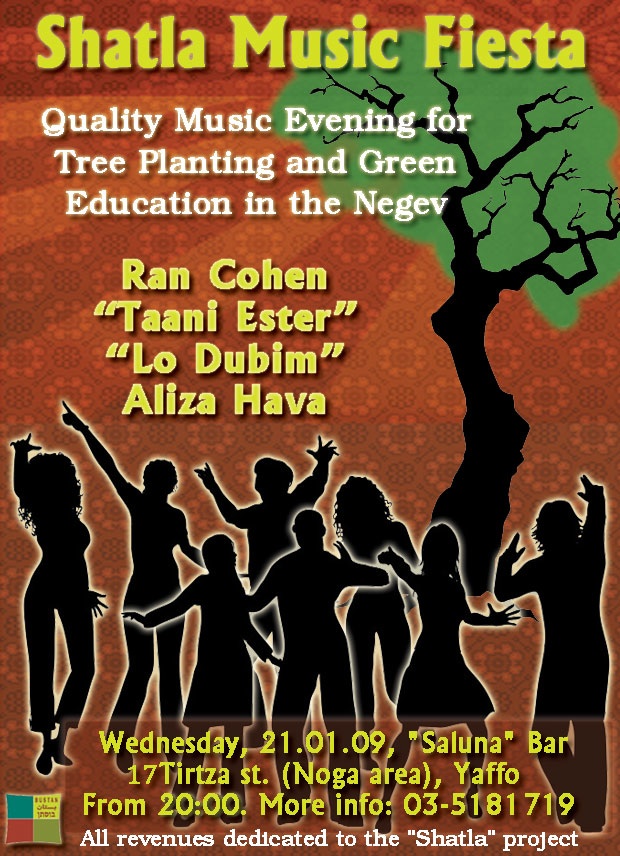
Our resourceful friends at the Bedouin NGO Bustan are refusing to allow the current tension in the South of Israel affect them.
Despite having to cancel some tree planting dates due to the war and the related school closures, they have upped sticks to Tel Aviv and are organising a benefit evening this coming wednesday 21st January at the Saluna bar (17 Tirza Street, Jaffa) to raise funds for future tree planting within the Bedouin communities, and other green education activities.
Tu B’Shvat is the Jewish holiday marking the beginning of a new year for trees, and is usually celebrated by planting trees and exchanging gifts of dried fruit with loved ones. While these traditional activities are great and we support going out to plant trees (thus increasing the amount of carbon-eating leaves out there), these activities sound a little stale.
Tu B’Shvat Party at City Tree, Tel Aviv: Get down with fellow green folks in Tel Aviv’s ecological apartment – City Tree. Enjoy dates, carobs, dried fruit cookies, organic wine, and other surprises. Saturday February 7th, 23 Bialik Street, Tel Aviv, 8pm-11pm
The Giving Tree, Jerusalem: The Society for the Protection of Nature in Israel is hosting an evening to discuss the topic of The Giving Tree: How to Protect Adult Trees in the City. The evening will include lectures, film, a discussion of the Jerusalem municipality’s policy on urban trees, and a presentation of a map of the Jerusalem trees being discussed. For details and reservations contact the Center for Green Culture, 02-6252357.
From Garbage Hill to Green Park: Join the Society for the Protection of Nature in Israel for a tour of Hiria, a former garbage-dump-turned-national-park, to learn about recycling. A highlight of the tour includes a hike to the top of Hiria to see an impressive view of the Gush Dan region. February 5th. Reservations required, 057-200-30-30.
Tu B’Shvat Street Party, Tel Aviv: Alma, the Home for Hebrew Culture, is hosting a cultural Tu B’Shvat street party which will include artistic installations, a theatrical performance, live jazz music, and activities for kids.
The main event will be a performance by Marap (which includes musician Kobi Oz, the lead singer of popular Israeli band Tipex). Friday February 13, 12:00-4:00pm, reservations required.
Here at Green Prophet we’ve covered a variety of conferences, with the most recent being a seminar in Jerusalem about architecture (coming up on January 25th). We have yet to cover a conference (let alone an environmental conference) in Libya, though, which is why we were so happy to learn about a call for papers from a sustainable architecture conference there.
I went to see Scott Hamilton Kennedy’s documentary film, “The Garden,” at Tribeca Cinemas in Manhattan, part of docs on the shortlist for the Gucci Tribeca Documentary Fund. I went with a group of farmers living in New York, some of whom work on urban farming projects in and around the City.
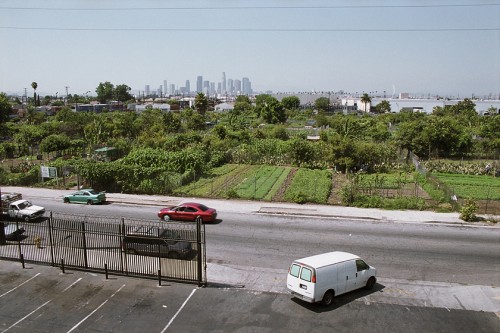
The film tells the tragic story of the largest community garden in the United States in South Central Los Angeles.The garden, a full-fledged 14 acre farm in a blighted neighborhood, was created in response to the LA riots in an effort to heal the city. Lower income residents tended the garden. As the demographics of the area changed, more Latin Americans moved to the area and soon made up a majority of the farmers.
The film shows stunning images of corn and tomatoes growing amidst and industrial backdrop.In fact, the viewer sees countless helicopter images of this impressive green square in the middle of Los Angeles sprawl, demonstrating the stark contrast between sunflowers and concrete, verdancy and the pallor of urban industry. The importance of the garden to many of the gardeners is most inspiring, as many relied on the garden to feed their families and had been looking for empowering work to do in the city that would allow them to feed their families hearty and healthy meals.
The story, however, takes a dreadful turn as we see the end result of a failure of government.Without notice the farmers arrive one day to see a letter of eviction, signed by a developer whose name the farmers did not recognize.The mostly immigrant farmers were left asking, who is this developer, and isn’t this government land?
Special guest desert dwelling activist and academic Lucy Michaels, gets to the heart of the matter with a classic eco text: “The burnt cliffs and lonely skies … all that which lies beyond the end of roads:” From Desert Solitaire and why Israel’s deserts need their own Edward Abbey.
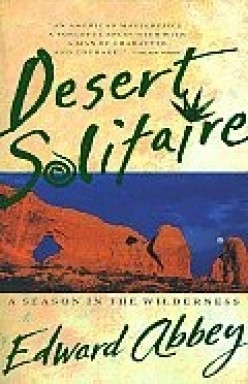
In the late 1950’s, a young ranger and sometime philosopher, Edward Abbey, spent three seasons as a ranger at Arches National Monument, a national park in southeast Utah in the USA. Desert Solitaire, his classic memoir of life in the desert wilderness chronicles both his adventures and his quest to experience nature in the raw.
“The idea of wilderness needs no defense, it only needs defenders.” ― Edward Abbey“Why this cult of wilderness?… because we like the taste of freedom; because we like the smell of danger.” ― Edward Abbey
Abbey’s book, however, transcends specific locations and speaks directly to the desert experience. His world is the slickrock desert with views open and perfect in all directions. A world of natural arches like jug handles or flying buttresses, tilted or warped by pressures from below or eroded by water or wind.
His garden is the pinyon pine and the juniper; the cactus and the cliffrose. His neighbours: the kangaroo rats, tiger lizards and beetles. His world turns from off-white to buff, pink, brown and red, tones which change with the time of day and the moods of light, weather and the sky. Out here, 20 miles from civilisation, his ticking watch is meaningless, ridiculous.
Desert Solitaire, original cover
Against this vast canvas, Abbey’s stories are small yet riveting. His communion with the snakes that visit his trailer; the survey crew who lay the flags for a new paved road through the national park, which he carefully removes later that night; the fates of the local cowboys, Indians and prospectors; the moon-eyed horse gone feral in Salt Creek; the dead man at Grandview Point.
The centrepiece his dreamlike adventure paddling down Glen Canyon to witness “a portion of earth’s original paradise” that would soon be drowned forever by the damming of the Colorado River. All the while time passes and seasons change as he sits out on his porch surveying his 33,000 acre view.
More than nature writing
Abbey’s book is, however, more than just nature writing at its finest (a definition he personally hated); it is an urgent call to defend the canyon lands from encroaching development.
For Abbey “Desert Solitaire” is both a memorial to “places already gone or going under fast” and “a tombstone or a bloody rock” to be hurled defiantly at “something big and glassy” such as the windows of a corporate headquarters.
It is not surprising, therefore, that Abbey is widely acknowledged as an inspiration to the American wilderness defence movement.
Abbey reserves special venom for tourists who drive in national parks, but not through other sacred places, such as cathedrals or museums. Besides “you can’t see anything from a car; you’ve got to get out of the goddamned contraption and walk, better yet, crawl, on hands and knees over the sandstone; through the thornbush and cactus. When traces of blood begin to mark your trail you’ll see something, maybe. Probably not.” The desert lands move too slowly for those of us hurtling about in our everyday lives.
Abbey’s great gift to us in “Desert Solitaire” is in noticing and revelling in the imperceptible things that simply don’t exist from a passing car window.
Wit as sharp as desert cliffs
What makes this book so engaging is that Abbey’s wit is as sharp as the jagged cliffs he describes. At times sanctimonious and overly dramatised, for the most part he is startlingly sincere.
Whist his tone is definitely his own, his message draws deeply on Thoreau and Emerson in perceiving wilderness as humankind’s sacred ancestral home and sole source of hope. For Abbey, the wilderness is essential as a place of freedom and escape to complement and complete civilization. “It is not a luxury, but a necessity as vital to our lives as water and good bread. A civilisation which destroys what little left remains of the wild cuts itself off from its origins. Industrial man…will make himself an exile from the earth and will know, at last, the pain and agony of final loss.”
Since the days of Abraham, and very probably long before, Israel’s mythical deserts have been sacred: a place of spirit, of revelation and renewal. Yet prominent Zionist leaders, notably Israel’s first prime minister, David Ben Gurion, came to see the desert in a very different light: it needed to be subdued and “made to bloom” to meet the needs of the young state. While this vision may have improved our material understanding of deserts, it has also engendered the destruction of exquisite places causing untold environmental damage for the sake of haphazardly placed factories, waste dumps, greenhouses, plantations and mines.
And Israel’s deserts are still threatened by Ben Gurion’s dictum: from sand mining in Israel’s last intact sand dune to build hotels in Eilat and the re-introduction of copper mining in Timna.
From the plans to build a hotel for 4X4 drivers in the peaceful Sasgon valley, to the Valley of Peace – a proposal to transform the Arava into a Las Vegas of the East by billionaire Itzhak Tshuva, clearly a megalomaniac of Nebuchadnezzan proportions. Besides, much of Israel’s spectacular open spaces are located in military zones, tantalisingly out of reach, whilst other places are deeply scarred by tanks, bulldozers and off-road vehicles, whose tracks remain decades after they are gone.
Desert Solitaire demands another understanding. It is for those who have rambled through Israel’s desert lands following a tempting track down a wadi or tracking the ibex across the cliffs. It is for those who yearn for the shadows cast by the setting sun on the Edom Mountains, have charted the movements of the stars across the vast night skies or made coffee on an open fire under the shade of an acacia tree.
It is for those who have drawn inspiration from the eroded paths and changing colours of the day. It is for those for whom the desert simply is; and not for those for whom the desert waits to be something else. As a desert dweller myself, it was overwhelming to find such an articulate voice for the inexpressible sentiments that I feel for the land around me.
A call to defend the desert
While these deserts have had their literary champions in the past, from Dhu al-Rumma to TE Lawrence, Gertrude Bell and Pierre Loti, Israel’s deserts of today cry out for defenders. Defenders who understand what is at stake when we despoil our deserts and ride roughshod over their ancient wisdom for the sake of short term profits. Defenders who support mindful and sustainable development where necessary, and not simply development that claims to be “green” or “eco” when it is nothing of the sort. Defenders to encourage Israeli school kids to read old “Cactus” Ed as they memorise Ben Gurion. This would leave them with no excuse for perceiving the Negev and the Arava as blank canvases for exploitation and development.
The Negev does have some powerful literary voices, among them both Daniel Hillel and Haim Watzman. The Negev and Arava also have many unsung heroes who have also resisted sprawl and unnecessary development in recent years, but there are too few of us.
Put this book in your rucksack next time you go for a tiyul (trip). Find a shady spot on a craggy hilltop with a huge view, and read. You may well return home transformed.
About Lucy Michaels
Lucy grew up in North London, a long way from her current desert home, but has always followed the call of the wild. At university she discovered Earth First! and has been active in radical environmental and anti-globalisation movements ever since. This included a five year stint as a director/researcher at Corporate Watch in Oxford.
From the first moment she arrived at Kibbutz Lotan in the Arava valley in Spring 2005 she knew she had come home. After a year working in Jerusalem, she found her way back down: first, to study and then work at the Arava Institute for Environmental Studies and now as a doctoral student of Professor Alon Tal at Ben Gurion University’s Desert Studies Institute in Sde Boqer where she is researching what Israelis think about climate change. She’s happiest when out hiking in the desert or involved in some crazy permaculture project.
Lucy currently lives with husband Uri Gordon somewhere on the route 40 between Kibbutz Lotan and Sde Boqer.
Some say that Eco-Design and other green initiatives are just a trend and it’ll go away like many other buzzwords. According to Trendwatching.com this is not the case.
It looks like Simplexity is going to rule 2009. We’ll see more designed products that carry a simple design, maintaining ease of use while not giving up on complex features. Some say it’s because the Baby Boomers are growing up wanting comfortable products but still technologically innovative.
The economic crisis requires designers to be more creative in their designs using smaller budgets. We might see bolder designs than what we’re used to.
Among the leading trend in 2009 are:
Retro design
Simplexity
Minimalism
Bold designs
Designs clashing clean designs together with prominent colors
Eco-Design
Personalized designs.
Eco-Design will be mentioned more as Sustainable design. We’ll see more companies like Nike that design entire collections from sustainably-sourced fabrics, and footware from sustainable materials.

 After Pharaoh rejects Moses’ first request for his people’s freedom God steps up the attack and gives Moses the tools to send plagues onto the Egyptians in order to leverage the Jew’s freedom from slavery.
 With everything going on over the past month, many of our thoughts have been turned towards the southern area of Israel and the Negev. At more than 60% of the country’s land mass, however, the Negev desert should really be part of the Israeli consciousness more often.









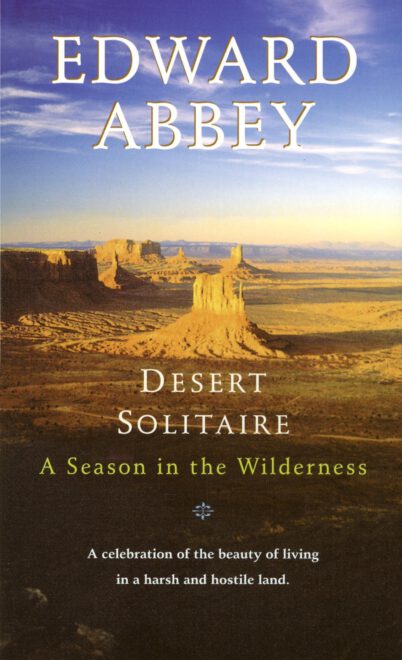


 The centrepiece his dreamlike adventure paddling down Glen Canyon to witness “a portion of earth’s original paradise” that would soon be drowned forever by the damming of the Colorado River. All the while time passes and seasons change as he sits out on his porch surveying his 33,000 acre view.
 Lucy grew up in North London, a long way from her current desert home, but has always followed the call of the wild. At university she discovered Earth First! and has been active in radical environmental and anti-globalisation movements ever since. This included a five year stint as a director/researcher at Corporate Watch in Oxford.