Home Blog Page 725

"Agam Energy Systems" Pulls Out The Pistons For 100 Miles To The Gallon

0

People love their cars, even environmentalists. In the Middle East, it’s less so, but in America, people and own more cars per capita than anywhere else on earth — some 765 for every 1,000 people. But turbulent financial times everywhere threaten both the automotive industry and the ability to put gas in the tanks of our favored mode of transportation.

agam-energyElectric cars offer promise, but switching over still has limits: infrastructure is lacking, new cars need to be built, and the electric car just doesn’t have the same “muscle” as the petrol-fueled machines that people love.
An entirely new solution may come by way of an Israeli company – Agam Energy Systems — which has developed a piston-less turbine engine, featuring a new kind of compressor that the company hopes will revolutionize the automotive industry.

American automakers are already taking notice, the company reports.

Why Don't Cars Last Forever? Some Tips on Greening Your Ride

0

 green-your-ride photoI was in Grade 4, in Canada, and learning about all the secrets and marvels of life. There was the discovery of books like 1984, new information about sex and how our parents’ genes combine to make us who we are; we were taught how to make our own movies, and program computers – and one other thing stuck in my mind: It was when Mr. Birch taught us about the automobile industry.

“Why don’t cars last forever,” he asked? “It’s not like the materials aren’t there to prevent them from rusting, or the technology for the motor from wearing out,” he explained.

The real reason, the big secret was… Yes? I was on the edge of my seat, waiting for a special answer… “The real reason,” he said, “is that automobile manufacturers don’t want to make their cars last forever. It isn’t in their interests. A car that last forever isn’t good for business.”

Courtney Nichols’ on Charity: Water

2

courtney nichols blood water film photoHow do changemakers form bold ideas, and turn them into a massive project like a major documentary film? Today we talk with Courtney Nichols, producer of the new film Blood For Water, on how she came from the world of business to take on the global problem of water politics head on. She’s planning on turning the film into An Inconvenient Truth, about water.

And the film, we’ll read, talks about the implications for people living in the Middle East. 

So here she is: Courtney Nichols, a 38-year-old NYC resident, and founder/CEO of CampaignWater Inc.:

How did you transition from the world of business, to as you say “make a real impact?” in the world of water. Was it a dream in the middle of the night, an aching sensation, or just something you were leaning towards? It was a slow creep really. I quit my job after four years because i wanted to find a way to use my skills at launching businesses to doing something more connected to “doing good” but I also just needed a break!

About a year ago, I sat around a table with some folks and heard them talking about the water crisis. Now, I consider myself a relatively engaged person, maybe not the MOST informed, but certainly caring and connected to the world around me and yet I have never heard this talked about.

I thought, How is this possible? What came to me as this NGO talked about its goals for fundraising was this: what you basically have is a branding problem.

This issue needs to be “marketed” to a mass audience so people understand that water, in fact, is at the root of or related to many of the problems they hear about: disease, conflict, environmental degradation and food shortages as well as lack of education (mostly women and children). I began to volunteer my time advising two fantastic organizations: Charity:Water and Blue Planet Run both with strategy advice/connections and fundraising.

About 6 months later at a dinner I was hosting just to start reaching out to friends, influencers etc. to get people talking about water, a friend told a story having just returned from Sudan (south) about seeing men with guns fighting over access to a well.

He was there to research the subject of his book (Stefan Templeton subject of biography by David Matthews, to be published by penguin in 2010) who works as a humanitarian mercenary of sorts and is dedicated to this issue of water as a source of conflict. As he was talking, I thought, that’s it, let’s make the Inconvenient Truth about water!

Eco-Rabbi: Parshat Vaera – Plagues, Pharoah and Dissonance

1

Each week Orthodox Jews read one segment of the Five Books of Moses so that they can complete the entire Five Books within the course of a year. In last week’s Eco-Rabbi post we discussed the Jews slavery in Egypt along with Moses’ first prophecy via a burning bush. This week continues Moses’ fight for his people’s freedom.

oil-river-pollutionAfter Pharaoh rejects Moses’ first request for his people’s freedom God steps up the attack and gives Moses the tools to send plagues onto the Egyptians in order to leverage the Jew’s freedom from slavery.

This week’s segment describes the plagues of blood, frogs, lice, wild animals, pestilence, boils, hail and locusts. Each of these plagues, in their own right, would cripple a society in those days.

The interesting thing is that God told Moses from the start that Pharaoh would reject Moses’ request until the end. Why would anyone in their right mind do such a thing? Moses is telling Pharaoh that all his troubles will go away if he only lets the Jewish people leave Egypt.

But Moses’ pleas falls on deaf ears.

But there is an explanation, God tells Moses: “I will harden his heart.” And sure enough he does. Moses pleas with Pharaoh to let his people go, and each time Pharaoh denies Moses’ request.

Taking on Middle Eastern Classics: Baba Ganoush Recipe

21

eggplants baba ganoushphoto
Last week with our recipe for the Syrian dip muhamarra, we embarked on a perilous culinary adventure: trying to recreate authentic versions of classic Middle Eastern dishes.

Why perilous? Well, my grandmother and grandfather couldn’t, between the two of them, agree on the best way to make charoset. Trying to come up with a recipe everyone can get behind? Totally hopeless.

But, as we said then, everybody needs to start somewhere, and it’s far better to get in the cooking game than to watch from the sidelines. Trying, as our grade two teacher told told us, is half the battle.

And with that, we plunge fearlessly into the wonderful world of… baba ganoush!

Alubin's All Season Windows Pivot To Save Energy

5

windows-alubin

Windows are one of the most significant costs in building projects or home renovations. Next to that are the bills homeowners have to pay for heating and air conditioning. Solving two problems under one roof — literally — is an Israeli company Alubin that has developed all-season reversible windows. The solution is also good for the environment.

Based on the research of Professors Evyatar Erell and Yair Etzion from the Department of Man in the Desert at Ben Gurion University, Alubin is set to commercialize a unique two-sided window that promises to absorb and keep in the heat during the winter, while reflecting the sun for a cool indoors when the hot summer months strike.

Grassroots Beer Sheva NGO Makes the Earth a Promise

1

With everything going on over the past month, many of our thoughts have been turned towards the southern area of Israel and the Negev.  At more than 60% of the country’s land mass, however, the Negev desert should really be part of the Israeli consciousness more often.

Community based NGO Shvuat ha-Adamah/Earth’s Promise, based in Beer Sheva (the capital of the Negev), encourages people to not only think of the Negev as a crucial part of the country, but to think of it in a sustainable way.

Shvuat ha-Adamah’s mission is: “to improve and safeguard the quality of Israel’s environment by creating replicable grassroots models of sustainable urban development.”  The organization works closely with the community in order to create lasting initiatives, such as community gardens and recycling programs.

Some of their current projects include:

Israel's Offshore Gas Deposits May Lead to Cleaner Air But Not Energy Independence

1

natural gas israel deposits photo

The historic discovery of a large deposit of natural gas off of the Israel coast has the potential to restructure the Israeli energy market, with effects reaching into other countries in the region as well.  The “Tamar 1” deposit, located 90 km west of Haifa, is projected to begin delivery in 2015, and contains at least 88 billion cubic meters of gas.   The projections are that Israel will use 220 billion cubic meters by 2030 to generate electricity, so that this deposit will provide about a third of the demand over the next 20 years – certainly a substantial contribution to Israel’s energy budget. 

Is Bubbe's Eastern European Diet "Kosher" for Your Health?

6
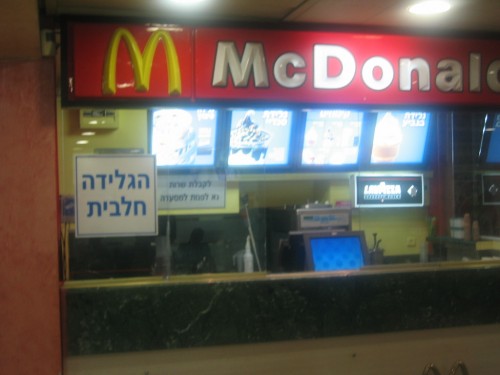
McDonald's, Ramat Gan, Israel

Israelis come from a variety of countries and their diets tend toward the eclectic. My own culinary heritage is staunchly eastern European. But while my mother rendered chicken fat from time to time, she preferred adapting traditional foods to make them lighter.

Alternet‘s Terence McNally  interviewed Michael Pollan, ecological food expert and best-selling author of In Defense of Food,  who expressed concern about the loss of food’s cultural connotations. Marketers and researchers  devalue our intuition, leading us to suspect the foods we were raised on:

Michael Pollan (MP): I remember my mother dutifully giving us all margarine instead of butter. She would say, “Some day they’re going to figure out that butter is actually better for you than margarine,” and we thought she was nuts. In fact, it turned out that margarine was lethal and butter is fine.

Terence McNally (TMN): She was still feeding it to you suspecting that would happen…?

MP: The authority of mothers was essentially destroyed by the food industry. The $32 billion a year in marketing muscle out there has undercut culture’s role in determining what we eat, and culture is a fancy word for your mom.

TMN: Just to emphasize that number, that’s not the food industry, that’s the food marketing industry.

Of course many eastern European staples are healthy. Think of  soups rich with legumes and vegetables, stuffed cabbage and chopped liver that “stretch” meat (even if  the cabbage is overcooked), and lots of fresh vegetables straight from the garden.

I have rejected my own mother’s copious use of Crisco, a tasteless, pareve (meaning meat nor dairy, thus neutral for a kosher kitchen) shortening heavily marketed by corporate giant Procter and Gamble. Instead I bake with whole wheat flour and canola oil, and serve humus and eggplant salad along with potato kugel and matzah balls.

How have you adjusted your culinary traditions to eat more healthily?

A Cooking Legacy (from A Mother in Israel)

Syrian recipe for Muhamarra

Organic Falafel in Tel Aviv

Israel Strikes "Natural Gas" Pocket, Promising Energy Independence for 15 Years

2

natural gas reserve israel imageAmidst all its struggles to develop clean and cleaner technologies (and a war with Gaza), it seem that Israelis got a huge gift this week: Israelis were celebrating this week over the discovery of a massive 3 trillion cubic feet natural gas pocket found buried 1.5 km below the sea floor, some 90 km off the coastal city Haifa.

I’d spoke yesterday with a rep from one of the major stakeholders, Shaya Segal from Delek Drilling, who confirms the find, but who, like the local analysts were saying, says that it will take about 2.5 weeks to know what the discovery can mean. 

I’ve read reports that taking the natural gas stock from the pocket called Tamar, after the granddaughter of a geologist working at the site, will cost somewhere around $1 billion. But that the value of it amounts to about $15 billion. 

If Israelis can pull the gas from the seafloor, with the help of a major Houston-based stockholder Noble Energy, then they could, say reports, be close to energy independent for 15 years. That means buying less fuel resources from Egypt, and other less than friendly neighbors.

But natural gas, a fossil fuel, is not exactly a clean fuel. 

The find does question however, the direction of Israel’s future and the development of clean technologies. I imagine the discovery is exciting for Shay Agassi at Better Place, who I’ve personally criticized. His plan to use electric cars in Israel was a good idea on paper, but up until now, it looked as though Israel’s power plants would continue to be fueled by very polluting coal sources. 

Meanwhile, according to the Jerusalem Post, just when Israelis and Gazans were hoping for quiet, after a ceasefire earlier in the week, we learn that Lebanon is claiming that part of the Tamar natural gas reserve is in Lebanese territorial waters:

“The Lebanese government might warn Noble Energy Inc., a US corporation which is part of the consortium that discovered the Tamar 1 gas reserve off the shores of Haifa, that the reserve may be in part in Lebanese territorial waters, according to Al Liwaa, a Lebanese paper.

“In a meeting of the Energy, Infrastructure and Public Works Committee in the Lebanese Parliament, Chairman Muhammad Kabbani said Israeli media reports on the recently discovered natural gas reserve raise the possibility that the reserve extends to Lebanon’s territorial waters. “We should take every legal measure possible in order to preserve Lebanon’s right,” the paper quoted Kabbani as saying.”

What’s certain, is that it’s never boring over in these parts of the world. 

For more on the story unfolding in Israel, read an earlier piece by Green Prophet’s Maurice on the natural gas found off the coast of Gaza

::JPost

Tel Aviv Cafes Offer Great Cappucinos and Free Bike Rentals

4

tel aviv bikes cyclingBicycles have long been recognized as one of the most efficient means of transportation within a city, definitely more efficient than a car.  Not only can you move faster within a city on a bike, but it is also much better for the environment since it does not rely on fossil fuels.  That’s why big European cities such as Paris have mass bike rental systems that are initiated by the municipality.  These programs are usually a great success.

But anyone who knows Israel and who is familiar with the laid back attitude prevalent in Tel Aviv knows that things move a little slower here.  The day that the Tel Aviv municipality takes it upon itself to set up a city-wide bike rental system won’t be anytime soon.

Which is why Rafael Aharoni, a Tel Aviv cafe owner, took matters into his own hands.

Aharoni recently invested in placing rental bikes outside of 3 Tel Aviv cafes, which are made available to cafe customers. 

Vegawarian Dinner

mujadera, lentils on rice, vegan flexitarian, vegawarian meals

Last night, my roommates and I hosted a dinner party for twelve. Out of the eight dishes, only the stuffed peppers had meat; the others were majadara (rice and lentils), garlic-mint carrots, and goat-cheese stuffed eggplants simmered in Hamutal’s amazing pepper sauce muhamarra.

Muhamarra: the addictive red pepper and walnut spread from Syria

This morning I considered the carbon footprint of the meal. Although the dinner wasn’t vegetarian, it was pretty close and very friendly to the guests who don’t eat meat.

In other words, it was Vegawarian.

A term coined by fellow Northwestern University alum Alex Hartzler, vegawarianism means “you are ‘aware’ that eating animals contributes more towards global warming than eating plants.

So, maybe, sometimes, you will choose the vegetarian option instead of the meat option.”

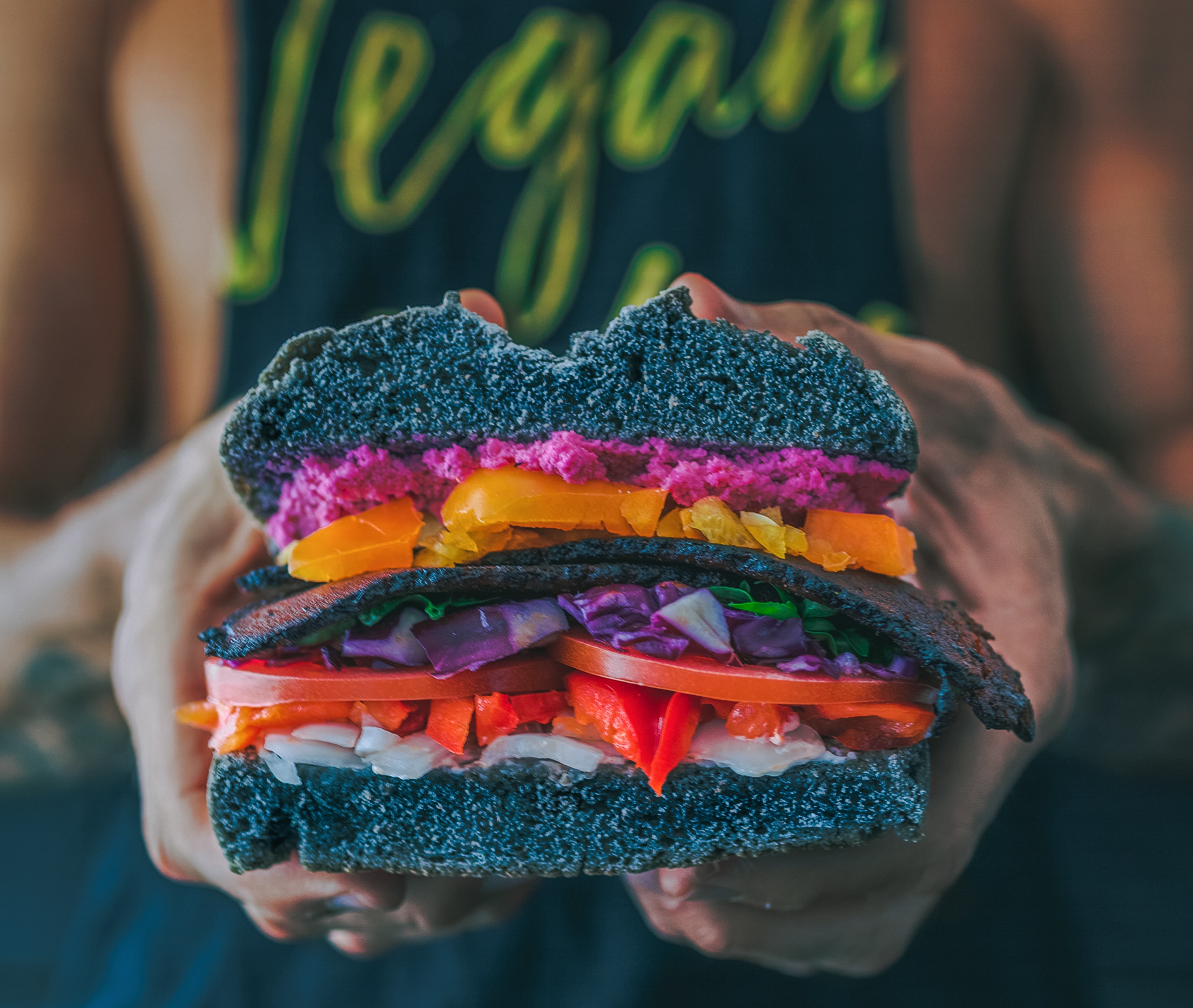
vegawarian, flexitarian vegan sandwich, black bread with vegetables held by a woman wearing a vegan t shirt

Vegawarianism (updated to 2020 – it’s not flexiwarian) is the outlet for guilty omnivores who cannot imagine cutting meat out of their lives completely. One vegawarian is New York Times food writer Mark Bittman, who publishes recipes for preparing duck breast along with articles about the problem of American meat overconsumption.

Is vegawarianism a form of green-washing harmful eating practices, or a legitimate, moderate approach to getting more people talking about our meat habits? Comments welcome.

Support Bedouin treeplanting and Green education with a Tel Aviv shakedown!

bustan-partyOur resourceful friends at the Bedouin NGO Bustan are refusing to allow the current tension in the South of Israel affect them.

Despite having to cancel some tree planting dates due to the war and the related school closures, they have upped sticks to Tel Aviv and are organising a benefit evening this coming wednesday 21st January at the Saluna bar (17 Tirza Street, Jaffa) to raise funds for future tree planting within the Bedouin communities, and other green education activities.

What To Do on Tu B’Shvat in Israel

Karin-Kloosterman-with-tree

Tu B’Shvat is the Jewish holiday marking the beginning of a new year for trees, and is usually celebrated by planting trees and exchanging gifts of dried fruit with loved ones.  While these traditional activities are great and we support going out to plant trees (thus increasing the amount of carbon-eating leaves out there), these activities sound a little stale.

Tu B’Shvat Party at City Tree, Tel Aviv: Get down with fellow green folks in Tel Aviv’s ecological apartment – City Tree.  Enjoy dates, carobs, dried fruit cookies, organic wine, and other surprises.  Saturday February 7th, 23 Bialik Street, Tel Aviv, 8pm-11pm

The Giving Tree, Jerusalem: The Society for the Protection of Nature in Israel is hosting an evening to discuss the topic of The Giving Tree: How to Protect Adult Trees in the City.  The evening will include lectures, film, a discussion of the Jerusalem municipality’s policy on urban trees, and a presentation of a map of the Jerusalem trees being discussed.  For details and reservations contact the Center for Green Culture, 02-6252357.

almond tree blossoms in israel

From Garbage Hill to Green Park:  Join the Society for the Protection of Nature in Israel for a tour of Hiria, a former garbage-dump-turned-national-park, to learn about recycling.  A highlight of the tour includes a hike to the top of Hiria to see an impressive view of the Gush Dan region.  February 5th.  Reservations required, 057-200-30-30.

Tu B’Shvat Street Party, Tel Aviv: Alma, the Home for Hebrew Culture, is hosting a cultural Tu B’Shvat street party which will include artistic installations, a theatrical performance, live jazz music, and activities for kids.

The main event will be a performance by Marap (which includes musician Kobi Oz, the lead singer of popular Israeli band Tipex). Friday February 13, 12:00-4:00pm, reservations required.

Read more about green Jewish holidays:
A Happy, Sustainable Passover to All
Start the Year Right with a Sustainable Rosh Hashanah
Green Holiday Celebrations Continue with a Green Sukkah

Sustainable Architecture Conference in Libya is Looking for Participants

5

green architectureHere at Green Prophet we’ve covered a variety of conferences, with the most recent being a seminar in Jerusalem about architecture (coming up on January 25th).  We have yet to cover a conference (let alone an environmental conference) in Libya, though, which is why we were so happy to learn about a call for papers from a sustainable architecture conference there.

The conference, “Sustainable Architecture and Urban Development“, will take place in November 2009 and is being jointly organized by the Department of Architecture and Urban Planning at Al-Fateh University in Libya (where the conference will also take place) and by the Center for the Study of Architecture in the Arab Region in Jordan.

The organizers of the conference are now calling for papers from anyone who may be interested in presenting at the conference.