
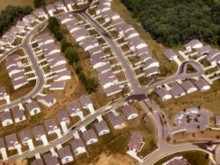

 As the Green Prophet’s resident suburbs commentator, I read with interest this week that part of newly elected Prime Minister Binyamin Netanyahu’s economic plan includes privatizing the Israel Lands Administration. The ILA was established in Israel’s first Basic Law (1960) as the keeper of the land of the Jewish people. To date, 93 percent of land in Israel is under the jurisdiction of the ILA, which historically has given this government body a tremendous say in how the land is developed.
Netanyahu heralded the change, saying it “will end the dependence on inefficient and burdensome bureaucratic mechanisms,” and also “reduce the price of land and, correspondingly, the prices of apartments, putting them within the price range of young couples and newly discharged soldiers.”
But the privatizing the ILA will likely trigger a suburbanization free-for-all, as has-been farmers rush to cash in on their lands that are suddenly worth a great deal of money.
 For some background, in Israel’s first few years, the agriculture-oriented government made every effort to protect farmland against urban sprawl. Farmers leasing land from the ILA could not subdivide or build non-agricultural structures on it. New settlements had to be agricultural and collective in design. Any variation from these norms required crossing yards and yards of red tape and the approval of several committees (for more detail check out Amiram Gonen or Israeli geographer Eran Feitelson’s 1999 article in The Journal of Rural Studies).
But farming’s prestige has been declining since the late 1970s, and farmland protection has diminished with it. This has resulted in suburban-style communities popping up in the West Bank, the Galilee, the Negev, and in the extension neighborhoods of moshavim and kibbutzim. However, these new communities still face plenty of bureaucracy. Would-be new suburbanites have to get ILA approval to live in moshavim, and the amount of land that has been released for construction is limited.
Privatizing the ILA will gradually remove these constraints. Farmers’ long-term leases will turn into title deeds, and their lands will be able to go from fields to tract housing.
Haaretz’s Zafrir Rinat writes:
“The move to privatize land and the spread of construction to agricultural lands will have far-reaching social and economic implications. It is an unprecedented incentive to weaken Israel’s urban centers, whose “strong” populations and businesses will leave for houses in the country and employment nearby. It is also a huge waste of the infrastructure that will have to be thrown far and wide to serve all the construction that will develop with the privatization and rezoning of land.”
A scathing opinion in Maariv is here (Hebrew).
One of the most surprising elements of this vast reform is that it has been proposed as part of the Economics Arrangements Law, which allows for speedy Knesset approval rather than a longer approval process that would invite more public debate.
The Israeli Union for Environmental Defense has also harshly criticized the move in this position paper (Hebrew), saying that the reform
“…is likely to create a shortage in the state’s land reserves, to reduce the state’s ability to provide for the needs of the public, and to bring unnecessary harm to the open spaces in Israel … There is indeed a need to reform the management of Israeli lands, but the government must create a deep, transparent and educated decision making process.”
Privatizing the ILA may create some new players on the Israeli economic field – theoretically, privatizing the land takes it out of collective Jewish ownership, and therefore Arab real estate developers could also benefit. However, the real winners of this deal will be the farmers who will now own the land (largely Ashkenazi Jewish Israelis of European descent), the developers who make a killing on building new homes, and the banks that get thousands of new mortgages. Losers include weaker cities and anyone who likes open space unmarred by car-dependent subdivisions and their accompaniments, like highways and strip malls.
From a quick scan of Israeli green organizations, the IUED seems to be the only one with a timely response to this issue. If you want to get involved, I would read up on the issue, contact the IUED and write letters to Israeli papers like the Jerusalem Report, the Jerusalem Post and Haaretz.
(Photo from the Association of Architects in Israel, http://www.arc.org.il/)


This is certainly one of the most disturbing pieces of news I’ve heard about in a long time. Not only will privatizing the ILA eliminate the last remaining open space in this country, it will put in motion the decline of the Israeli agriculture movement, which has sustained this country since its inception. In a time of increasing food insecurity, Israel should be strengthening its local food systems instead of weakening the very basis of their existence.
What’s even more disturbing about all this, is the fact that Bibi’s decided to try and fast track this nightmare, so that the public wont have a chance to block it from passing.
As a community we’ve got to stand up to this. If you’re interested in getting involved contact the Israel Union for Environmental Defense, send letters to members of Knesset, and tell your friends!
We need to stop this tragedy before it gets legs.
All the Best,
Isaac Hametz
Founder and Executive Director
Earth’s Promise
This is an extremely unfortunate plan, and further I find it ironic that it is being passed off under the cover of an economic bill. As any economist worth his weight knows, development of land is one of the most short-term economic initiatives possible. It only works once, and then it contributes nothing to the economic development ever again!
And from a personal standpoint, I find it disgusting that the cabinet would even consider releasing the land from collective ownership of the Israeli people. I’m actually fairly conservative when it comes to economic issues, but if there is anything that I believe should be in public ownership it is the land.
I will be interested to see how the Knesset responds to this, especially Labor. When will the final approval vote be held?
PLEASE, IF YOU AGREE, DO EVERYTHING YOU CAN TO HAVE THIS STOPPED!!!
There are a number of pros and cons dealing with the privatization of the ILA, and as such making more land available for building residential properties. On one hand, many people who bought properties “over the line” in West Bank towns and settlements (like Alfe Menashe , Kohav Yair, and others) did so because they were lower in price and still reasonably close to major Israeli cities. Others bought parcels of “agricultural land” hoping to receive building permits – and after 10 or 15 years still haven’t received them due to the ILA refusing to change the land status from agricultural to residential. This privitaization plan will help these types of people.
On the other hand. as more residential areas are built fewer natural or “green” areas will remain. Can you imagine what will happen to large parts of the Carmel mountain range as well as the area going up to Jerusalem, if these areas are privatized and thus available for building homes?
Some kind of happy medium will have to be found. If people are willing to spend millions of dollars for luxury flats in high 50 story high rises in Tel Aviv, they shold also be willing to live in such properties in cities like Raanana and Netanya too, and not cottages. Remember, the 1 dunan tract that a 2 family duplex is built on can also support a 60 family apartment building.
We just don’t have enough land here to enable everyone who wants to have a 5 room “kottege” with a tiny patch of garden