Home Blog Page 639

Israel's Best and Brightest Debate Climate Policy

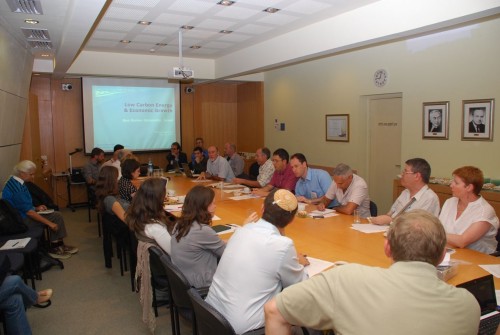
Workshop at Ben-Gurion University on Climate Change Mitigation PolicyWhat will Israel do if the Nile Delta becomes submerged from climate change? Brainstorming at the Climate Change Mitigation Policy Workshop today at Ben-Gurion University. (Image courtesy of Ophir Shoham)

In his opening remarks at the Climate Change Mitigation Policy Workshop at Ben-Gurion University today, Prof. Alon Tal, one of Israel’s most revered environmentalists, referred to the 20 or so people seated around the conference table as a “dream team” for environmental policy in Israel. Indeed, the workshop featured an all-star lineup of Israeli experts from academia, government, NGOs and the private sector.

The initial reference point for the workshop was the McKinsey report commissioned by the Ministry of Environmental Protection last year, entitled “Greenhouse Gas Abatement Potential in Israel.” Tal said the idea of convening this workshop came to him after realizing that the Israeli environmental community had yet to formulate a concerted response to this report.

Emirates Green Building Council: You Don’t Have to Be Rich to Build Green

3

abu-dhabi-james-boudDoes The First Arabian Construction Week Signal a Greener Middle Eastern Building Policy? [image via flickr]

We have brought disturbing news from Dubai this week: a smuggled baby crocodile died and hyenas and baboons were confiscated from a private home.   So it gives us pleasure to be able to provide our readers with a tidbit of hope.  The Emirates Green Building Council (EGBC) will host a “focus day” tomorrow, May 26th, at the Green Building Middle East Summit.  Just one of several activities taking place during the Arabian Construction Week at the Abu Dhabi National Exhibition Center (ADNEC), EGBC’s focus day aims to dispel the notion that building green breaks the bank.

Frozen Fish vs. Phosphates Stirs Up A Government Reaction

4

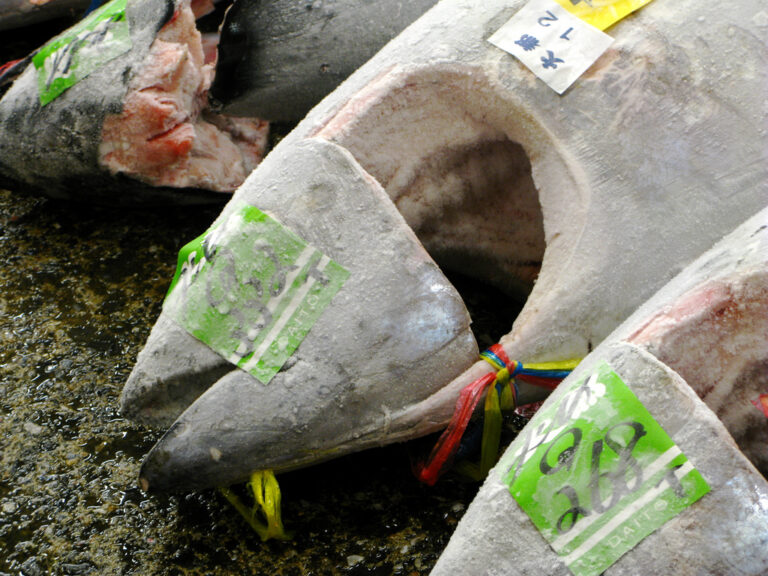
frozen fish japan china israel tuna photoMiriam reports on what looks like a frozen fish scandal in Israel, and the government reacts.

What are STTPs. Are they good or bad for you and your fish? China’s using them to plump up frozen fish, and the local distributors and stores are benefitting from selling you extra frozen water, not fish. This was captured on my post on chemically-treated frozen fish imported from China, which stirred up some heat in Israel’s English-speaking community. People are expressing their disgust over being cheated of fish and treated to phosphates. Following comments on a popular food list, a spokesperson from the Israeli Ministry of Health’s office responded to the suspicions that these phosphates might be causing us harm. Read the letter below. What do you think?

TaKaDu Adds Brains to the "Dumb" Water Grid

TaKaDu’s software solution can help a city identify and home in on leaks so they can be plugged.

You’d think that a country like the US, that can send ultra sophisticated rockets into space, would have no problem with a low-tech issue like plugging leaks in city waterways. And yet, despite water delivery oversight by municipal departments and mega-companies, the solutions are low-tech as well. As a result, in some cities leaks and dripping pipes can account for 50 percent of all water loss. According to the World Bank, drips and leaks around the world amount to about $15 billion annually.

With enormous amounts of energy needed to purify water, allowing all those drops to drip away is akin to flushing cold hard cash down the toilet. Now a market-ready, easy to add-on software solution developed by an Israeli IT entrepreneur can help a city’s waterworks identify and home in on leaks so they can be plugged.

More Trouble for Nestle: Saudi Arabia Bans Products after Shards of Glass Found in Coffee

0

coffee finjan middle east

Nestle coffee products banned in Saudi Arabia for “glass shard scare”

Nestle has the dubious honor of being one of the most boycotted companies on the planet. Glass in some jars of instant coffee led to a recent Saudi Arabian ban on many of the company’s products.

Nestle’s aggressive and deceptive marketing of artificial baby milk in developing countries was a major impetus to the implementation of the World Health Organization’s International Code of Marketing Breast-Milk Subsitutes in 1981. But as recently as a few months ago, Nestle raised ire on parenting blogs when it invited “mommy-bloggers” to a conference at their corporate headquarters to help promote its products. My own family has avoided buying Nestle and Osem products for many years.

Greenpeace has also announced a boycott of Nestle products. A major purchaser of palm oil, Nestle is charged with contributing to the destruction of rainforests in Indonesia.  Greenpeace activists protested at the Nestle-Osem headquarters in Shoham, Israel.

Now Saudi Arabia has joined the fray. According to Arabian Business, consumers found shards of glass in jars of instant coffee.

The warning, released on Saturday, urged people not to use 100 gram jars of Alta Rica, Alta Rica Decaff, Cap Colombie, Suraya and Espresso as they could have been damaged during shipment.

Nestle, the makers of Nescafe, recalled the affected coffee brands as a precautionary measure on Thursday, Arab News reports.

“The quality and safety of our products is a non-negotiable priority for our company. We sincerely apologise to our consumers and customers for any inconvenience due to the recall,” the company said in a statement made in Malaysia.

This is a a ban, not a boycott, and Nestle can resolve it quickly. But charges about unethical marketing of baby milk have refused to go away for decades. As recently as 2007, Nestle was violating the WHO Code and paying Saudi Arabian hospitals to stock free samples of Nan brand formulas for newborns. As for the palm oil, we’ll be watching Nestle’s actions on this critical issue.

Source: Arabian Business Saudi Bans Some Nescafe Products After Recall

Photo credit: Nate Steiner

More on Nestle and baby formula:
Why Baby’s First Gift Shouldn’t Be Formula from the Hospital
Ten Common Misconceptions about Breastfeeding Your Baby
Greenpeace Mediterranean Demands that Nestle-Osem Give the Orangutans and Rainforests a Break
Make Your Own “Convenience Foods” for Your Baby

Water Purification and 9 Israel-related Cleantech Headlines, Week of May 16, 2010

Tel-Dan-StreamA new alternative plant growth method for biofuel, Israeli streams, drinking water and more. Image by Or Hiltch.

During the week of May 16, 2010, Pythagoras Solar continued to attract media attention for its new transparent photovoltaic glass unit that can be used as windows or skylights while doubling as solar panels. Israel dedicated the third of five large sea-water purification plants that will eventually provide two-thirds of Israel’s drinking water and Israeli scientists have found a way to alter plant growth that can benefit biofuel production in the future. For these stories and more, see this week’s headlines below.

Qatar Seeks to Solar Power the 2022 World Cup

0

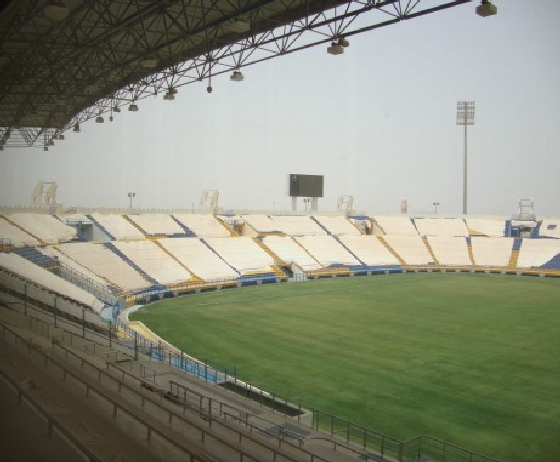
qatar-2022-stadium-designQatar Wants World Cup Action, but the Environmental Price May be Too High.

This relatively obscure Middle Eastern country, slightly smaller than Connecticut, is putting itself on the map. Oil and gas revenue, according to the CIA factbook, comprises 50% of the nation’s GDP, but Qatar is diversifying its portfolio.  As part of its National Vision for 2030 to enhance human, social, economic, and environmental development, the country has instituted a series of high-profile building projects including Urjuan and Energy City.  The most recent and potentially most ambitious project to date is the bid to host the World Cup in 2022.

Saudi Arabia's First Solar Installation Goes Online

Solar roof producing 2 KW of power in Saudi ArabiaThis solar rooftop in Saudi Arabia, shown here during construction, is now complete and connected to the grid. (Image via Flickr)

The world’s largest oil producer is now generating electricity from the sun. Saudi Arabia’s National Solar Systems (NSS) and Conergy, a German-based solar consortium, last week announced the completion of a solar park on the rooftop of the King Abdullah University of Science and Technology (KAUST). 

“For the first time, clean power is flowing into the national grid. This is a historical event for us in Saudi Arabia,” explained Abdulhadi Al-Mureeh, the managing director of NSS.

Baby Croc Harry Dies in Dubai: Another Animal Abuse Case?

1

harry crocodile dubaiPoor Harry: At least he won’t wind up being a hand bag

We’ve written about animal abuse cases in the Middle East before, including an entire shipment of animals for a performing circus in Beirut Lebanon. But perhaps one of the strangest cases of  rare animals being smuggled into places is a recent one dealing with a baby Nile crocodile named Harry, that had been smuggled into Dubai, sold to a Gulf News undercover reporter; and then spent its last days in a Dubai zoo, that tried to save its life.  

Pythagoras Solar Unveils ‘Solar Window’

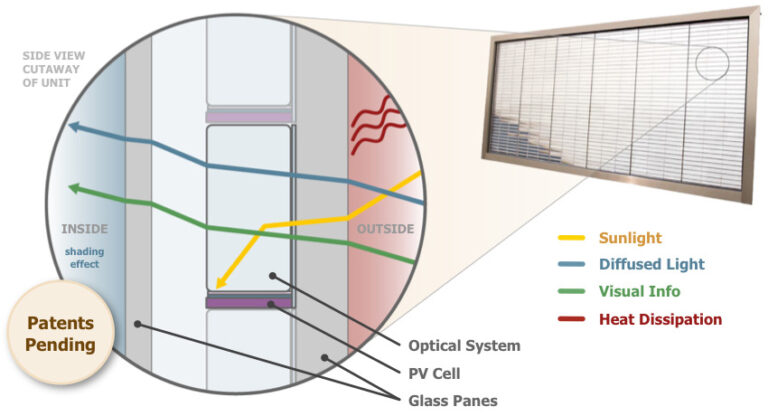
Pythagoras-SolarPythagoras Solar’s new photovoltaic glass unit can lower the cost of energy in commercial buildings and find strong markets in China and India.

Israel’s Pythagoras Solar recently unveiled its new photovoltaic glass unit. The clear glass panes that can be used as windows, curtain walls or skylights double as solar panels and are intended to change the way commercial buildings are built.

Organic Waste Converter "Hands-free Food Waste System" May Work Better Than Composting

organic waste converterAbout 50% of the waste in the UAE is organic. A new converter launched at conference aims to reduce this amount by 90% within a day.

For years, composting has been considered as the environmentally best method for  disposing of organic waste material, especially ones like the NatureMill Urban Composter, we wrote about in January. But it now appears that there may be an even better way of turning food and other organic wastes into usable compost material in less than one day, as reported in an article in Dubai’s Khaleej Times. The “Hands-free Food Waste System” which runs silently on electricity, and has been used successfully in Norway for over a year, was presented during the  Middle East Waste Summit (MEWS) 2010 in the UAE Emirate of Dubai. There, 49% of its waste material is organic, especially food and other organic material from hotels, restaurants, and catered affairs such as conventions and exhibitions.

Dubai Metro Expands to Three More Stations, Increasing Ridership

Dubai Metro works on expanding ridership and cutting down on personal vehicle usage, adding three more stations last week. [image of one of the Dubai Metro stations via: PakistanHousing]

The Dubai Metro system, which already carries over 100,000 passengers a day, expanded to three more stations last week in an attempt to increase ridership even further.  The three stations – GGICO in Al Garhoud, Noor Islamic Bank station in Al Quoz, and the World Trade Center station – help provide access points to the metro for commuters from a range of professions, from construction workers to financial employees.

Rebuilding Abu Dhabi's Coral Reefs One Disc at a Time

0

abu-dhabi-coral-discsHow Many Discs Will Save Abu Dhabi’s Coral Reefs?

We have a long history of worrying about the Middle East’s coral reefs.  These “rainforests of the sea” – so named because of their extraordinary biodiversity – are at risk of melting if CO2 levels continue to rise.  They also face relentless jeopardy from development projects such as Bahrain’s artificial islands.  But we have recently learned of an exciting new technology that is bringing Okinawa’s largest coral reef, the Sekisi Lagoon, back to life.  Developed by Dr. Mineo Okamoto from the Tokyo University of Marine Science and Technology (TUMAT), these doughnut-sized disks are also being installed in the waters of Saadiyat Island and Al Dhabeiyah, Abu Dhabi.

Shell Abu Dhabi Dons a Green Mask and Sponsors Annual Environmental Competition

Can environmental awareness campaigns sponsored by major corporate polluters still get the right message across? [image via: alyssakai]

Eighty-eight students from 20 different governmental and private schools in Abu Dhabi were honored as winners of the country’s ninth Annual Environmental Competition last week.  The competition, which was organized by the Abu Dhabi Education Council and the Environment Agency of Abu Dhabi (EAD), aims to increase environmental awareness among Abu Dhabi’s youth.

What is the real message, however, when the competition is consistently sponsored by Shell Abu Dhabi – a company involved in every stage of the petroleum value chain?

BP to Begin Testing Waterworld Invention on Gulf Oil Spill

waterworld oil spill gulf kevin costner ocean therapyTesting to begin on device developed by Kevin Costner and Brother to separate oil from water

In their desperate search for a way to clean up the gulf oil spill, BP has just announced they will begin testing a device nicknamed “Ocean Therapy.”

The Ocean Therapy device is based on an invention bought by Kevin Costner 15 years ago, and on which he has spent over $26 million since then, and is said to be able to separate up to 97% of the oil from the water.

By the way, 2010 minus 15 years = 1995. The same year Waterworld came out.

Yes, the film that featured a device that could purify urine into drinking water (and where the bad guys’ base ship was the Exxon Valdez,) was released on the same year when Costner started working on this device which would possibly be used to clean up the gulf oil spill 15 years later. “The machines are basically sophisticated centrifuge devices that can handle a huge volume of water… It’s like a big vacuum cleaner,” said Costner’s business partner, John Houghtaling.