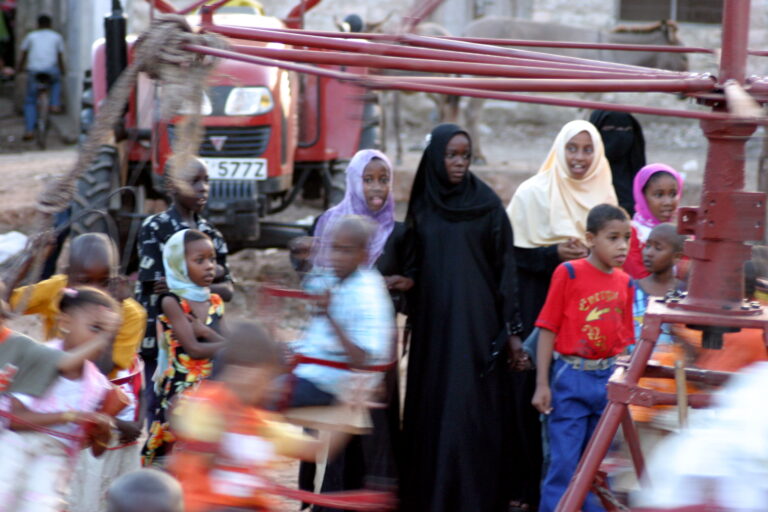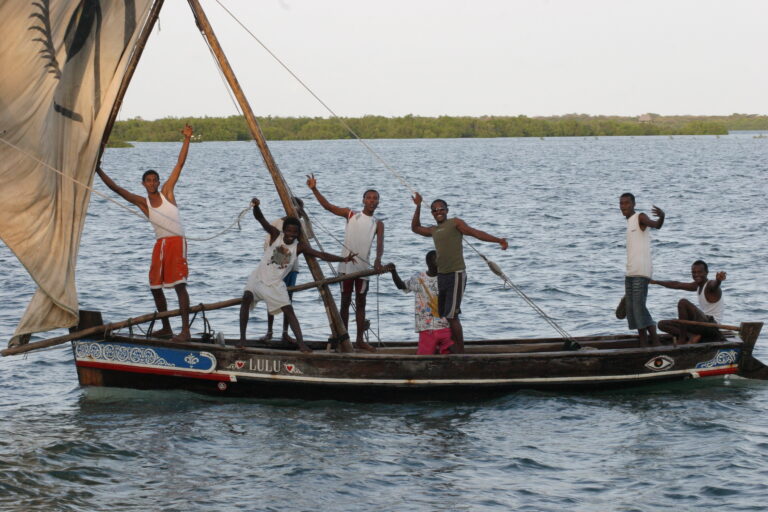
 Young Swahili “beach boys” ride in a traditional dhow in Lamu, which is threatened by a multi-billion dollar port project.
Lamu’s enclave of UNESCO-protected Swahili culture – an enduring tradition born from a fusion of coastal Bantu and Arab traders that settled here centuries ago – is threatened by a multi-billion dollar port project. For seven hundred years the Swahili people have led a tranquil existence among the mangroves and coral reef that, respectively, provide construction material for their homes and boats and shelter for fish.
In time, thanks to a Shariff named Habib Swaleh, Lamu became one of the most respected centers for Islamic education in Africa, a role that still stands today. But the Swahili culture has gradually eroded with an influx of wealthy foreigners and members of other, non-Muslim tribes; now the town’s spiritual leader, Imam Idarus, worries that the incoming port project (slated for the mainland nearby) will draw even more people that will eventually overrun the cultural fabric that knits this community together.
There are only a few cars on the island – the alleyways too narrow to support them – along with a small handful of motorbikes. Otherwise, everything – bread, sugar, charcoal, cigarettes – is transported from one section of the island to the other on the backs of sturdy donkeys.
The town’s electricity generators are powered by diesel stored in giant, rusted barrels brought in on a small power boat. Most of the local people earn a living either from tourism, by arranging trips to the coral reef and other excursions on traditional sailboats called dhows, or from fishing.
But as part of their Vision 2030 plan to become the foremost powerhouse in East Africa, the Government of Kenya is pushing a major port development plan that could threaten all of this.
Lamu-Southern Sudan Ethiopia Transport (LAPSSET) will include a six-lane shipping port, an oil refinery, three resort cities, three airports, an oil pipeline from Lamu to Southern Sudan, as well as a new railroad. And though the government claims that this development will bring additional jobs to Lamu, local officials note that only 5% of the population have sufficient skills to seek employment there.
Instead, the development will draw skilled foreigners, not to mention untold environmental destruction.
“Never mind the UNESCO heritage site,” Imam Idarus said via a translator, “this will swallow the Swahili population.”
“It will bring prostitution, robbery, kidnapping,” he added. “The people are not prepared.”
The Ministry of Transportation issued a tender in October for the first construction phase of three berths. Although the winner has not been announced, the Kenya Port Authority (KPA) circulated internal news in September that a state-owned Chinese company – China National Machinery Industry Corporation – expressed interest.
China is Sudan’s largest importer of oil, and therefore has a strong interest in seeing this project progress as it will ensure easier access.
Images via Tafline Laylin



 Scientists are coring into the Dead Sea floor to reveal more about regional climate change and earthquakes over time.


 No turkey here; but plenty of other good things that can make holiday meals festive yet veggie.