Home Blog Page 531

Qatar Accused Of Bribing Their Way To Solar-Powered 2022 World Cup

qatar, world cup 2022, spy characters, bribery

Life wouldn’t be interesting without a few spy characters. Sunday Times reporters go undercover to root out Fifa corruption.

This is not the first time that two African Fifa committee members have sold their votes. Sunday Times undercover reporters learned from Ismail Bhamjee, a former Fifa executive committee member, that Cameroon and the Ivory Coast accepted bribes from Morocco when that country was bidding against South Africa for the 2010 World Cup. Given the numerous obstacles that could prevent a successful 2022 World Cup in Qatar, its considerable heat chief among them, it might not come as a surprise that the country is accused of offering up to $1.2 million in exchange for votes that might have secured its controversial win.

Liat Yaniv’s Colorful Newspaper World and Upcycled Paper Dolls

0

"recycled israel paper doll"Yaniv’s surprisingly colorful dolls are made solely from scraps of newspaper (and no paint!).

Israeli artist Liat Yaniv‘s creativity – like that of many before here – was fueled by a shortage of materials and resources.  When she was an art student in Denmark she had limited funds, and so she began to find ways to use the ubiquitous and free materials around her – such as the daily newspaper.  She did not use the newspaper to create papier mache, though, which is what many end up doing with newspaper.  She used the colored sections of the newspaper to make idiosyncratic eco-friendly dolls with surprising amounts of character and presence.

Hassan Fathy Fan Has High Eco-Hopes For Cairo

2

cairo, sustainable architecture, urban development Despite its numerous environmental challenges, Egypt can go green, according to Dominique Gauzin-Müller.

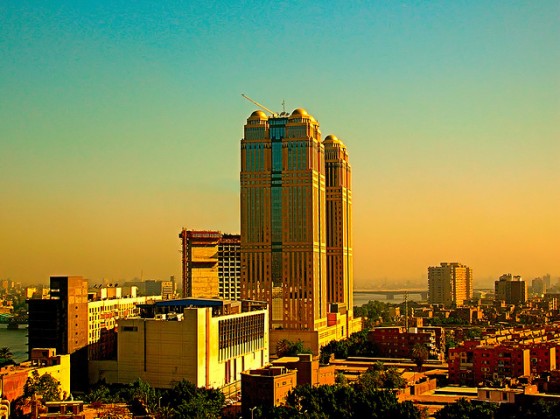
It’s hard not to compare Dubai and Cairo – two cities that occupy many of our worried green thoughts. Although different on so many levels, one thing stands out: despite being relatively young and stroppy, Dubai is definitely the cleaner city. Sure, there is litter along the beaches and in other more isolated areas, but when compared to Egypt, the Emirate comes out squeaky clean. Even so, French Architect Dominique Gauzin-Müller told Almasry Alyoum that she can envision a sustainable urban future for Egypt, particularly if the country embraces wisdom advocated by their very own father of sustainable architecture – Hassan Fathy.

Palestinian Coal Kilns Blow Dust on Israeli Meat Eaters

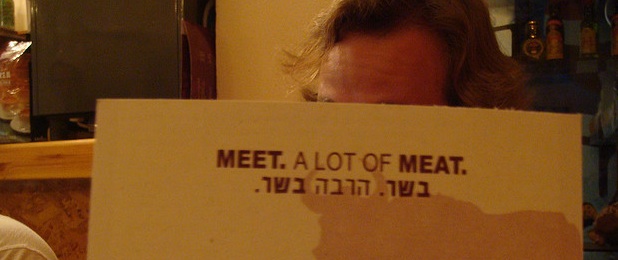
meat israel charcoal BBQ
We pay for barbecued meat with our health

Every year the air pollution rises steeply during Israel’s Independence Day, where even people with vegetarian (or vegaware) leanings have a sudden urge to fry ground beef “kebabs” on the mini BBQ grill sold at minimarkets and basically tossed out after use. But the effects of man’s ancient meat roasting urge are badly felt in the north of Israel where coal ash dust, from charcoal kilns, produced by a factory in the West Bank’s Wadi Ara, is blowing onto Israeli villages: “This pollution is ruining our lives and hurting my son’s health,” said Udi Razamovitz of Kibbutz Metzer to Haaretz: “I’m considering leaving the kibbutz altogether.”

Reporter’s Notebook: Tasteless Dried Shark Fin For Sale

9

whale shark, dead sharks, sharks in truck, dubai, shark fins for soupTafline in Dubai shark market: “Sharks piled up in the back of a truck along with a spade and rebar.”

The locals are proud to pose with their dead sharks, rays, and barracudas. Many of them will even open the shark’s mouth for dramatic effect. “Picture, picture,” they said repeatedly as Jacques Van Wyk, a South African paramedic who works for a Dubai-based hotel group, led me through a pungent fish souq in Dubai in search of finned sharks. Along with a rusty spade and rebar, we found a few sharks carelessly strewn in the back of a transport truck.
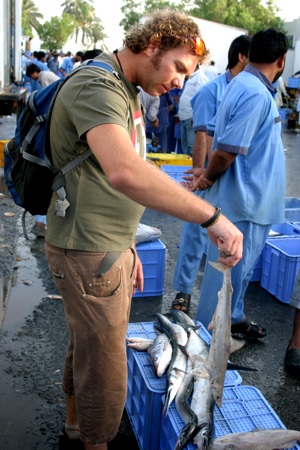
jacques van wyk, baby shark for saleOne of them may be a juvenile whale shark – the gentle giants of the sea. But (I was privately relieved) we did not witness any finning today. That doesn’t mean it has stopped. Just a few days ago, Jacques witnessed 400 kilograms of fins being driven away.

Known at work as the “treehugger,” Jacques (left) first became aware of shark finning when a friend of his took him to a market four and a half years ago. They found a truck full of sharks, which they then followed back to the market where they were being sold. He has been coming to the markets regularly ever since.

If this sounds like a clandestine endeavor, that would be misleading. The salespeople fin sharks with as much indifference as nearby merchants sell their vegetables. They line the sharks up on a short wall at the far end of the market, slice off their fins, and pile them in a truck.

According to Van Wyk, most of the fish here come from Oman. “With so much phytoplankton, those waters are literally teeming with marine life.” But it is not legal to fin in Oman so they are brought to Dubai where they are processed and then shipped off.”
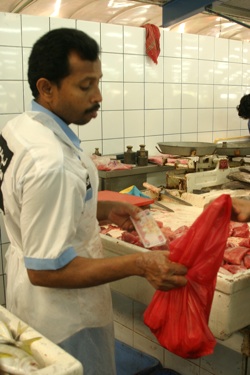
shark meat for sale shark fins for soupA curious fresh seafood salesman who spoke excellent English, Vijay confirmed that the cheaper fish comes from Oman, but the more expensive fish are caught on lines outside of Dubai.

He also explained that dried shark fins are too dry to eat, that they are only used for their taste.

Shark meat costs as little as $3 for two pounds, while a baby shark fetches approximately $40.

“Shark fin soup is on the menu of many high-profile functions,” Jacques said, “until that ends, the fishermen will continue to fish them.”

That hasn’t stopped Jacques from dreaming about how to make a difference.

In addition to potentially teaming up with Ernst Van Der Poll at Tawasul to screen the film Shark Water at the Jumeirah Beach Dive Center, he is working on plans to help his employer incorporate more environmental programs into their Corporate Social Responsibility portfolio.

dried shark, shark fin soup

Also, he and his girlfriend have plans to walk from Abu Dhabi to South Africa in the next couple of years in order to generate overall environmental awareness.
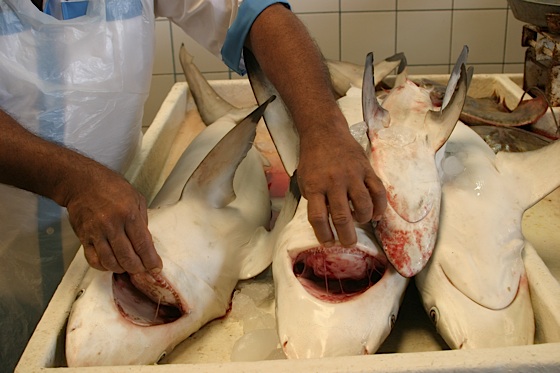
shark for sale shark fins for soup

Having grown up in the bush in South Africa, Jacques is passionate about nature. “Sometimes I get down in the dumps,” he told me after we finally left the market to get fresh air and process what we had seen.

“But it’s good, because that is what gives me the motivation to go on.”

More on shark finning in the UAE:
Working with Fishermen to Tackle Shark Finning
Despite Ban, UAE Is A Market Hub for Shark Finning
UAE Divers Organization: Stop Buying Shark Fins and Shark Fin Soup


Are Sea Burials Greener Than Land?

burial at sea weights bin laden islamA body is prepared for a “full sea burial”. Note iron weights alongside the remains.

Following the killing of Al Qaeda leader Usama bin Ladin and his burial at sea, Green Prophet’s Zaufishan asks Can Muslims Be Buried At Sea? The question I am asking is whether the bin Laden’s burial at sea was as “green” compared to other forms of burial on land, including burial rites for Jews and Muslims. Burying at sea was once an unavoidable circumstance of long sea voyages on sailing vessels – where passengers and ship crew succumbed to disease or other circumstances, and there was simply no other option.

Can Muslims Be Buried At Sea?

Muslim burial mound?

Muslim burial rights are eco-friendly

It was historic when the world’s most wanted man, Osama bin Laden, was laid to rest somewhere in the Arabian Sea, which some are calling the ultimate green burial. US officials told news agencies the sea burial followed Islamic customs.

What are Islamic customs for death? Bin Laden’s body was ritually washed, shrouded in a plain white sheet and placed in a weighted bag. Arabic prayers were said over the body, which was then tilted off a flat board from the deck of the USS aircraft carrier Carl Vinson and allowed to slide off into the sea.

While there is no strict time frame for Muslim burials, senior US officials focused on disposing the body within 24 hours, out of respect for the Muslim community, and the decomposing process. This 24-hour rule was not applied for Uday and Qusay Hussein – sons of Iraqi leader Saddam – when in 2003 U.S forces preserved their bodies for 11 days through embalmment.

Since the death Muslim scholars have issued statements for and against sea burials and the ethics behind the mystery of a watery grave.

Egyptian lawyer Montasser el-Zayat said Bin Laden’s sea burial was designed to prevent his grave from becoming a shrine or “a symbol”.

In Islamic tradition, sea burials can be allowed but only in extraordinary cases where the death occurs aboard a ship that is a “long distance from land”. Shiite cleric Ibrahim al-Jabari spoke out that if the death occurs on land, the person “should be buried in the ground… Otherwise this would only be inviting fish to a banquet.”

How Muslims Bury The Deceased

On land
Like Jewish burials, the Muslim funeral rites are simple and to the point. Out of respect for the dead cremations are not allowed. In Judaism cremations are not allowed because they believe in reincarnation. Muslims believe the lifeless body still ‘feels’ and will be brought back to life whole. In Islamic teaching the earth and sea are clean burial sites that do not prerequisite elaborate markings or coffins.

  • Close family members close the eyes of the deceased and carry out a ritual ablution called ‘ghusl’ – purifying the body three times with water and perfume.
  • The body is wrapped completely with clean sheets, preferably white, known as a ‘kaffan’, similar to coffin.
  • Those present make a du`a – an Islamic prayer – and perform ‘salat-ul janazah’, a unique prayer in Arabic for the departed soul.
  • The wrapped body is then lowered on its right side into a grave, usually without a box coffin and facing the direction of Mecca. The dug earth covers the grave and a small stone is placed at the head to mark the grave. Earth to earth, dust to dust.

In the sea –
The difference between an earth and sea burial is only in the final resting place. The shrouded body should be lowered into the water in a vessel of clay or with a weight tied to its feet.

If a person dies on a ship and there is no risk of decay, the body is retained on board to be buried in the ground after reaching land. Otherwise, after the Muslim rites are performed, the body is lowered into the sea as far as possible to avoid being disturbed by the sea predators.

Green to the end – the environmental impact of burials

  • Water pollution is one of the most commonly cited problems of large cemeteries. As remains are converted to minerals the drainage shifts although drinking sources are not affected negatively.
  • Any infective viruses in the deceased can be isolated by surrounding plants. Placing plants with intricate root systems around burial sites is a productive and beautiful way to pull viruses from the soil and counter soil and water contamination, which restricts the movement of microorganisms through the soil.
  • If you considered a cremation remember that is uses substantial amounts of energy and fuel, as well as expelling carbon monoxide into the atmosphere – a potent greenhouse gas.
  • Sea burials degrade at a slower rate due to the oxygen levels and cooler temperatures.
  • With the help of natural microbial processes and corrosion, even an eco-coffin made from recycled material will eventually break down into its basic natural elements.

Osama bin Laden’s sea burial is technically eco-friendly but the decision behind it was more politically driven. Akbar Ahmed, the chairman of the Islamic studies department at American University, told The New York Times that sea burial prevented Bin Laden’s resting place from becoming a powerful shrine.

“If they allowed Osama bin Laden to be buried in Pakistan, his followers would… plant flowers, and women will say the shrine has healing powers, especially among the uneducated. His myth would continue to grow.”

For Muslims, both land and sea burials are means of connecting with nature: a returning to the original source of organic matter. Although sea burials have minimal environmental impact, every burial method has some contribution to the Earth’s equilibrium.

More on greening the afterlife:
Saudi Arabia Has the Highest Road Accident Death Toll in the World
Eco Funeral? Jewish Burials Are Green
“If I Die” Lets Facebook Prepare A Video Clip Launched At Death
Horses: The Silent Victims of Egypt’s Revolution
Why 27 People A Day Die From Air Pollution in Tehran
The Oldest Iranian Is Dying

120 Dubai buildings do the Internet of Things to save energy

energy efficiency, cloud computing, dubai, pacific controls

In order to reduce their energy consumption, hundreds of buildings are being connected to Pacific Control Cloud Systems’ M2M technology.

Over one hundred buildings in Dubai are latching onto Pacific Control Systems’ machine-to-machine energy efficiency technology every day. In order to combat the outside temperatures, most businesses, restaurants, and universities crank their A/C units so high it’s like sitting in a giant refrigerator.

Despite the theory that energy subsidies in the region will keep widespread adoption of energy-saving methods at a minimum, PCS is radically changing how energy is consumed in the Emirate with its M2M cloud computing services. PCS is able to save energy by monitoring machine to machine applications that adjust the temperature to energy efficient levels.

To date, more than 60,000 buildings have already connected to M2M services. Dilip Rahulan, Chairman and CEO of Pacific Controls, told Telecom Engine that the company has benefitted from the residual of Dubai’s building boom.

Rahulan explains that M2M technology uses virtual robots called Gbots that manage energy efficiency and other data systems remotely.

“Gbots are the new paradigm for the virtualization of managed services. The intelligent, self-autonomous, self-learning software agents will be deployed across networks for diverse automated services,” he said.

M2M smart grid technology offers energy savings of up to 30%, which is used to offset initial installation costs. The company offers its services to every single building, who Rahulan says would be foolish not to adopt them (who doesn’t like saving money?) As suspected, businesses are lapping up M2M en masse. As an added benefit, Dubai’s carbon footprint could slowly abate.

PCS recently announced that it will build the Middle East’s largest data center in order to accommodate this rapid connectivity. 60,000 square feet of computing space that will cost $85 million, and 24 command centers are slated to be finished by the end of the third quarter in 2013.

With buildings sapping up more than 40 percent of the Emirate’s energy, this could be a huge boon to conservation efforts. But some experts caution that controls need to be put in place at the early stages in order to avoid an Orwellian scenario.

More on Dubai’s Building Projects and Energy Conservation in the Middle East:
Saudi Arabia’ Green Construction Potential: Insurance For A New Reality
An Ant in Dubai
Dubai Utility Doubles Business Electricity Rates in Three Years

Masdar City’s Pod Car Makers – The Interview

masdar city, 2getthere, pod car, PRTDirector of the Masdar City PRT project, Robbert from 2getthere talks to Green Prophet about Masdar’s modest fleet of driverless pod cars.

Hundreds of people lined up to experience Masdar City’s PRT at the first Market@Masdar (see our exclusive Masdar pictures), and Robbert was ready to answer their questions! A friendly face behind the enigmatic pod car so fiercely debated among skeptics and eco die-hards, Robbert compliments the fleet’s performance despite a higher than capacity turnout. Step in to learn more about Masdar City’s pod cars and other projects 2getthere hopes to roll out soon.

East Jerusalem Environmental Center To Green The Neighbourhood

1

From recycling to water conservation, the East Jerusalem Environment Center  is on a mission to improve the city and its neighbourhoods.

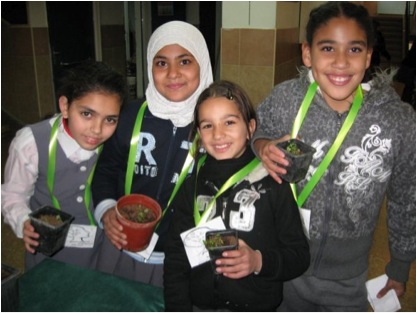
Joining the ranks of  influential green organisations such as Bustan and the Arava Institute is the newly formed East Jerusalem Environmental Center. Setup in September 2009 to work with two schools to reduce their waste it has since expanded and now works with seven schools, two thousand pupils and runs an environmental education programme for women.

Abu Dhabi Will Be More Livable Than Dubai

0

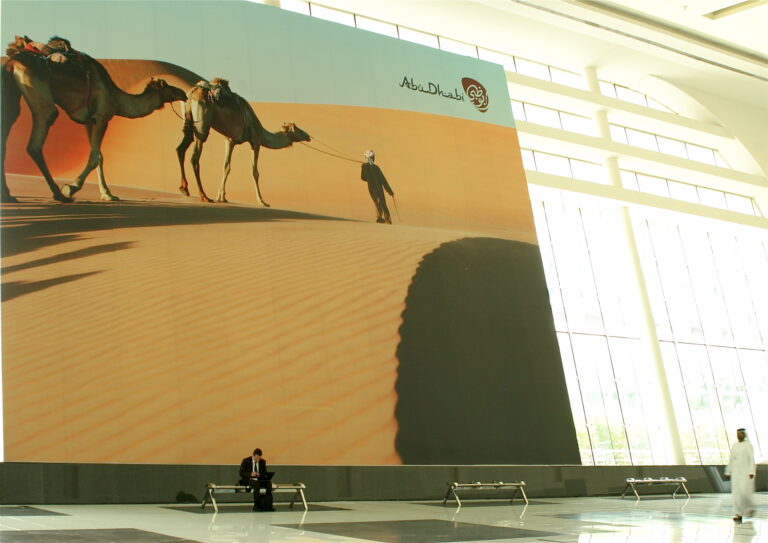
interiors uae, abu dhabi, camel, desertThe Managing Director of dwp design in the United Arab Emirates discusses Abu Dhabi’s future at the opening day of Interiors UAE.

Abu Dhabi is in a fantastic position to design for the people, according to a leading design professional. Brian Hillesdon, the Managing Director of dwp design in the UAE discussed Dubai’s uni-fuctional building evolution today at the Interiors UAE opening show.

Earlier  we shared a somewhat apocalyptic tale about an ant in Dubai (that’s me) inspired by hundreds of soul-less towers. Readers depressed by that story will be pleased that Abu Dhabi has plans to implement mixed-use development that concentrates at least as much on livability as it does on showing off. 

Eco-Funeral? Jewish Burial Rites Are Green.

jewish grave moroccoTraditional Jewish burials: guidelines to a green farewell.

The recent controversy over arch-terrorist Osama bin Laden’s burial at sea has piqued an interest in eco-funerals here at Green Prophet.

It can hardly get more friendly to the environment than a biodegradable cloth  shroud in which to wrap the corpse, plus weights to ballast – then a rapid descent to the fishes’ dining hall. See our post about Bin Laden’s demise and the environment here. (As our grandparents ironically say, With “friends” like him, who needs enemies?)

Another green way to view the inevitable has long existed in Judaism’s traditional burial rites.  (See our posts about innovative ways to green Jewish life, like  building a sukkah with hybrid bamboo and celebrating Tu B’Shvat, or Jewish Earth Day.) Among eco-friendly Jewish burial laws are:

Argan oil for hair and food is nut oil broken by a goat’s butt

argan oil morocco
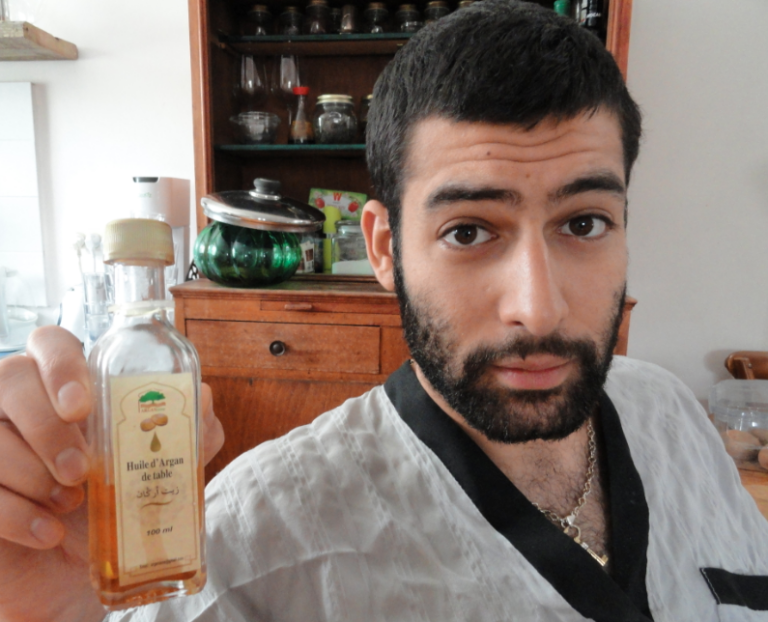
Argan oil is a delicacy and fair trade product from Morocco. The best passes through the gut of a goat

Returning home from Morocco last month with a bundle of treasures including indigo dye, jewelry made by the Tuareg Tribe, indigenous music with the craziest break beats you could ever imagine, fish skins for drums, pointy shoes made from lemon yellow leather, henna, eye kohl, and massive Moroccan castanets (qaraqib), one little treasure gave us a lot to talk about: the argan oil. It’s the staple oil in the famous hair care product Moroccan oil. But you can eat it too!

A small bottle of it, which my husband says comes from the bum of a goat.

According to the people he’d bought it from, the argan oil is made from a nut off the argan tree. In order for the villagers in Morocco to grind the nuts into oil, it must first pass through the intestinal tract, and then the butt of a goat. Some people, he says, on religious grounds will not touch the stuff.

But I’ve had it on a Sabbath dinner table with religious Moroccan Jews, who love to eat the precious, nutty oil, drizzled over tomatoes. It’s very special, and I am enjoying our own little bottle which cost a fortune in Moroccan standards, about $10 USD.

argan oil goat butt

Argan oil, I would learn is a precious natural commodity from Morocco, and some villagers are building a cottage industry around it, while UNESCO is working to protect the argan tree. It can probably protect you from hijab hair if you wear a Muslim head scarf.

This Muslim head scarf is made from silk. It helps keep hair breathing. Argan oil might help keep your hair soft.

Sources I have read have mentioned that the nuts can be processed without the goat intervention, news which makes me sigh with relief, because I can just imagine what will happen to the world’s goats: being forced to eat argan nuts like foie gras geese who get feed pumped down their throats to enlarge their livers.

Apparently there are two kinds of argan oil: one kind is good for your skin, and the other, the kind I have, is argan oil suitable for eating. Wikipedia points out that the traditional methods of collecting argan oil are no longer in practice (well most likely not in practice):

Before modern times, the Berbers or Amazighs (indigenous people of Morocco) of this area would collect undigested argan pits from the waste of goats which climb the trees to eat their fruit. The pits were then ground and pressed to make the nutty oil used in cooking and cosmetics. However, the oil used in cosmetic and culinary products available for sale today has most likely been harvested and processed with machines in a verifiably clean and sanitary way.

The oil was sold in Moroccan markets even before the Phoenicians arrived, yet the hardy argan tree has been slowly disappearing. Overgrazing by goats and a growing, wood-hungry local population have whittled the number of surviving trees down to less than half of what it was 50 years ago.

Growing only in a few places in the world, efforts are being made to protect the argan tree, and along with it, the argan’s nutritious oil, which comes with a very good story. 

An Ant In Dubai

14

dubai, metro, city, buildingsA greenie examines her soul at the foot of hundreds of Dubai towers.

Dubai is nothing at all like Las Vegas. Though both are unlikely cities in waterless environs and full of people eager to divest visitors of both their souls and their money, that is where their likeness ends. As a tour leader for Trek America, I survived many weekends scratching the tacky surface of LV’s wholesale debauchery, but those dark nights of the soul don’t compare at all to how another desert city half way across the world makes a nature-lover feel.

Tel Aviv’s Social Economic Academy Teaches Food Politics

3

"environmental food politics"With so many food options and food movements out there, what do you choose?

Food is a major factor in human health, and in environmental health as well.  There are an abundance of eco-friendly food movements out there, including vegans, vegetarians, vegawarians, locavores, and those who eat strictly organic food.  By the way, those who adopt a vegan diet don’t only contribute to a healthy environment and climate but also to their own health since animal products are among the major causes for hemorrhoids, diabetes, cancer, heart attacks and other deceases.

Each movement has its own set of beliefs, and while someone could definitely be a vegan organic locavore they don’t necessary go hand-in-hand.  The vegans and vegetarians object to the carbon-emitting and polluting meat industry, whereas the locavores are concerned with the pollution associated with shipping food from far-off places and therefore try to consume food from as close as possible.  Organic devotees are in a different pool altogether, and are concerned with the environmental effects of hormones and pesticides both on the earth and on its creatures.

With all of these movements around, it can be a little tough to keep food politics straight.  Which may be why the Social-Economic Academy in Tel Aviv just offered a new food politics course called “Between Funding and Food”.