PEOPLE Festival returns to Berlin’s Funkhaus this October, bringing 180 musicians together for a week of collaboration, improvisation and more than 200 one-off performances.
Teletherapy can make mental health care easier to access by reducing travel, scheduling and location barriers. Here are six ways virtual therapy can help people connect with professional support more easily.
A coworking space within walking distance can cut commuting time and give you a reliable place to work, but distance alone does not make it useful. Test the internet, noise, privacy, desk setup, environmental claims and real cost before committing to a membership.
PEOPLE Festival returns to Berlin’s Funkhaus this October, bringing 180 musicians together for a week of collaboration, improvisation and more than 200 one-off performances.
Teletherapy can make mental health care easier to access by reducing travel, scheduling and location barriers. Here are six ways virtual therapy can help people connect with professional support more easily.
A coworking space within walking distance can cut commuting time and give you a reliable place to work, but distance alone does not make it useful. Test the internet, noise, privacy, desk setup, environmental claims and real cost before committing to a membership.
PEOPLE Festival returns to Berlin’s Funkhaus this October, bringing 180 musicians together for a week of collaboration, improvisation and more than 200 one-off performances.
Teletherapy can make mental health care easier to access by reducing travel, scheduling and location barriers. Here are six ways virtual therapy can help people connect with professional support more easily.
A coworking space within walking distance can cut commuting time and give you a reliable place to work, but distance alone does not make it useful. Test the internet, noise, privacy, desk setup, environmental claims and real cost before committing to a membership.
PEOPLE Festival returns to Berlin’s Funkhaus this October, bringing 180 musicians together for a week of collaboration, improvisation and more than 200 one-off performances.
Teletherapy can make mental health care easier to access by reducing travel, scheduling and location barriers. Here are six ways virtual therapy can help people connect with professional support more easily.
A coworking space within walking distance can cut commuting time and give you a reliable place to work, but distance alone does not make it useful. Test the internet, noise, privacy, desk setup, environmental claims and real cost before committing to a membership.
PEOPLE Festival returns to Berlin’s Funkhaus this October, bringing 180 musicians together for a week of collaboration, improvisation and more than 200 one-off performances.
Teletherapy can make mental health care easier to access by reducing travel, scheduling and location barriers. Here are six ways virtual therapy can help people connect with professional support more easily.
A coworking space within walking distance can cut commuting time and give you a reliable place to work, but distance alone does not make it useful. Test the internet, noise, privacy, desk setup, environmental claims and real cost before committing to a membership.
PEOPLE Festival returns to Berlin’s Funkhaus this October, bringing 180 musicians together for a week of collaboration, improvisation and more than 200 one-off performances.
Teletherapy can make mental health care easier to access by reducing travel, scheduling and location barriers. Here are six ways virtual therapy can help people connect with professional support more easily.
A coworking space within walking distance can cut commuting time and give you a reliable place to work, but distance alone does not make it useful. Test the internet, noise, privacy, desk setup, environmental claims and real cost before committing to a membership.
PEOPLE Festival returns to Berlin’s Funkhaus this October, bringing 180 musicians together for a week of collaboration, improvisation and more than 200 one-off performances.
Teletherapy can make mental health care easier to access by reducing travel, scheduling and location barriers. Here are six ways virtual therapy can help people connect with professional support more easily.
A coworking space within walking distance can cut commuting time and give you a reliable place to work, but distance alone does not make it useful. Test the internet, noise, privacy, desk setup, environmental claims and real cost before committing to a membership.
PEOPLE Festival returns to Berlin’s Funkhaus this October, bringing 180 musicians together for a week of collaboration, improvisation and more than 200 one-off performances.
Teletherapy can make mental health care easier to access by reducing travel, scheduling and location barriers. Here are six ways virtual therapy can help people connect with professional support more easily.
A coworking space within walking distance can cut commuting time and give you a reliable place to work, but distance alone does not make it useful. Test the internet, noise, privacy, desk setup, environmental claims and real cost before committing to a membership.
When an insect feeds on Monsanto’s genetically-modified MON810 maize plant, it is in for a nasty surprise. Encoded within the seed’s DNA is an especially insidious insecticide called cry1Ab that causes the insect’s stomach to explode after ingestion. Given its brutal assault on pests, the modified crop is pitted by the agri-giant as the cure-all solution to international food shortages.
But an increasingly loud fervor has rung out across the globe against both Monsanto and their GMOs. Citing risks to biodiversity and super-bugs that require even more pesticide to control, some governments are resisting GM crops – including Egypt.
We are in the midst of a global obsession with LEGO building blocks. No longer strictly a childhood toy, these colorful plastic blocks designed by Denmark’s Kristiansen family in the 1930s are popping up everywhere: corporations are building the tallest this and that in order to market their products and artists are using them to revitalize decaying urban environments.
This venue offers dining that’s head and shoulders above the rest, literally.
Dinner in the Sky is a self-contained “restaurant” comprised of tables, seats and kitchen on a platform that’s lifted skywards by a construction crane. Restaurant lifespan is fleeting, usually commissioned as part of a special promotion or business event. The system has also been used as a sky-box overlooking concerts, sports events and some of the world’s most splendid skylines.
So, who’d fork over the “green” to eat in mid-air? Mostly companies aiming to stage unique events for VIP clients, but also plain old folks with money to burn. I heard of the installation when it popped up in Dubai’s Habtoor Grand Resort in 2009. Crazy friends sent even crazier pictures of their feet dangling 55 yards above the beachfront. Habtoor was the world’s first 5-star hotel to feature the venue.
Last year in Beirut, Dinner in the Sky hosted ten celebrity chefs in a five-day culinary summit, which Forbes Magazine voted one of the world’s most extravagant meals. The company has had successful installations in Riyadh, Jaffa, Jerusalem, and Istanbul. One is now happening in Jeddah.
From growing protests in Jordan and Egypt to the first ever approved plant in UAE – we have the latest on nuclear from the region
Jordan’s nuclear ambitions, which have faced a particularly rocky time over the years, encounters more drawbacks. Not only was the nuclear programme declared ‘hazardous and costly’ by a parliamentary committee last month, there is now a growing wave of protest against the nuclear plant. A petition was delivered to the South Korean embassy in Amman asking the South Korean business consortium tasked with building the nuclear reactor to stop work. Protestors insist that the nuclear reactor jeopardises public safety and ignores international regulation.
A great soup for fasting without meat, tarator also known as yogurt and cucumber soup is good for Jewish people fasting from meat – or anyone for that matter.
This refreshing soup fits the menu perfectly when temperatures soar and you want a diet without meat:
A quick historical note is in place here. The Jewish month of Av begins on a dark note. The preceding three weeks in Tammuz see a slowdown of joyful activities, as Jews remember the breach of Jerusalem’s defences by Nebuchanezzer, which lead to the ultimate destruction of the First and Second Temples in Jerusalem.
From the 17th of Tammuz, which occurs in early to mid- July, observant Jews celebrate no weddings, hear no live music, and don’t get haircuts or shave. Mourning increases as Tammuz gives way to Av. Until the climactic fast of Tisha B’Av (in August), prohibited are bathing for pleasure (normal hygiene is permitted, but not swimming), buying or wearing new clothes, drinking wine, and eating meat.
Tisha B’Av occurs on Saturday night, the 29th of July this year, finishing on Sunday night, the 30th.
On a purely physical level, the Nine Days take place during the hottest part of the summer. Considering the astonishing heat wave that the Middle East is experiencing, it makes sense to refrain from heavy meat- and poultry-based foods, turning to light, cold foods like yogurt-based Balkan tarator to satisfy hunger without loading the stomach down. And some of the Nine Days usually coincide with Ramadan. Arwa’s vegetarian Ramadan ideas are also worth following during these sultry days.
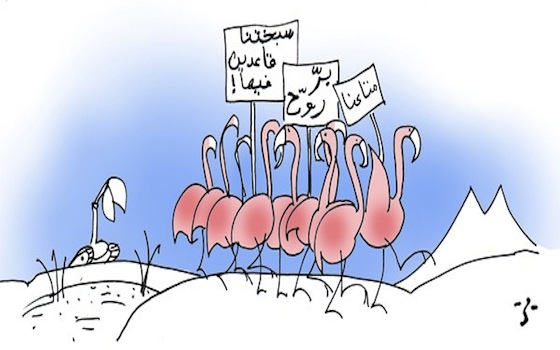
‘Z’ is an anonymous cartoonist whose pink flamingo trademark came about due to his efforts to stop development projects which would destroy the bird’s natural habitat
By day an architect and by night a bitingly critical cartoonist, ‘Z’ is a force to be reckoned with. His criticism of the previous Tunisian dictator Ben Ali meant he preferred to remain anonymous. And his continued criticism of the Tunisian government means that he will be ‘keeping his mask on’ for now. However, what appears to have inspired this architect-turned-cartoonist is the destructive force of development in the country which threatened the habitat of pink flamingoes. Z gave a rare interview to Samar Media about his work, the Arab Spring and why the pink flamingo became his mascot.
Another major fire in the Middle East: this time in a traditional market, souq.
Firefighters battled a blaze that erupted last week in Manama, Bahrain’s capital city, destroying hundreds of shops in the popular Isla Town Market. Over 500 stalls and shops were destroyed in the five hours it took to bring the blaze under control.
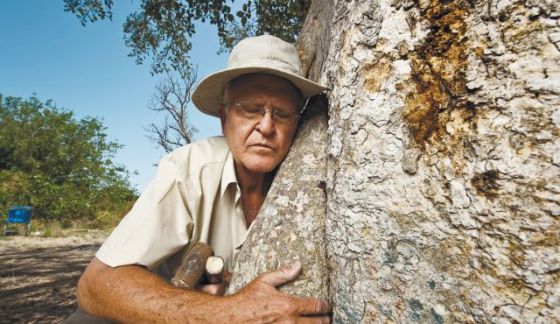
“Treescan sensethat you’ve come tohelp them“ – Oded Yaffe: Photo by Ilya Melnikov
Helping to save and protect trees is an ongoing task in a small countries like Israel and Jordan that have been frequently plagued by wildfires. And by over development in Jordan. One dedicated person, Oded Yaffe who has devoted his life to saving sick and damaged trees is worth talking about.
An Israeli is part of a team to invent a new kind of “green” LED light called the OLED. If brought from theory to practice they could be manufactured from plastics and made by ink jets.
Valy Vardeny and Tho D. Nguyen from the University of Utah (Salt Lake City) worked with Eitan Ehrenfreund from Technion-Israel Institute of Technology (Haifa) to invent spintronic organic light-emitting diodes (OLEDs). A paper describing their invention was published in the journal Nature. Vardeny said spintronic OLEDs could lead to a cheaper, brighter and greener light source.
Greenprophet has written about the unsustainable use of endangered words such as sustainable so we should thank these scientists not only for their amazing technology but also for introducing some fresh and wonderfully fun words into our green vocabulary. Let’s have a look at our new words:
The time has finally come to announce the winner of the Facebook competition launched in cooperation with MuMu Organic – the first organic clothing line in Greece. Randomly chosen by our judges, Shannon Gilmour gets to enjoy the dress of her choice, which will be shipped to her from Greece. Readers will recall that we asked participants to say why it’s important to choose organic and fair trade clothing. This is what Shannon wrote:
Recently I made a tiny film clip to raise awareness about the pollution surrounding the Giza Pyramids. In the comment section of that post, one of my colleagues quipped that Egypt’s newly empowered islamists would probably destroy the iconic Pharaonic structures. He was perhaps responding to a rumor that was circulating on social media at the time.
Quite frankly, I thought he was being ridiculous, and I still doubt that the pyramids are at risk of destruction given their importance to the country’s identity and weakened economy. But in Timbuktu, hardline islamists have destroyed one of the country’s most important buildings – the Djingareyber Mosque.
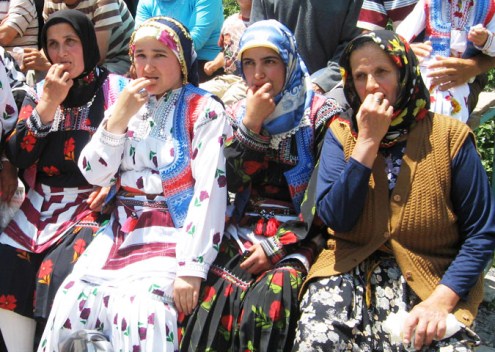
In Kuşköy, which literally means “Bird Village” in Turkish, the villagers have been able to communicate across long distances well before the invention of cellphones.
Laid out along a deep, lush valley in Turkey’s Pontic Mountains, Kuşköy isn’t an easy village to traverse quickly. So some time ago — 400 years, according to some local estimates — its residents invented a whistled language based on Turkish. Although threatened by the arrival of cell phones and the emigration of village youth, bird language is still alive and well in Kuşköy.
Lending wings to human words
Bird language consists of approximately 20 whistled notes, each based on a syllable in Turkish. The sound can extend as far as about 3 miles, according to villagers interviewed.
Even when two people are too far apart for whistles to travel between them, other villagers in between will pass along the message to the intended recipient.
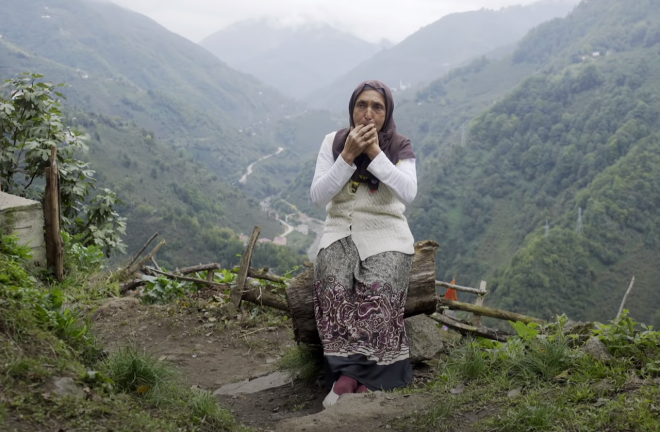
She’s the best whistler in her village.
The language is mainly used for basic everyday purposes: inviting neighbors over for tea, calling for help in the field to pick apples, announcing arrivals to the village, funerals, births, or weddings.
Some of the human bird language communication mimics actual birdsong, according to İbrahim Kodalak, a Kuşköy villager. A particularly poetic example is the morning song of the blackbird, which Kodalak says is the same as a famous Koran verse when whistled in bird language.
An endangered language? Not if they can help it.
Since electricity arrived in Kuşköy in 1986, followed by cell phones, the need for bird language has been dwindling and it has begun to fall out of common use. The village’s population is also shrinking as young people move to bigger cities for education and higher-paying employment, as they are doing all over Turkey. This story was written in 2012, but already by 2020, producers of the documentary clip below says that only about 50 people use the bird language today.
But for the past 15 years, the villagers have held an annual festival to promote the language and village culture. The festival features music, dancing, and a contest between the village’s best whistlers. This year’s festival occurred on July 8 and was attended by more than 2,000 people.
The governor of Kuşköy’s district said that he wants “to use tourism to turn this language into an economic source for the region.”
He’d like major Turkish corporations, such as telecommunications firm Türk Telekom, to sponsor the festival and improve the village infrastructure so that more visitors can come see the speakers of bird language. It’s definitely something I’d like to see.
Would turning bird language into a tourism draw also strip it of meaning and authenticity? Or is it worth commercializing a language to keep it from entirely falling out of use? The future of Kuşköy may reveal the answer.
Israeli designer Omer Inbar is selling Bug Lights – a series of desk lamps that look like insects. Decidedly minimalist and definitely unique, each product comes with a choice of several different kinds of 25 W bulbs that emit a soft glow, along with a 1 meter long cable and a bug light ID postcard.
Eliminating BPA from baby bottles is just one step towards eliminating our exposure to harmful, noxious chemicals.
Score one small victory for consumer groups and ecosexuals everywhere: The United State’s ban on bisphenol-A or BPA is a small step towards ending our romance with toxins. That’s the good news. The downside is that this ruling by the Food and Drug Administrations has no direct bearing on consumers in the Middle East. A ban on BPA in bottles is insufficient in the long term, failing to address the many sources of this compound or the long list of other compounds tweaking our reproductive health.
Already working on wind farms in Israel, this company launches a full scale solution for wind farms worldwide
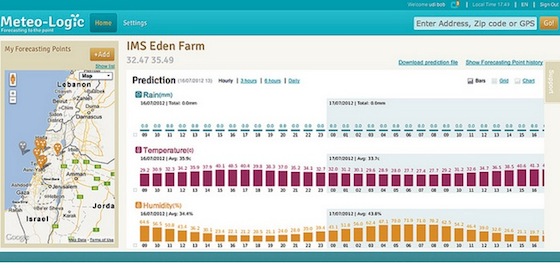
Meteo-Logic, a software provider of custom-made accurate weather forecasting, launched yesterday a new service specifically designed to provide the wind farm energy industry with highly accurate localized weather forecasts.
Meteo-Logic offers detailed weather parameters and tools required for making weather-sensitive decisions for specific locations at specified times. This is done while dramatically reducing the direct and indirect expenses of wind farms, maximizing profits and reducing financial uncertainty.

 When an insect feeds on Monsanto’s genetically-modified MON810 maize plant, it is in for a nasty surprise. Encoded within the seed’s DNA is an especially insidious insecticide called cry1Ab that causes the insect’s stomach to explode after ingestion. Given its brutal assault on pests, the modified crop is pitted by the agri-giant as the cure-all solution to international food shortages.





 In Kuşköy, which literally means “Bird Village” in Turkish, the villagers have been able to communicate across long distances well before the invention of cellphones.
 She’s the best whistler in her village.